

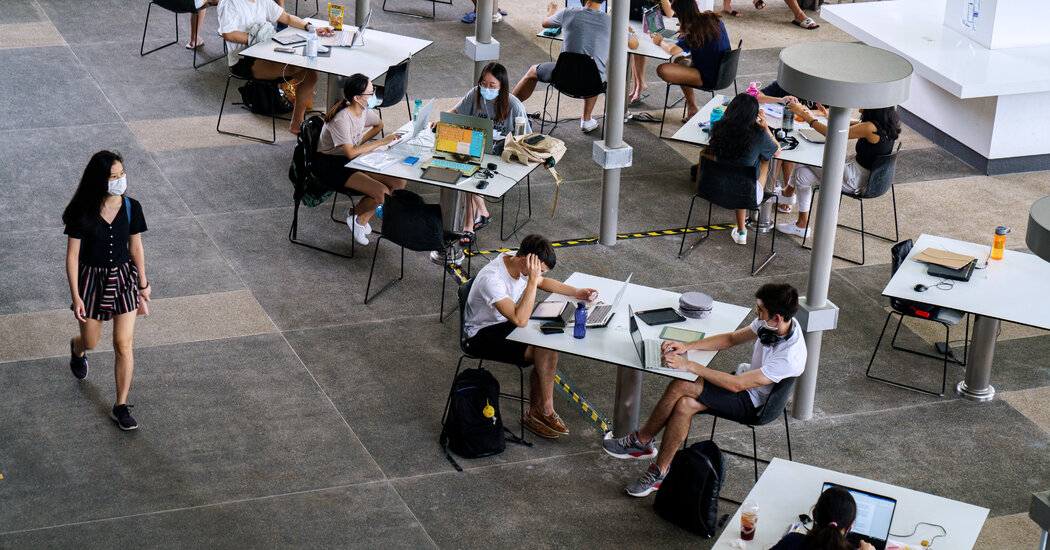

SINGAPORE — Every day, the president of the National University of Singapore scans his online dashboard to see how crowded the cafeterias are.
If the real-time map shows that one cafeteria is too packed, the president, Tan Eng Chye, has administrators send out an advisory to avoid it and to remind students that there are campus-run food delivery services, free of charge.
Following the government’s lead, universities in Singapore, a semi-authoritarian city-state of almost six million people, have taken a top-down approach to managing the coronavirus. The result: Since the start of the pandemic last year, no cases of community transmission have been detected at any of Singapore’s three major universities.
While the universities have benefited from a generally low caseload in Singapore’s broader population, their experience and stringent measures stand in stark contrast to many campuses across the United States. A number of American universities experienced an explosion in cases almost as soon as students returned last fall.
The National University of Singapore, or N.U.S., describes its strategy as containment, decongestion and contact tracing. The university has harnessed technology to enforce social distancing measures, assigned students to different zones on campus and imposed tough penalties for flouting the rules. If necessary, it says, it is prepared to test people extensively. It is already sifting through sewage for traces of the virus in dormitories, as some American colleges have.
The goal, Professor Tan said, “is to make sure there are no infections” among the students, faculty and staff members at N.U.S.
“We are very mindful that we are a big population of 50,000 just on campus, and whatever we do also has a bearing on the larger community outside the campus,” he said in an interview.
The relative safety of the three Singapore universities — N.U.S., the Nanyang Technological University and the Singapore Management University — comes with certain trade-offs.
Kathlyn Laiu, a 19-year-old freshman who lives on the N.U.S. campus, said the only party she attended last year was on Zoom, for Halloween. She spent her first semester eating most meals in her dorm room, counting the number of people in the dormitory lounge before entering and reporting her temperature twice a day through a university app.
The zoning restrictions made it complicated for students to access banking services, eat in their favorite cafeterias or organize group meetings, though they could meet friends and classmates off campus. A petition last October to lift the restrictions was signed by more than 800 students.
“I think it’s quite hard to live with, honestly,” Ms. Laiu said. “It’s a very different idea of college.”
One major reason for Singapore universities’ success in keeping the virus at bay, experts say, is the aggressive pandemic response in society at large. The government offers free testing and medical care to all citizens and long-term residents, and it quickly isolates infected people and traces their contacts. It punishes those found to have violated restrictions, including by deporting foreign nationals and revoking work passes.
“We have not had any outbreak in the universities because the government has taken very good care of the policies,” said Rajesh Krishna Balan, an associate professor of information systems at the Singapore Management University.
Singapore has had almost 59,000 coronavirus cases and 29 deaths, according to a New York Times database. Ninety-three percent of those cases were among migrant workers from South Asia and elsewhere, whose dormitories were the site of severe outbreaks that caught the government off guard.
Since those outbreaks were extinguished last fall, Singapore has averaged fewer than one locally transmitted case each day. On Dec. 28, the country began its final phase of reopening, though migrant workers continue to live under harsher restrictions than the rest of the population.
As reopening proceeds, the Singapore Management University is planning more face-to-face classes, while N.U.S. has lifted its zoning restrictions. But the universities are also maintaining caution. The Nanyang Technological University said it would offer free testing to all students returning to the dormitories this semester.
Professors in Singapore say one major thread connects all three universities: a cooperative student population.
David Tan, the vice dean of academic affairs at the N.U.S. faculty of law, noted that students at Harvard Law School had vocally opposed plans to hold classes online last fall. In contrast, he said, his students did not utter a word of protest.
“In Singapore, we just roll with it,” he said. “I think we are blessed with rather compliant students.”
Another advantage is that unlike in the United States, most students in Singapore do not live on campus. Those who do must comply with more restrictions, such as limits on the number of visitors to their dormitories. Singapore also does not have fraternities and sororities, which on American campuses have hosted parties of hundreds that led to major outbreaks.
“You just wouldn’t see 500 people at a party with loud music and drunk in Singapore,” said Dale Fisher, a professor in the N.U.S. Department of Medicine. “It probably wouldn’t even happen in normal times.”
Olyvia Lim, a senior at the Nanyang Technological University, said she and her classmates were baffled by reports about American college students partying amid a pandemic.
“We all said, ‘Why would they risk themselves to do such a thing?’” Ms. Lim said. “It’s a bit hard to believe because we are of similar ages, but I think it’s culture. They are all about freedom, but when the government here says, ‘Wear a mask,’ we all do.”
The Coronavirus Outbreak ›
Words to Know About Testing
Confused by the terms about coronavirus testing? Let us help:
-
- Antibody: A protein produced by the immune system that can recognize and attach precisely to specific kinds of viruses, bacteria, or other invaders.
- Antibody test/serology test: A test that detects antibodies specific to the coronavirus. Antibodies begin to appear in the blood about a week after the coronavirus has infected the body. Because antibodies take so long to develop, an antibody test can’t reliably diagnose an ongoing infection. But it can identify people who have been exposed to the coronavirus in the past.
- Antigen test: This test detects bits of coronavirus proteins called antigens. Antigen tests are fast, taking as little as five minutes, but are less accurate than tests that detect genetic material from the virus.
- Coronavirus: Any virus that belongs to the Orthocoronavirinae family of viruses. The coronavirus that causes Covid-19 is known as SARS-CoV-2.
- Covid-19: The disease caused by the new coronavirus. The name is short for coronavirus disease 2019.
- Isolation and quarantine: Isolation is the separation of people who know they are sick with a contagious disease from those who are not sick. Quarantine refers to restricting the movement of people who have been exposed to a virus.
- Nasopharyngeal swab: A long, flexible stick, tipped with a soft swab, that is inserted deep into the nose to get samples from the space where the nasal cavity meets the throat. Samples for coronavirus tests can also be collected with swabs that do not go as deep into the nose — sometimes called nasal swabs — or oral or throat swabs.
- Polymerase Chain Reaction (PCR): Scientists use PCR to make millions of copies of genetic material in a sample. Tests that use PCR enable researchers to detect the coronavirus even when it is scarce.
- Viral load: The amount of virus in a person’s body. In people infected by the coronavirus, the viral load may peak before they start to show symptoms, if symptoms appear at all.
Students say they comply with the rules because of the threat of punishment. Some of their classmates have been evicted from dormitories for hosting visitors.
“The consequences are severe, so people are scared,” said Fok Theng Fong, a 24-year-old law student.
Things do slip through the cracks. At N.U.S.’s U-Town campus, a popular section of the university with several restaurants and cafes, students said it was clear that many had come from other zones without permission. Several admitted that they did not faithfully report their temperatures.
To control campus crowds, the universities have relied heavily on technology. It began last spring with the Singapore Spacer project, which used public Wi-Fi networks to collect anonymized location data from people’s mobile phones.
The project, developed by Michael Chee of N.U.S. and Professor Balan of S.M.U., went live in April as a way to monitor crowds “as passively as possible and with minimum inconvenience,” Professor Chee said.
N.U.S. now encourages students and staff members to check an app with a platform called CrowdInsights, which was developed by administrators at the university. But more important than technology, Professor Chee said, is the attitude among students that the collective good matters.
“We don’t have this militant ‘We must have freedom’ approach that the West has,” he said. “The technology supports the mission, but it’s useless if people don’t have that ethos and culture to apply it.”
At N.U.S., many students said they put up with the restrictions because they recognized the need to safeguard public health.
Valencia Maggie Candra, a 20-year-old freshman who returned to Singapore in September from her native Indonesia, said she “definitely felt a difference” in people’s attitudes.
Ms. Candra said she was studying alone in her dormitory lounge in November when a security guard came in and told her to wear her mask. She readily complied.
“Everyone is just relatively more socially responsible,” she said. “Even though the rules are not 100 percent followed, everyone still respects it.”
Recent Comments