

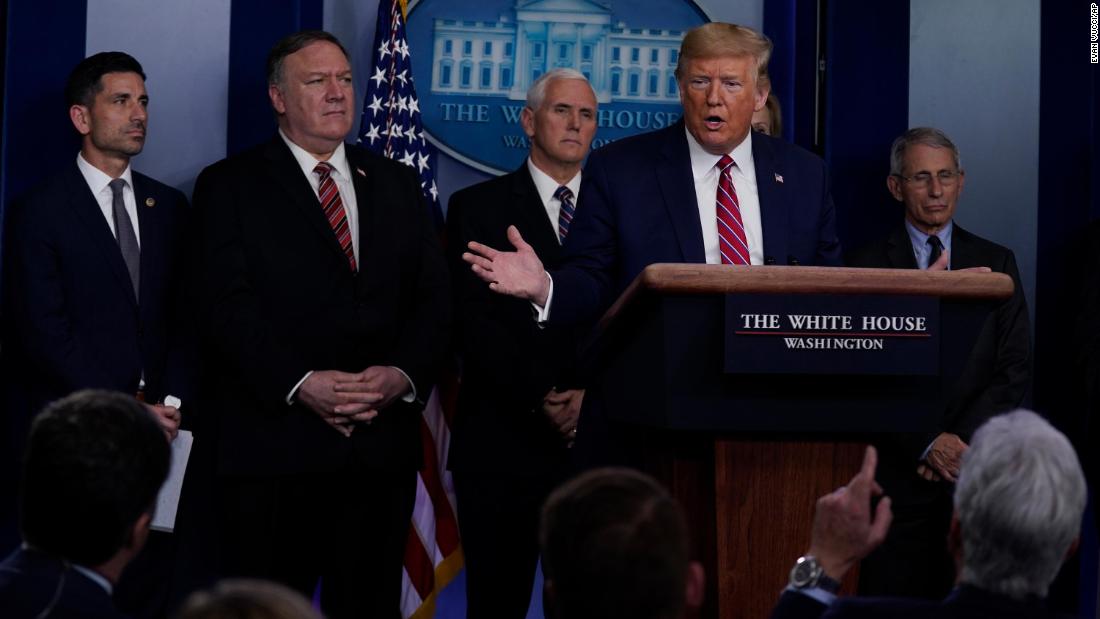

Trump told governors in a phone call Wednesday that they should work with private companies to secure masks and other items, but said Friday that the federal government had procured millions of masks and would be distributing them directly to the states. After a week of inconsistent information, health care workers head into the weekend with dwindling, if any, supplies and no idea what’s next.
The Defense Production Act
Later that day, during a meeting between Trump and a group of nurses at the White House, the President’s decision was applauded, as he once again heard stories of those on the frontlines and the importance of securing more personal protection equipment for health care workers for nearly an hour. According to one source in the room, Trump appeared to understand the gravity of the situation.

But not everyone was pleased with the President’s announcement. According to a source familiar with the conversations, the White House received immediate push back from the business community after invoking the DPA. The message conveyed was “just tell us what we need to do and we’ll do it,” telling Trump that with the DPA there are too many unknowns, including profit loss. The big fear being that by injecting legal uncertainties, the companies will have to stop their production to make sure they are in compliance — and that DPA only needed to be put in place if companies were not stepping up.
Hours later, the President appeared to walk back his earlier declaration, tweeting that he “only signed the Defense Production Act to combat the Chinese Virus should we need to invoke it in a worst case scenario in the future.”
“When I saw it on the television,” said Dr. David Benton, a nursing industry representative who was at the earlier meeting, “I thought, it’s somebody writing the stuff for him.”
“It was so disassociated from what he said this morning at the press conference and what he said to us,” Benton said, describing the tweet as “not connected to where the President was.”

After another two days of back and forth, Trump announced once again that DPA was not only back on the table, but that he had kicked it into “high gear.” But it appeared the President was conflating companies offering to help with a federal mandate that would force them to comply.
A source working closely with the White House on the coronavirus response said the conversations behind the scenes are equally confusing.
“We are constantly on high alert for a tweet that might just be the new law.”
The back and forth has put the business community on edge. A source told CNN that many companies are preparing for a scenario in which they were confronted with the DPA and what it would look like in modern time.
The Strategic National Stockpile: What is it and why isn’t it the answer?
As states looked to Health and Human Services for help procuring medical supplies from the Strategic National Stockpile, top health officials warned that there is not enough stockpiled medical equipment to combat this pandemic and much of what they do have, in terms of masks and respirators, is past its shelf life.
The SNS contains supplies and resources, stored across the country, in case of a national emergency. This includes vaccines, pharmaceuticals and medical supplies like respirator masks and ventilators. Most of the content is designed to respond to chemical, biological, radiological and nuclear terrorism type incidents and the exact contents of the stockpile are kept secret as a matter of national security, Greg Burel, the former manager of the stockpile told CNN.

According to Burel, the US does not have the manufacturing capacity within its borders to make all the masks it would need during an immediate state of emergency, something realized during the 2009 outbreak of H1N1. The stockpile has a finite amount meant to serve as a bridge while manufacturing ramps up.
“It was never intended to supply the entire United States with all the N-95s needed to do all the healthcare,” Burel explained.
Before the H1N1 outbreak, Congress passed one-time supplemental appropriations to increase the capacity of the stockpile to help respond to a national flu-like pandemic. The stockpile procured a number of medical supplies. Congress did not reauthorize the funds again and the masks and supplies used during the H1N1 pandemic did not get replenished.
“In 2009 my association issued a formal plea to the government to restock the Strategic National Stockpile and it never happened,” said Charles Johnson, the president of the International Safety Equipment Association. According to Johnson, the vast majority of the 100 million respirators in the SNS were used during the H1N1 outbreak.
For the Covid-19 response, the stockpile is using the remaining masks, many of which have expired.
In February, the FDA issued an Emergency Use Authorization, which allowed materials to be used past its expiration date. Yet, even with the EUA, there are not nearly enough medical supplies — particularly masks.
According to multiple sources, the process to get supplies from the stockpile can be long and tedious. In general, in order for a state government to access the supplies needed from the stockpile, they must put in a formal order through the Centers for Disease Control and Prevention emergency operations center, which was set up after the September 11 terror attacks. The SNS must then approve that order, and send it out. All federal distribution from the stockpile will be handled by the HHS department.
According to an HHS spokesperson, all medical supplies will be deployed “to areas in need in the most equitable way for a nationwide response” through an allocation strategy that is based on a “pro-rata formula that is proportionate to the population size of each jurisdiction based on 2010 U.S. Census data. Jurisdictions included in the allocation include all 50 states, 4 large metropolitan areas (New York City, Chicago, Los Angeles County and Washington, DC) and 8 island jurisdictions.”

Meaning that during a major incident, many states might not get all they request. After their order is filled they can put in another request.
The spokesperson also noted that these allocations are “likely less than what states are currently requesting. However, jurisdictions are receiving 100% of their allocations. Areas of high transmission may receive additional allocations by request.”
Many governors have expressed concern and frustration at the lack of testing and medical supplies they are getting from the federal government and from the SNS. A source familiar with the process said that any major donations of masks to the federal government would be dispersed through the national stockpile’s system — including the five million masks the Department of Defense said it would make available to the public.
The process of going through the SNS becomes even more tedious when you are a private entity such as a hospital or a nursing home. In this case the government requires you to contact your state department of health and jump through a series of hoops to get approval from the state and have them send in your request for them.
Another kink in the supply chain has been the back and forth over who is in charge — HHS or the Federal Emergency Management Agency. FEMA has a large infrastructure to coordinate supply distribution and generally, during a major incident, the agency is quickly given the lead. The nature of the coronavirus pandemic kept HHS as the lead agency until Thursday.
A source in contact with FEMA on Friday said the agency was still trying to take control of the situation and hadn’t yet put into place a streamlined process.
Recent Comments