


The Air Force’s pitch days have become so popular that several of the squadrons are excitedly borrowing the idea.
These squadrons have a good reason to expand this approach to attracting new and different companies. About 80% of all participants in the pitch days are non-traditional defense contractors.
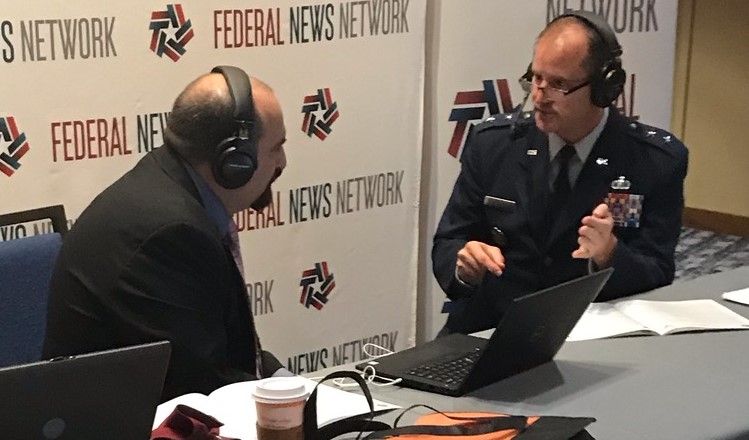
Maj. Gen. Cameron Holt, the deputy assistant secretary for contracting in the Office of the Assistant Secretary of the Air Force for Acquisition, Technology and Logistics, said he wasn’t surprised by the number of new contractors participating in this new approach to finding emerging technologies.
“We are hoping for those kinds of returns. After all, the idea of Air Force pitch days is specifically for that purpose,” Holt said at the National Contract Management Association’s Government Contract Management Symposium. “A lot is said about government contracting and the barriers being so high. In fact, many venture capital firms will be very open with young tech startups in America and tell them if their business model includes doing business with DoD, then they will not back them because the cash flows are too long, the time periods are too long and the processes are too long.”
Holt said the Pitch Days are breaking down all of those perceptions.
The service followed the Federal Acquisition Regulations (FAR) when constructing these events. Pitch Day’s premise is simple — bring in companies, listen to a 10-minute pitch, spend five minutes asking questions and then, if the Air Force likes the idea, hand them a contract before they step out the door.
A giant calling card
At the first Pitch Day in March, the Air Force awarded 51 contracts to companies that have little or no experience with the military. The service doled out $3.5 million to those small businesses. And the first installments of the companies’ contracts were in their bank accounts almost immediately.
“We can actually take all the existing laws and all the regulations, hack them in a way that shows and proves we can lower the barriers to entry,” Holt said. “We are reaching out again to American business and tech startups. We wanted to put a giant calling card on the table, not just to say we are going to do it, but do it.”
He said the other perception that the Pitch Days had to change was that the government was the only game in town. Holt said it used to be that when the Defense Department put out a request or a need, industry came running.
Today, Holt said, he believes fewer cutting edge technology providers are listening so the Pitch Days are lowering the barriers.
“When you lower the barriers to entry but you still have all of the laws and regulations to follow, it is true you have to work very, very hard to make it look that easy. In fact, a lot of people don’t know that we got a protest before our first Pitch Day, but because our contracting ninjas did such a great job with the process and documenting it, it was dismissed in one day,” he said. “Dr. [Will] Roper, [the assistant secretary of the Air Force for Acquisition, Technology and Logistics], is really shaking up acquisition and challenging our thinking and industry thinking all for the right reasons because of the National Defense Strategy, and gaining a foothold in this great power competition we find ourselves in.”
Holt said in the end, the Pitch Days are one way the service is trying to expand the industrial base, but also partner and challenge traditional contractors in new ways.
So far, the Air Force has held at least 15 Pitch Days for weapons systems acquisition and four on the operational area at the wing level.
Rapid prototyping and the DIB
Along with Pitch Days, the Air Force also is trying to shake up the system with a rapid prototyping, rapid fielding authority. Congress gave the DoD this authority in the 2016 National Defense Authorization Act.
Under Section 804 of the law, DoD has to field an initial idea in six months and then get the full production capability in five years.
Holt said while five years may seem like a long time, it’s much better than where the Air Force had been, especially when it comes to weapons systems.
“We have to be careful, and this is just my opinion, that we don’t make the five years the imperative, that we are better informed about where does this capability sit against adversary capabilities and how important is it to get it right, and how complex is this technology?” he said. “In contracting, I’m actively, even persuasively and coercively, if necessary, reaching out to our industry partners and saying ‘we are going to flip the business model.’ I’m not interested in industry not being profitable. I want them to be profitable. It doesn’t serve us to have a weak U.S. defense industry. In fact, I’d love to attract more businesses in the defense industry.”
One way Holt wants to “flip the business model” is by moving spending out of operations and maintenance and into development, modernization and enhancement (DME).
“[W]e have to flip the script a little bit on the 70% of the cost is sustainment where our companies start to engage Congress on that’s where the money is so don’t let the Air Force retire the Air Force we don’t need. If we don’t retire the Air Force we don’t need, we can’t fund the Air Force we do need,” he said. “We are looking at very creative ways to flip that business model and make it very profitable for companies in development and production, and make sustainment and upgrades ubiquitous.”
New tools next year
In 2020, Holt said he expects real progress in flipping the business model.
The Air Force has integrated its smart intellectual property cadre with its mission leadership.
“We are going to be looking to come up with tools that program executive officers (PEOs) and other leaders can use in their acquisition strategies that make that flipping the business model a reality,” he said. “For example, if you had to compete for a development and production program, but as part of the criteria you had to prove to us that you could transition it to 100% organic maintenance and upgrade after production is over. That might change your thinking a little bit about buying in on the front end where companies add their own funding in some cases to the development because they think it will make them more competitive for a very long program. It actually makes it much more likely we will have friction in the execution of that program and in intellectual property and other issues.”
He added the contractor would have to prove the profitability of the technology when it’s in production.
“If we can make it profitable for industry up front, then I think we have a really good shot at flipping the business model so there is not buying-in behaviors, and we get really great engineers working in development and production and incentivizing independent research and development (IRAD) investments even before they finish producing the current programs,” he said.
Holt said the Air Force will reach out to industry to get their comments on changing this concept.
Copyright © 2019 Federal News Network. All rights reserved. This website is not intended for users located within the European Economic Area.
Recent Comments