


One of the world’s largest battery storage projects will be built on the banks of the River Thames in Essex, after the UK government recently granted permission. When it is completed in 2024, the battery will eventually store 1.3 gigawatt hours of electricity – enough to to supply more than 300 homes for a year. It may herald the beginning of an escalating race for ever bigger electrical energy storage systems.
This sort of storage will be needed more and more due to the rapid growth of solar and wind power which may be renewable but only generates electricity intermittently. If it can be stored, the energy produced by solar or wind farms can subsequently be used at night or when the wind doesn’t blow.
Currently, around three quarters of the UK’s energy storage is in the form of pumped hydro-electric: a reservoir’s-worth of water is pumped uphill at a time when power is cheap and demand is low, and is then released when demand surges, generating electricity as the water flows downhill through turbines. These can provide vast amounts of power for between six and 10 hours. The UK’s largest pumped-hydro power station, built in an abandoned quarry in Snowdonia national park, Wales, would be a key part of rebooting the national grid in the event of a total nationwide blackout, a so called “black start”.

steved_np3 / shutterstock
However pumped-hydro is restricted by geography as there are only so many abandoned quarries and hillsides suitable for reservoir construction and operation. In contrast, batteries can essentially be installed wherever required.
A phone battery – but much, much larger
Large scale battery projects currently almost exclusively employ lithium-ion technology. That essentially means larger versions of the batteries you’d find in your mobile phone or laptop computer.
Typically these systems employ “pouch” cells, a vacuum packed lithium-ion cell in a plasticised aluminium sheet cover similar to vacuum packed coffee bags. These are then assembled into “modules”, typically a metal enclosure about the size of a large desktop computer, and then a large number of these modules are stored on shelving racks. It looks a bit like a large wholesale warehouse or containerised shipping system.
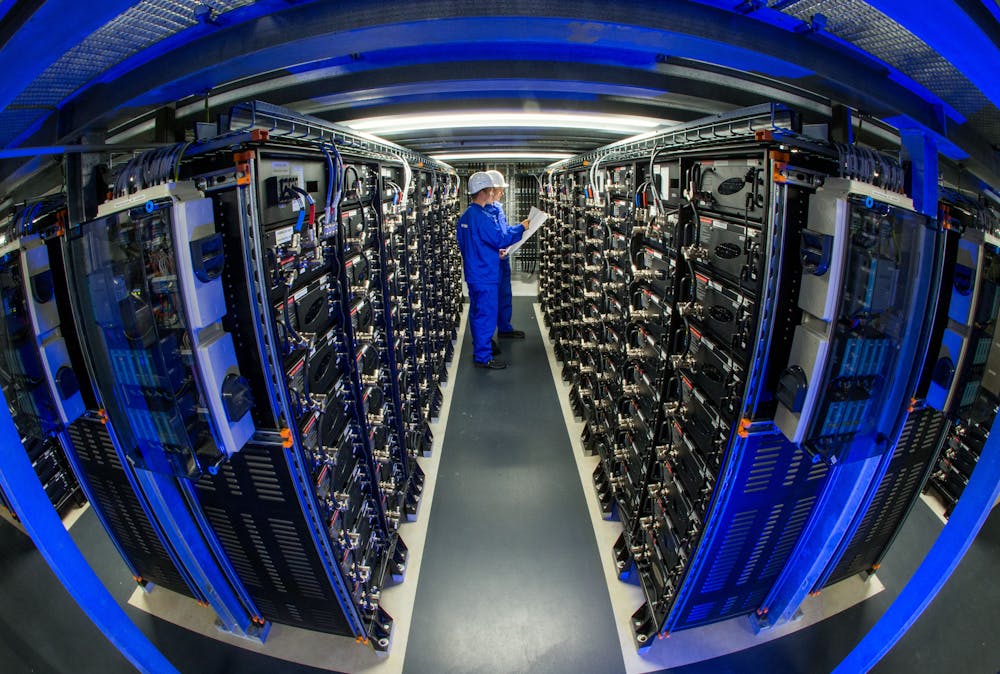
Jens Buettner / EPA
California has some of the largest lithium-ion batteries. The LS Power Gateway project in San Diego County is scheduled to store more than 1 gigawatt hour during 2021, and the huge Moss Landing system in Monterey is ultimately aiming to store 6 gigawatt hours.
When introducing new technologies like these we should consider the emissions generated through the whole life cycle of their production and use. In this regard batteries fare well: recent research looked at the overall global warming impact of eight different ways to store electricity, including as hydrogen, compressed air or in various types of batteries, and found that reused electric vehicle batteries had the lowest impact, followed by lithium-ion.
If large scale lithium-ion batteries are to be sustainable they will also need to be recycled effectively. Starter batteries in petrol cars are a nice example of what could be achieved: around 99% of the lead in these “waste” batteries can be reused to make new batteries.
Naturally lithium-ion has some competitor technologies. There are sodium sulphur batteries, which store energy in molten salt kept at high temperatures (around 300℃), or batteries based on the metal vanadium which offer a lengthy lifecycle and low flammability.
There is also developing vehicle-to-grid technology that aggregates many electric vehicles and enables bidirectional charging to essentially use them collectively as one huge battery. Currently a trial called Bus2Grid is underway in London. As the batteries are owned by whoever owns the vehicle, and so are “free” to the grid, this potentially offers the lowest cost storage. However it is yet to develop at a larger scale and will require lots more people to switch to electric vehicles.
Storing such large amounts of energy may be necessary to regulate the electricity grid, but it does come with inherent risks. A series of fires of both lithium-ion and sodium sulphur batteries highlight the dangers of this technology and the requirement for further safety improvements.
The need to transition to a clean, sustainable energy system will benefit from the regulation such large energy stores can provide. Caution and improved safety design is paramount, but surely the biggest risk is not taking any risk at all.
Recent Comments