

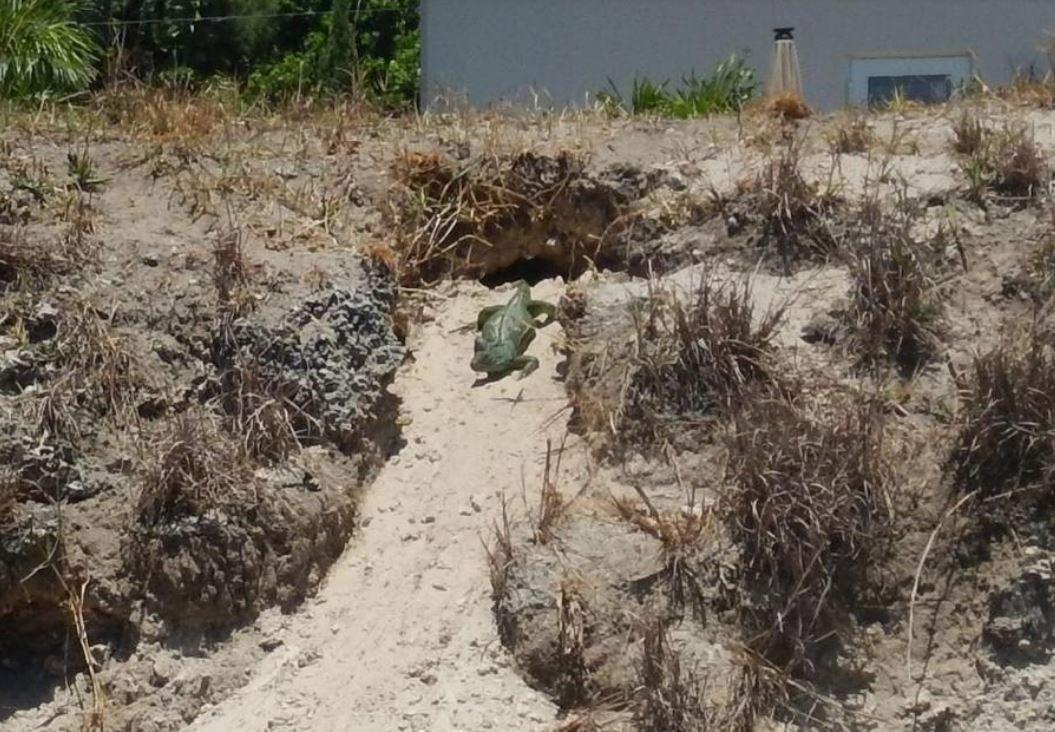

A growing population of invasive iguanas have dug burrows that are causing infrastructure concerns, such as a dam that controls water delivery into West Palm Beach’s reservoirs.
The City of West Palm Beach is hardening water control structures against invasive iguanas after burrows dug into the soft dirt around an aging dam likely contributed to the need for $1.8 million in emergency repairs.
Poonam Kalkat, director of public utilities for West Palm Beach, said city employees noticed last year that water was seeping around the edges of a decades-old weir that controls water delivery from the M Canal through Grassy Waters Preserve into the twin city reservoirs of Lake Mangonia and Clear Lake.
The structure, built in the 1950s, is between Congress Avenue and Interstate 95 south of 45th Street.
“The sheet piling was getting pretty old and needed to be replaced, but the digging by the burrowing animals like iguanas made it more vulnerable,” Kalkat said. “I can’t say how much the iguanas were the cause because it’s an older structure, but they definitely made the situation worse.”
South Florida’s green iguana population has exploded since the last prolonged cold spell in 2010 led to a widespread culling. They’ve become infamous for nuisance pool pooping and munching on ornamental landscapes, giving rise to a cottage industry of iguana-removal experts.
But they also are becoming a bigger problem for agencies in charge of managing the hundreds of miles of canals that channel water throughout South Florida so people can live on former swampland, said William Kern, an associate professor in the entomology and nematology department at UF’s Fort Lauderdale Research and Education Center.
Kern, who works on urban control and management of invasive species, said female iguanas dig burrows four to six feet deep to lay their eggs. If the burrows are in canal banks, it can cause erosion, and eventually lead whole sections to collapse.
Iguanas begin digging new burrows in February and March to lay their eggs, he said.
“The iguanas are the start of the problem,” Kern said. “It’s going to be an ongoing situation now that they are established.”
Murray Logan Construction in West Palm Beach was given the emergency repair contract for the city’s water control structure in April. A request for additional expenses submitted in August includes $8,500 to install more of a material to “deter burrowing animals from making holes or tunnels.”
The material, called Geogrid, is used to prevent erosion, but Kern said it’s increasingly being added to projects to protect against iguana holes.
Kalkat said the city is reviewing all its stormwater control structures to see if there is iguana damage, and discussing ways to manage the city’s iguana population.
“Some people have suggested spraying water on them, but they like the water,” she said. “Someone suggested hanging CDs, but I’ve seen iguanas and their whole families sitting next to where the CDs are.”
While a winter blast this week could stun the iguanas — the cold-blooded reptiles become immobilized when temperatures go much below the mid 40s — it’s unlikely the chill will be enough to kill them.
The 2010 die-off included a 12-day period of the coldest temperatures since at least 1940, according to the National Weather Service.
It was also cloudy for several consecutive days, meaning iguanas couldn’t bask in the sun to raise their temperatures, Kern said.
“We have seen a lot of iguanas recently and our staff generally feels it’s because of rising temperatures,” Kalkat said. “It seems like it will be an issue into the future. With a single water control structure, you can fix it, but how can you do it for hundreds and hundreds of miles of canals?”
Homeowners trying to deter iguana digging should fill existing burrows with dirt or rocks and then cover them with heavyweight plastic or chicken wire. He said areas where busy roads are adjacent to canals are especially attractive to iguanas because there are fewer predators.
“The iguanas are just thriving there, with plenty of sandy banks and vegetation,” he said. “The are doing just fine.”
@Kmillerweather
Recent Comments