

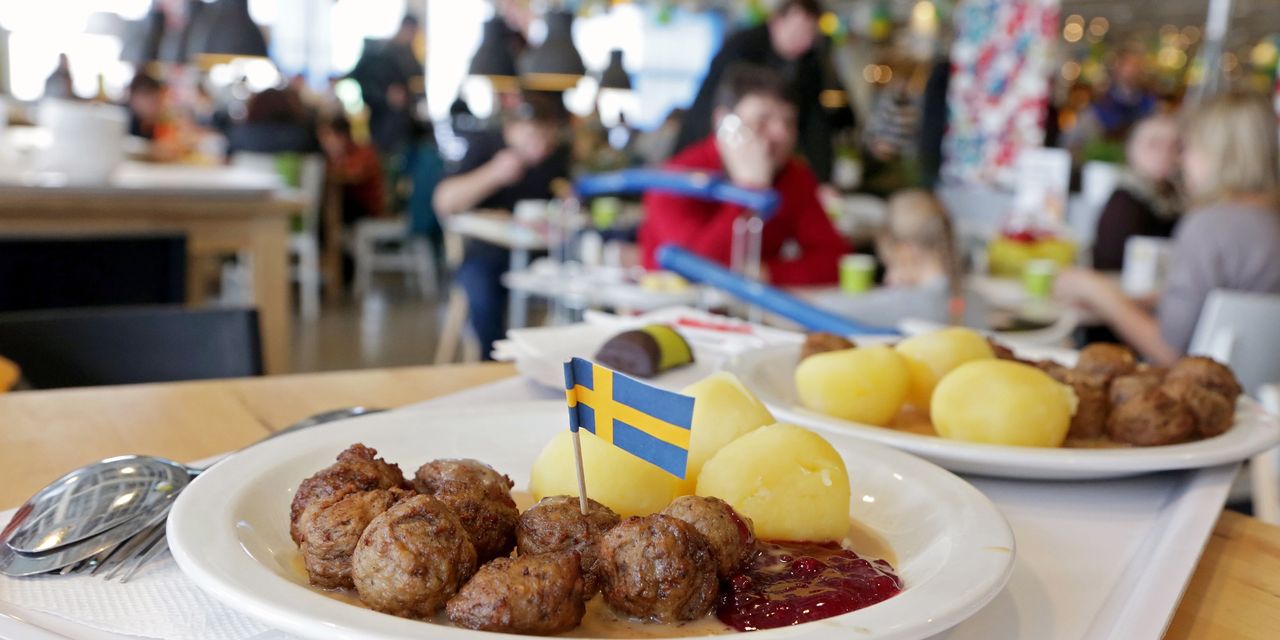

IKEA wants to bring the supply-chain precision behind its flat-pack furniture business to the way it manages meatballs and lingonberry jam.
The Swedish furniture giant is starting a digital overhaul of its food division aimed at shaving costs, reducing waste and using technology to connect hundreds of store operations that now use paper and spreadsheets to track the flow of food products.
“You need to find every single corner where you can cut costs, and the supply chain is the core of that,” said Lars Gunnarsson, IKEA Food Services AB’s deputy business manager and digital transformation leader. “We’ve been doing it for furniture for many, many years. So basically we’re going to apply the same business model and thinking to food.”
Known for its sprawling, warehouse-like blue-and-yellow stores, IKEA became a global retail powerhouse by selling and shipping furniture in disassembled form, an approach that brought significant operational savings and lower retail prices. The brand had about $46 billion in sales in 2019 and is in the midst of resetting its approach to the consumer market to keep up with changing shopping habits, including establishing smaller outlets in city centers and potentially using its retail stores to fulfill online orders closer to customers.
IKEA began serving food soon after opening its first store in 1958 to keep hungry shoppers inside the stores instead of leaving for lunch.
The food service that began as an offshoot of its furniture showrooms has become a big business in its own right, accounting for roughly 5% of IKEA’s retail sales and generating around $2.37 billion in sales last year at the company’s sit-down restaurants, bistros and food markets. IKEA now sells one billion meatballs annually and serves up local dishes—noodles in China, for example, or fish and chips in the U.K—alongside classic Scandinavian fare.
But for years the retailer took the food segment somewhat for granted, Mr. Gunnarsson said.
Then in 2013 the company got caught up in a burgeoning food-safety scandal in Europe when food inspectors in the Czech Republic found traces of horse meat in a batch of IKEA meatballs.
“That was really a crossroads for us,” Mr. Gunnarsson said. If the company was going to keep feeding hundreds of millions of people a year, it needed to bring its supply chain up to speed.
That triggered basic changes like using the same technology to ring up food and furniture sales instead of having separate point-of-sale systems.
Other steps took more time. Perishables pose distinct challenges for retailers. Different products must be stored at different temperatures. In-store food preparation adds wrinkles.
IKEA is working with supply-chain software provider JDA Software Inc. to establish a digital platform for the food division “in which we agree, from the global to local level, exactly what products are going to be sold, at what time, to what volumes,” Mr. Gunnarsson said. The project began last year and is expected to roll out this fall with a test run in Croatia.
IKEA is bringing the store ordering function in-house so it can build up data and pricing history and apply artificial intelligence. The project will digitize receiving, mirroring what happens on the furniture side, said JDA Solution Executive Nicolas Sprotti. Workers will be armed with scanners so inventory can be tracked as it moves from the loading dock to other locations around the store.
Digital dashboards will display data on predicted peaks, incoming deliveries, food preparation times and staffing. Workers in receiving can flag incoming products that appear suspect, such as yellowing broccoli, and send a photo to the chef, who can decide whether to accept or reject the order. Chatbots can tell the chef how many meatballs are on hand or frozen, and how long before they expire.
The system will also notify managers if the store crew is producing too much waste, allowing supervisors to act quickly instead of getting a report at the end of the month.
“We see massive potential here for saving costs, time, efficiency and food waste,” Mr. Gunnarsson said.
Write to Jennifer Smith at [email protected]
Copyright ©2019 Dow Jones & Company, Inc. All Rights Reserved. 87990cbe856818d5eddac44c7b1cdeb8
Recent Comments