

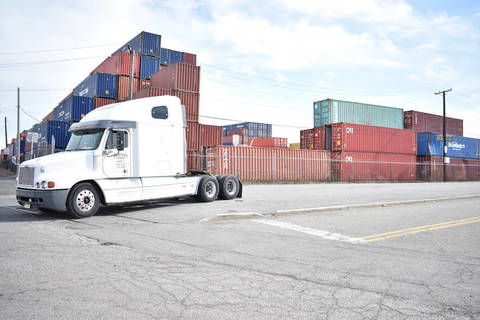

NEWARK, NJ — As COVID-19 chaos continues to send industries across the economic spectrum into crisis, the Port of New York and New Jersey is feeling the impact and preparing for a continued slow-down as its top trade partners’ factories remain shuttered.
Now several weeks into the outbreak, about 10 to 13 fewer vessels are expected in March, according to Port Authority, and two calls have been pre-noticed so far for April. Steve Coleman, deputy director of media for Port Authority, said there have been differing estimates and reports about the timing and extent of a rebound in April.
Port Newark Container Terminal on Calcutta Street, the lead of the six terminals within the Port of New York and New Jersey’s network, provides more than 13,000 jobs and generates $3.25 million in business income. With more than 272 acres and a $500 million upgrade that has increased capacity by 80 percent, PNCT also boasts 10,000 feet of operation rail track.
“The Port is evaluating what this means as far as cargo volume impacts. Nevertheless, with a reduction in scheduled vessel arrivals attributable to the coronavirus, there will be reductions in cargo volume,” he said. “There also will be reductions in cargo volume on existing vessel services attributable to the virus and the impacts it is having on China factory output.”
China is responsible for more than 26 percent of all cargo that enters the Port, according to the latest data. That amounts to more than $39.5 million in goods like electronics, textiles, furniture and housewares. A typical ship can carry 14,000 20-foot container units, but not all units are unloaded at one port. A single terminal could handle around 6,000 containers on and off one ship.
A breakdown of terminal data for PNCT was not available.
There is no official quantification for volume reduction at the present time, but 10-13 cancellations put estimates at around 20 percent, according to John Nardi, president of the New York Shipping Association. Cargo is expected to see a sharp rebound as soon as the crisis dissipates, triggering an all-hands-on-deck flurry of activity.
Dockworkers are provided hours on the basis of seniority, and although the reduction in volume may mean fewer jobs for those with less preference, Nardi said he expects the rebound to compensate for those lost wages.
But the length of the outbreak, and just how long it will continue to contaminate the global economy, is a factor that’s presently undetectable. Nardi said the industry anticipates it will take six to eight weeks for the volume to come back.
“It’s still early to know the full impact,” he said. “The operations in China seem to be returning to normal, so if there’s a lead time involved with that, we expect that we will see a significant volume reduction over the next couple months. But then we expect it to go right back up again, and there should be a peak season because there will still be a demand for the volume.”
The Port of NY and NJ is landlord-tenant, meaning it has private sector tenants who run the day-to-day operations. Terminal operators are limiting their onsite employees to essential personnel only, according to Lisa Yakomin, president of the Association of Bi-State Motor Carriers, a nonprofit membership group of about 170 trucking and industry-related firms.
Yakomin said the Port typically sees a lull during and around the Chinese Lunar New Year, so despite the reduction in vessels, a dip in freight volume is normal for this time in the season. There are mixed reports regarding how the outbreak is impacting labor and companies individually.
“I’m hearing conflicting things, and some folks are saying they’re noticing a significant slowdown in the amount of volume that they’re handling. Others are saying it’s typical,” she said, adding that independent contractors are especially accustomed to the rise and fall that occurs during the three-to-four week down period.
Despite the way the coronavirus has ravaged stocks and brought terminals to a halt at hard-hit ports like the Port of Los Angeles, its ripple effects have reached the Port of NY and NJ with less severity. Mass layoffs of drivers like those seen in California are unlikely — in fact, companies are not expecting to layoff any drivers, according to Yakomin.
A buildup of freight resulting from record-breaking volumes in New York and New Jersey has also kept workers occupied as volume plummets.
“We don’t know how much longer it’s going to be until the crisis has passed. We’re keeping an eye on things, but no one is in panic mode,” she said.
Recent Comments