

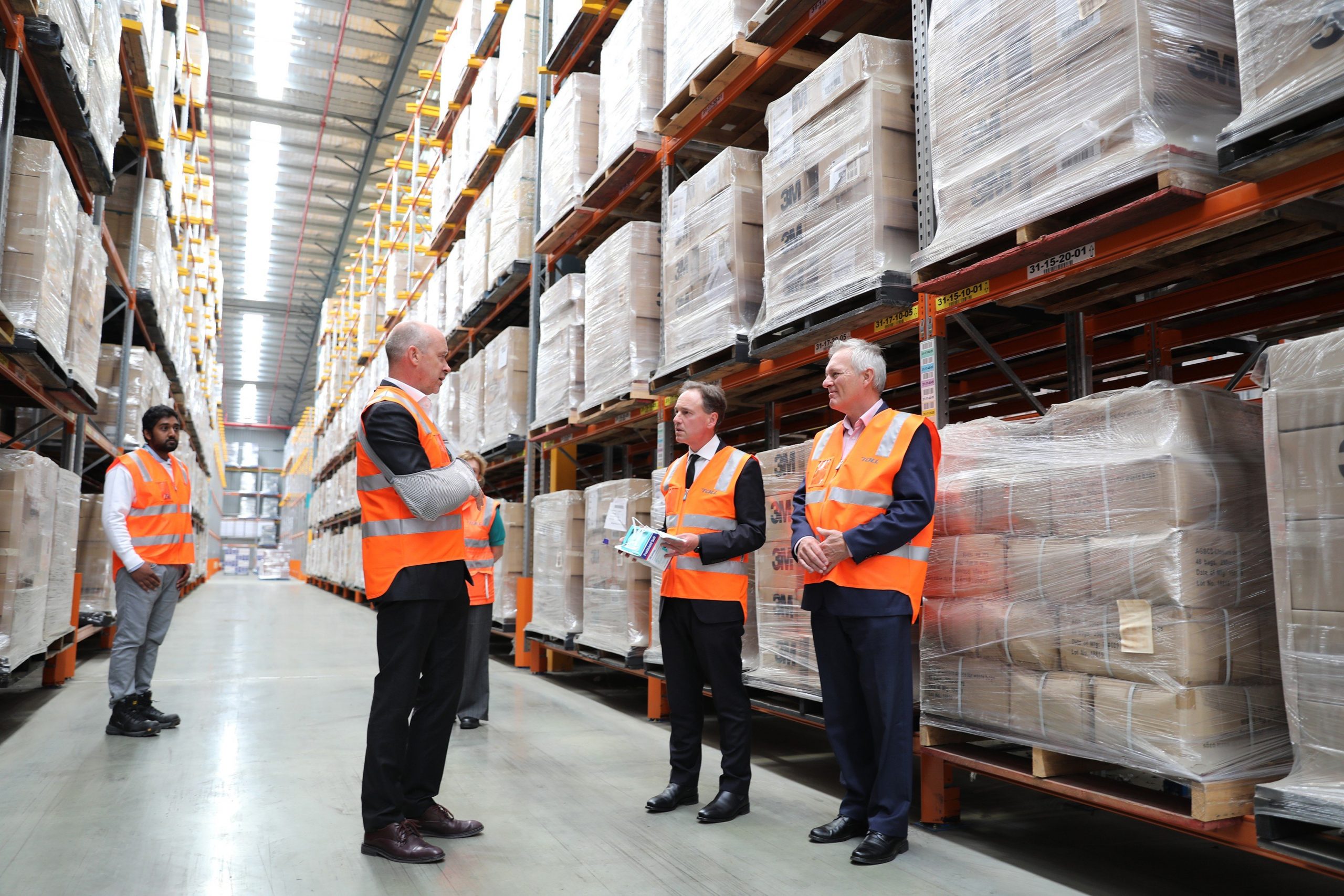

In nondescript warehouses across the country, a $1 billion element of Australia’s defences against terrorist or biological attacks, pandemics and natural catastrophes is stacked to rafters in boxes officials hope will never need to be opened.
The Morrison government’s decision this week to release 1 million extra face masks into the community to combat the spread of the coronavirus included references to the little-known and rarely discussed National Medical Stockpile.
The NMS comprises emergency reserves of vaccines, antidotes, “highly specialised drugs” and protective equipment such as masks, which are stored at various locations around the country, and await quick dispersal, if deemed necessary.
The exact locations and the stockpile’s contents are kept secret for security reasons.
Health Minister Greg Hunt gave a rare glimpse inside one of the warehouses last week when he posted a photograph during a tour of a facility. It revealed a row of industrial shelving piled floor-to-ceiling with shipping pallets stacked with cardboard boxes tightly bound in plastic wrapping.
He also gave a clue to scale of the total inventory, noting “we have now a supply of 21.5 million masks, 12.5 million P2 masks and 9 million surgical masks”.
“If more are required, more will be provided,” Mr Hunt said.
The stockpile, established in 2002 as part of the government’s anti-terrorism strategy, is intended for use in public health emergencies such as pandemics and biological attacks.
Over $750 million was allocated for the reserves in the decade to 2014, according to an auditor-general’s report published that year.
The federal government committed an additional $34 million over two years in the 2015-16 budget, $85.4 million over three years from 2017-18, and $17.1 million over four years from 2019-20.
That takes the total investment in the stockpile over fifteen years to around $900 million.
Masks are unlikely to be the most valuable or sensitive assets held in the reserves, which can be deployed by order of the health department secretary or Australia’s chief medical officer.
As of June 2013, 80 per cent of the “value” of the stockpile was tied up in pharmaceuticals, especially antivirals such as Tamiflu and Relenza.
“The stockpile also holds a limited supply of highly specialised drugs in an emergency that may not be available elsewhere within the Australian pharmaceutical supply system,” the Department of Health’s website says.
Investment in the NMS is not entirely cumulative.
Many drugs in the stockpile have a short shelf-life
The auditor-general’s report found that many of the stored drugs have a limited shelf life – antivirals typically lasted for seven to ten years – and that up-keep was a “significant cost” associated with the NMS.
“Unlike other inventories which are continually being recycled, an emergency stockpile is infrequently deployed, and significant volumes of unused goods need to be disposed of on expiry,” the report found.
Another 14 per cent was items related to chemical, biological, radiological and nuclear defence including responses to anthrax and human influenza pandemics, while the remaining 6 per cent comprised “personal protective equipment”.
In response to a separate inquiry, the Department of Health said federal authorities had a range of other emergency powers to prevent the spread of infectious disease, including the “capacity to evacuate premises, such as airports and schools”.
“These powers are serious in nature and would only ever be used if the public health risk was significant enough to justify it,” the department spokesman said.
The Department also said the Biosecurity Act 2015 was one legal framework that would guide Australia’s response.
The law grants federal authorities wide-ranging powers to compel individuals to submit body samples for examination, receive vaccinations and medication, or go into isolation.
The highest-profile use of the stockpile was during the H1N1 swine flu pandemic in 2009, when 900,000 courses of antivirals, valued at $29 million, and almost 2.1 million pieces of personal protective equipment were deployed.
The official government review of the healthcare sector’s response to the pandemic found that the stockpile had “met the demands” of the crisis, but that “the moderate nature of the pandemic led to limited demands on the NMS overall”.
“It would be expected that demands would be much higher with a severe pandemic,” the review found.
This story originally appeared in the Australian Financial Review. Read the original story here.
Business Insider Emails & Alerts
Site highlights each day to your inbox.
Follow Business Insider Australia on Facebook, Twitter, LinkedIn, and Instagram.
Recent Comments