


TRAVERSE CITY — Medical providers are struggling to come up with all the gear and supplies they need to treat COVID-19 patients and also protect their workers from the respiratory disease.
Officials at hospitals in northwest Michigan, as well as across the state and nation, have reported looming shortages of personal protective equipment like masks, disposable gowns, cleaning supplies and more. It has led to some unique purchasing efforts and a dependence on a local stockpile.
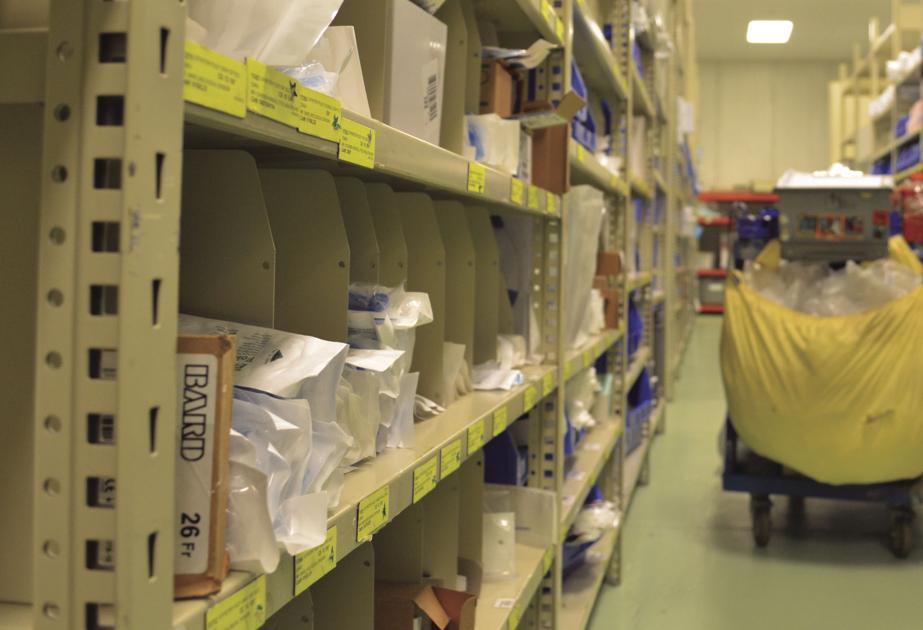
Local hospital workers said a Munson Healthcare warehouse built 20 years ago and stocked with equipment and PPE supplies has proven especially useful as the worldwide pandemic rages and now stretches into these northern reaches.
“We keep all of about 4,000 different types of supplies there from sutures and bandages to some computer items and PPE items,” said Mark Deponio, Munson’s senior vice-president of systems services.
He said the warehouse has for years provided a more efficient way to store, access and distribute needed supplies among Munson Healthcare facilities. The project was a partnership with Trinity Health, which previously owned the hospitals in Cadillac and Grayling.
That warehouse and its stockpile has been invaluable, Deponio said.
“We have been in a better position,” he said. “But in the last three weeks our use of PPE exploded. We have exhausted a lot of the on-hand supplies we have.”
Currently, Munson hospitals do have enough supplies for their patients and workers, said Dianne Michalek, vice-president of marketing and communications.
There are masks, gowns, gloves, face shields, goggles and booties. But that may not last, she said.
“It’s a national shortage,” Michalek said, explaining how without a stabilized supply chain, providers may run out before the pandemic wanes.
“We are going through much, much more PPE than we ever have,” she said.
“Every hospital in the world will run out if we don’t contain the virus, practice social distancing and isolation, and if we can’t get manufacturers to make more,” Michalek said.
It’s a similar story at McLaren Northern Michigan hospital.
“Our priority is the safety of our staff and patients. Right now McLaren Northern Michigan is facing similar needs to all other hospitals across the country, and we are expecting significant disruptions to our supply chain in the coming weeks,” said Todd Burch, chief executive officer at the Petoskey hospital.
“We are in communication with several local manufacturers and have products in development that may serve as reasonable alternatives to our normal supplies. Each of these alternative products are being vetted by our infection control team to ensure they will adequately protect our staff as they are caring for the community,” he said.
Recommended social distancing to slow the spread of the virus will be critical to help providers manage the crisis, Burch said.
The supply chain problems come as the number of cases in Michigan spiked to 334 as officials factored in test results from private labs and universities.
Nationwide, the U.S. Centers for Disease Control and Prevention reported more than 10,400 cases have been identified and at least 150 deaths have been attributed to COVID-19, the disease caused by the novel coronavirus.
Gov. Gretchen Whitmer called up the Michigan National Guard this week to help assemble and distribute emergency supplies.
“Our units frequently train and respond side-by-side with state and local emergency responders, making them well suited for domestic operations,” said Maj. Gen. Paul Rogers, adjutant general. “The National Guard has unique capabilities, providing local first responders with additional resources to combat COVID-19.”
Ground level
It’s not just those at the top of hospital hierarchy who have voiced concerns.
Access to proper PPE, paid time off for those exposed and protections for at-risk employees are major concerns for nurses, registered nurse Jason Judd said.
Judd works on B2 at Traverse City’s hospital — an inpatient unit with patients whose acuity is between ICU and general medical — and also is vice president of the Traverse City Munson Nurses Association. TCMNA, the local union under the Michigan Nurses Association, represents about 1,000 Munson nurses.
“We’re here to care for people, ready to provide care,” Judd said. “We just want some assurances and guarantees so we stay healthy and are able to take care of the community and continue to do our jobs.”
A major piece of PPE nurses are looking for are masks — specifically those with closed-system respirators, he said. Such masks are called for by higher CDC and World Health Organization standards, while surgical masks are the lowest standard, Judd said.
Currently, he said Munson is having nurses wear surgical masks while treating any COVID-19 patient not receiving a treatment that would cause the pathogen to become airborne. Treatments that could spread the virus in the air include being on a respirator or other breathing treatments, Judd said.
“For (taking care of) patients getting those treatments, Munson is saying those (closed-system) respirators are needed,” he said. “For all other patients, they’re saying a surgical mask is OK.”
He said TCMNA representatives emailed hospital administration a proposal addressing various concerns more than two weeks ago. They met with administrators twice last week and didn’t get many answers to their questions, Judd said.
The hospital’s making some good steps as far as changes, but there hasn’t been enough transparency with staff, Munson ICU nurse Lisa Kitchens said.
“My biggest concern is that we’re the ones who’re going to be on the front lines putting ourselves at risk,” she said. “I think we need transparency from the hospital regarding what PPE they have for us and we really need to have representation on the COVID-19 hospitalwide committee so we can have some say in what we’re going to have.
“Everyone feels like we’re up in the air with what the plan is,” Kitchens said. “It makes it hard to be trusting.”
Kitchens said it’s not so much her health — or even her 2.5-year-old daughter’s health — that she’s worried about. Should they contract COVID-19, it likely wouldn’t be serious because they’re in lower-risk demographics, she said.
But her husband, Matthew Kitchens, is diabetic with chronic kidney disease and her mother, who works in a nursing home, is a high-risk age. Her big fear is the possibility of becoming infected herself and then passing the virus onto either of them, Kitchens said.
Michalek said there are enough supplies for now, but workers must use what they have carefully in order to make the equipment and gear last as long as possible, particularly in light of the national shortages.
Supply and demand
A national survey last week of nursing homes and assisted living facilities found both PPE and disinfecting supplies are scarce at many.
The survey was conducted March 6 through 15 by Premier Inc., the top group purchasing organization for U.S. hospitals and nursing homes.
About two-thirds of the facilities answering the survey reported they have little to no ability to purchase face masks, face shields, sterile gowns, hand sanitizer, wipes or disinfectant sprays. Nearly one-third said they had no N95 masks, which provide higher protection than surgical masks.
Because many of the facilities don’t normally buy N95 masks and certain other protective gear, they can’t get orders filled by distributors. Those middlemen, aiming to prevent hoarding, are limiting how much they ship to customers based on their historic purchasing volume.
It’s a literal economic struggle between supply and demand, said professor Wallace Hopp, associate dean at the University of Michigan’s Ross School of Business.
“The increase in demand is obvious. The actual outbreak and the stocking up behavior in anticipation of it have spiked demand for a host of medical supplies,” Hopp said. “Panic buying and hoarding are further aggravating the spike in demand for certain products, such as masks. The increase was so sudden that the supply chains could not have kept up under the best of circumstances.”
The professor said something like half of the world’s surgical masks were made in China before the coronavirus crisis. After the outbreak, China not only kept their masks for themselves but also bought from suppliers outside their country, Hopp said.
“In many locations in China people were required to wear masks to go outside. So the country had an absolutely enormous demand for them. As a result, when the coronavirus reached other countries like the U.S., the worldwide supply of masks was already seriously short,” he said.
Hopp said a further complication is how the medical supply chains now trying to fill the void caused by these shortages are staffed by people, some of whom are sick or scared.
“This is decreasing production and transportation capacities right when we need to increase them. The result is severe shortages,” Hopp said.
And production capacity can’t simply be immediately ramped up, he said.
“Supply chains are full of lead times — time to ramp up capacity, time to produce components, time to ship components, time to assemble components, time to ship finished goods, etc. — so they can only respond so fast,” Hopp said. “Even though many people are doing their best to speed up the supply chains for key medical supplies, I fear we are going to continue experiencing serious shortages.”
By the numbers
At least three of the nation’s 150 deaths so far from COVID-19 were Michigan residents, officials said Thursday.
A woman in her 50s with other health complications died at McLaren Oakland medical center in Pontiac, while an 81-year-old man died at Henry Ford Hospital in Detroit.
“We encourage everyone to adhere to guidelines regarding social distancing and hand washing to help slow the spread of this highly contagious disease,” said Margaret Dimond, president of McLaren Oakland.
Both died Wednesday, along with a man in his 50s at a Beaumont Health hospital in Wayne County. The state’s medical executive, Dr. Joneigh Khaldun, said more deaths are expected.
More than 250 new positive cases were reported Thursday across Michigan, the majority in downstate communities such as Detroit and in Macomb, Oakland and Wayne counties.
Michigan’s Department of Health and Human Services reported at least 334 positive COVID-19 cases in the state, but the number likely is lagging because county health departments are getting more timely information.
Nearly 2,500 people in Michigan have already been tested, state statistics show.
In Traverse City, officials at Grand Traverse Pavilions nursing home said they screened their high-risk residents for the disease and are prepared to potentially accept new patients. Those test results remain pending.
“The Pavilions staff has been preparing for this reality and has set new processes and protocols in place to restrict the spread of the disease in the facility,” said Rose Coleman, the facility’s chief operating officer. “A specific isolation area has been established and will be activated as needed.”
For most people, the virus causes mild or moderate symptoms, such as fever and cough. For some, especially older adults and people with existing health problems, it can cause more severe illness, including pneumonia.
The Associated Press contributed to this article.
Recent Comments