

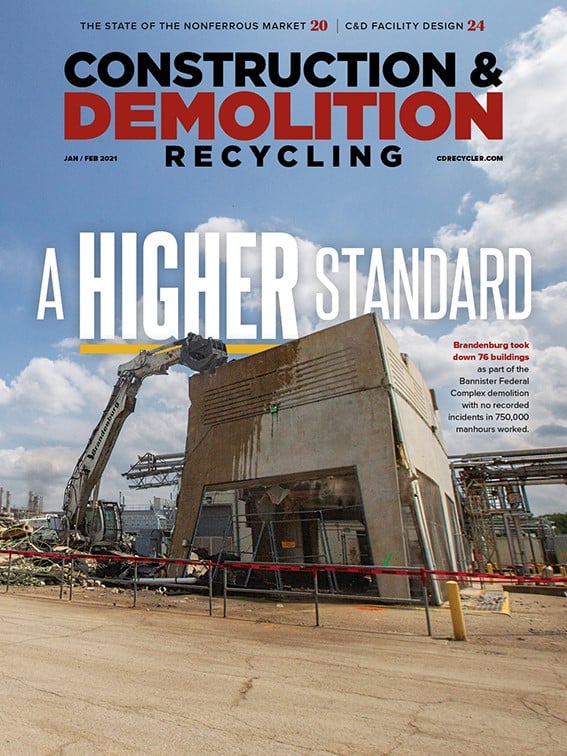

Even the smallest demolition projects require detailed planning, on-site coordination and constant communication, but when the task is taking down 4.5 million square feet of buildings located on 300 acres, the importance of proper preparation cannot be overstated.
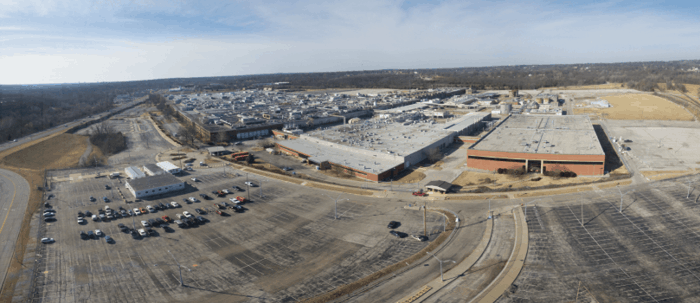
This was the challenge for Chicago-based Brandenburg when it was chosen as the demolition contractor for the Kansas City, Missouri-based Bannister Federal Complex, which was jointly owned by the Department of Energy (DOE) and the General Services Administration (GSA).
The site of the Bannister Federal Complex was agricultural land until the 1920s, when the Kansas City Racetrack was constructed and briefly operated. In 1943, Pratt & Whitney began manufacturing airplane engines at the site during World War II and did so until 1948, when the production of jet engines commenced. Jet engines were manufactured at the site until 1961.
Beginning in 1949, the U.S. Atomic Energy Commission expanded manufacturing operations at Bannister, including the manufacturing of non-nuclear components for nuclear weapons. Operations continued until 2012, when the government closed the site due to obsolescence and contamination.
In November 2017, it was turned over to the Oak Brook, Illinois-based private developer CenterPoint, who hired Brandenburg one month later to perform the environmental remediation and demolition activities.
According to Brandenburg VP of Sales and Estimating Dennis McGarel, the company’s comprehensive suite of services and diverse equipment fleet made Brandenburg the ideal contractor to tackle the Bannister project.
“There are a few factors that made Brandenburg uniquely qualified for this particular project,” McGarel says. “Brandenburg’s fleet of equipment allowed for multiple crews working in multiple areas and for work to proceed concurrently in several locations. The ability to perform demolition, concrete removal, concrete crushing, material segregating and load-out with company-owned and -maintained equipment allowed the project to proceed with minimal interruptions. The environmental contaminants required several disciplines from asbestos and PCB removal to contaminated soil and water handling. Brandenburg self-performed all removal with licensed and trained personnel. Having the ability to self-perform all aspects allowed for greater safety, communication and coordination of all site activities.”
Precise planning
With a demolition project the scope of Bannister, a significant amount of work had to be done to lay the groundwork for the job. Preliminary planning and feasibility studies for the project began in 2007. After being hired, Brandenburg worked with CenterPoint, engineers and environmental consultants to obtain Environmental Protection Agency and Department of Natural Resources approval for the property transfer.
Site assessments found the presence of asbestos, beryllium, lead-based paint and PCBs in the interior manufacturing areas. Fuel, PCBs and solvents also contaminated soil and groundwater on the site.
Due to the environmental concerns on the project, public hearings were held to keep citizens informed of the planned remediation and demolition processes and safeguards that would be taken to ensure no contaminants would be released from the site. After soliciting feedback from the community, Brandenburg committed to implementing a number of measures to counteract potential contamination, including deploying on-site air monitoring equipment; placing decontamination units at all entry and exit points; and using dust suppression technology, carbon filtration systems, sediment control basins, filtration systems and tire wash stations on-site.
“The local community’s fears of environmental contamination and [staying on top of safety measures] were the first challenges [we faced] and were addressed through public meetings, presentations and question-and-answer sessions,” McGarel says. “The remainder of the challenges were addressed with engineering controls and the use of best management practices. There were multiple real-time air monitoring stations that operated continuously, a water management system designed to handle extraordinary weather events, a state-of-the-art truck wash station for vehicles leaving the site, robust dust control equipment, and railroad tracks installed to limit truck traffic through the local community—just to name a few of the long- and short-term controls in use for the duration of the Bannister project.”
Because of the complexities of the project, McGarel says that Brandenburg went all-in to dedicate adequate resources to the job.
“This project resulted in one of the largest management teams in Brandenburg’s history to be solely dedicated to one project,” McGarel says. “The field staff was comprised of some of Brandenburg’s most experienced personnel that routinely support multiple projects. The project management and general superintendent roles had to be adjusted to allow these individuals to remain solely dedicated to the Bannister project.”
According to McGarel, Brandenburg employed over 120 people on-site for the ACM removal, interior removal and structural demolition.
Hitting the ground running
Following the initial planning and assessment work, Brandenburg workers began removing regulated and hazardous materials while tackling soil remediation efforts.
After the abatement work was completed, contractors were ready to begin demolition. All buildings on the site with the exception of a groundwater treatment facility and an existing substation were planned for removal. Additionally, the existing utility infrastructure was substantially removed or abandoned in place.
In all, Brandenburg demolished 76 buildings on the site. These buildings comprised over 3.4 million square feet of concrete structures and over 300,000 square feet of steel-framed building structures, including all basements and mezzanines on the properties.
Brandenburg’s machine demolition included the use of over 195 pieces of equipment, including excavators, loaders, skid steer loaders, water trucks, concrete crushers and a full contingent of attachments to complete the work.
To minimize truck traffic and ease public concern, Brandenburg used a rail spur to transport hazardous debris from the site to specialized landfills.
The company also made recycling a priority.
Brandenburg removed and recycled more than 70,000 light bulbs, 46,000 tons of structural material, and filtered more than 290 million gallons of water.
In total, the company removed 358,419.67 tons of debris, scrap and salvage materials from the site. Total scrap materials salvaged or recycled was 50,235.67 net tons and Brandenburg crushed over 750,000 tons of clean concrete to be reused on-site.
An emphasis on safety
Due to the sheer scope of work involved on the Bannister project, ensuring safe operations was of the utmost importance, according to McGarel. With safety paramount on the job, Brandenburg signed a strategic partnership agreement with the Kansas City OSHA Office. The partnership identified common issues that could be encountered on the site, such as falls, struck-by and caught-in-between accidents, and electrocution. The partnership encouraged worker participation in Brandenburg’s safety and health programs and prioritized educating employees on best practices to improve their overall safety and health. Two of Brandenburg’s safety and health managers were on-site full-time to ensure a safe work environment for all. Additionally, the company provided safety training for all 510 site workers and visitors. The company’s safety managers also developed a site-specific safety training orientation video requiring all contractors and visitors to view the video before receiving access to the site. This due diligence manifested in the following safety-related accomplishments:
- Total case rate (TCR) and Days Away, Restrictive and Transfer (DART) of 0 on a project with more than 750,000 manhours worked
- No occupational overexposures to silica, total dust, respirable dust and asbestos were determined during the duration of the demolition project
- During the project, 920 employees and 48 supervisors completed the site-specific safety orientation
- Each contractor had a supplemental Health and Safety Plan (HASP) that correlated with the Site-Specific Health and Safety Plan (SSHASP). Contractors had to adhere to stringent policies encountered in the site plans to meet these requirements.
- Brandenburg participated in OSHA’s Stand Down for Fall Protection week, Safe and Sound Week, and Heat Illness Prevention campaign.
According to McGarel, working with OSHA helped to keep all contractors on the same page.
“The partnership with OSHA showed the commitment from Brandenburg and the daily work practices showed the commitment from the site personnel,” McGarel says. “The daily morning safety talks [we engaged in] were interactive and employee involvement with safety observation cards allowed for the site employees to take ownership of their own safety while following the health and safety standards of the company.”
Brandenburg’s adherence to safety best practices did not go unnoticed, as the Kansas City OSHA Office recently recognized Brandenburg for its work on the job.
“During the demolition initiative, not only did Brandenburg … go above and beyond to ensure the safety and health of their own workforce, [they] also ensured the safety and health of all the workers at the job site,” Karena Lorek, OSHA area director of the Kansas City office, said during an award ceremony celebrating Brandenburg’s work.
According to McGarel, carrying out the Bannister project safely and without any incidents was a testament to the company’s due diligence.
“We consider the project a great success,” he says. “First and foremost, the project was executed safely and the client and local community were pleased. Beyond that, Brandenburg formed a successful partnership with the OSHA area office; executed a large-scale project that was under close supervision from many regulatory agencies to their satisfaction; and developed a very safety-conscious, dedicated and talented local work force to pursue future projects.”
In September 2020, with all demolition and remediation nearly complete, the DOE announced that Kansas City-based commercial landlord NorthPoint Development had a contract to redevelop the property into 2.6 million square feet of industrial use space. Construction has begun on a 240,000-square-foot building, which will be the first of seven facilities at the site.
Recent Comments