


Often, when prospective leaders of change are asked “How are you going to change the way you lead in order to most effectively lead change?”, the usual response is “I don’t need to change.” Their underlying model of change leadership goes something like this: “Change is for others because, obviously, as the leader I already have the skills I need.”
As the supply chain management industry continues to evolve, so to do the issues that management faces. Increasing cyber threats, absorbing ever-advancing technologies, addressing tariffs and political realities, and adhering to trade compliance rules are just some of the issues that are causing a great deal of upheaval throughout the industry. Meanwhile, the risk of supply chain disruption is greater than ever in the face of unpredictable climate events and socio-economic instability.
All of these issues point to the larger challenge that supply chain executives are facing, namely, developing and deploying a transformational roadmap to continually evolve their companies in the face of constant change. For management to succeed, executives and senior managers must develop a new set of leadership skills to guide their companies through a rapidly changing environment.
Yet there is profound conflict between the skills of an excellent operational leader and the skills required to be successfully lead change. In the operational excellence side of Table 1, the objective is to create predictability and efficiency through constant and comprehensive rationalization of the environment, and everything else that supports the drive to reduced variance and increase consistency. In contrast, change leadership deliberately introduces disruption and reduces efficiencies. These conflicting paradigms confuse existing leaders who suddenly want to become change leaders.
Table 1. Conflict between operational excellence and change leadership.
Compounding the challenge, in most organizations a leader must be effective in both types of situations simultaneously. By focusing too much on operational excellence, the current business thrives but the future is in jeopardy. By focusing too much on the transformational side, a leader puts immediate survival in jeopardy. Leaders must find a sophisticated balance to enable their organizations to survive – and that’s not easy.
A staggering 70% of digital transformations fail, with little improvement over time. While that is indeed disappointing, it also means that some 30% succeed, and therefore can be used to help us understand what works. In most cases, strong change leadership emerges as a critical reason for the success. Having been involved in many successful corporate transformation projects, we’ve seen first-hand that what separates the winners from the losers is the ability to create integrated learning and leadership development models that can be used to quickly and efficiently grow change leaders who function well on both sides of the grid at the same time.
There are three parts to these models:
1. Define the requirements for excellent change leadership in the “messy real world” of high stress environments that is the basis for the development program.
2. Launch the development program in a way that creates intense engagement including explicitly embracing the contradictions in the roles.
3. Guide the leaders to understand, realistically practice and deeply internalize the attitudes, behaviors and skills required for the necessary change or addition to their leadership skill set.
One of the best ways we’ve found to build an excellent change leadership model is to identify the leaders in the organization that already exemplify at least some of these attitudes, behaviors and skills and to “reverse engineer” how they think and act. In working with many of these successful executives, it turns out that they package their approach to driving transform into a number of distinct domains.
At the highest level, they gain a clear understanding of their purpose, and use that to guide the entire organization through the transformation. They have a compelling reason for why both operational excellence and the transformation are critical. Going a step further, they have blended these reasons and can articulate them in a very holistic, passionate and consistent way.
From there, they build what I call a path to mastery. They build the right mental model of the intended change and how it fits with operational excellence while defining the capabilities needed for the change to effective. They also look beyond the transformation itself to better understand the type of supporting infrastructure needed to sustain change over time.
Once the overall road map has been defined, successful leaders pull together detailed guidance or tips about the nuances of tradeoffs and application of the operational/transformation balance in real situations. This is the “how to…” of successful change leadership. These can then be distilled further to specific actions to both learn more about the situation and drive the actual change.
Developing change leaders
Very often, even leaders with a well-articulated purpose and a defined path to mastery struggle to effectively launch change leadership development programs. Executives and senior managers are often too busy dealing with urgent problems to embark on learning programs and long-term initiatives. Traditional training programs alone, as the dismal results indicate, are not up to the task.
Breaking through the malaise is best accomplished by tapping into neuroscience research on engagement. The human brain reacts positively to certain stimulus and the trick, as shown in Figure 2, is use this knowledge to drive desired behavior. By presenting the compelling purpose generated by top performers, and guiding the developing leaders into thinking about it, writing about it and discussing it with peers, various neural impacts occur including:
• As leaders see themselves contributing to a greater social good (the compelling purpose), the release of dopamine and endorphins provide a sense of confidence and openness to new ideas.
• When leaders write their purpose, fear portions of the brain are suppressed and the intellect is stimulated, giving a sense of enhanced control.
• By discussing the purpose with peers (this can be literally talking directly to someone or exchanging messages through messaging which is useful in global environments), serotonin and oxytocin are released, which generates a commitment to group success.
As a result of these processes, intense engagement by developing leaders occurs quickly and keeps them moving forward with a greater sense of focus. This way, when there are the inevitable delays and setbacks that come with any digital transformation, they are able to roll with the punches and stay on track.
Figure 2. Roadmap for how engagement stimulates the brain.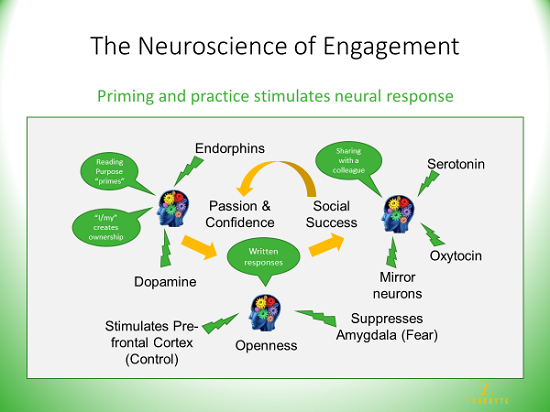
Applying these same interactive processes on the path to mastery further stimulates engagement by explicitly demonstrating that there is a clear means of achieving the purpose. Prospective leaders see that there is a way for them to learn the way to lead digital transformations and so more willingly embrace the purpose.
But how do prospective leaders transition into ongoing practice? The key to this is the neuroscience concept of “self-directed neuroplasticity.” Neuroplasticity is the ability of the brain to form new connections between neurons that are “learning” something new. The self-directed part is the use of the intellect to guide actions to do the practice required to rewire the neurons.
Throughout this process, the growing leader makes progress by reviewing the tips, writing about it and discussing it with peers. This causes the leader to assimilate the conceptual model of how to function in a specific situation. In turn, each tip has one or more associated actions that drive multiple repetitions of a desired behavior.
Does this really develop leaders who can drive a supply chain transformation effort? Formal measures have shown that leaders in programs similar to those described here demonstrate a more than 90% alignment with the desired attitudes, behaviors and skills. In other words, almost everyone successfully becomes a change leader and the supply chain transformation effort, non-coincidentally, becomes a success as well.
About the Author
William Seidman, Ph.D., is a recognized expert on the application of neuroscience to transformational leadership and change throughout any organization. He is CEO and president of Cerebyte.
Recent Comments