

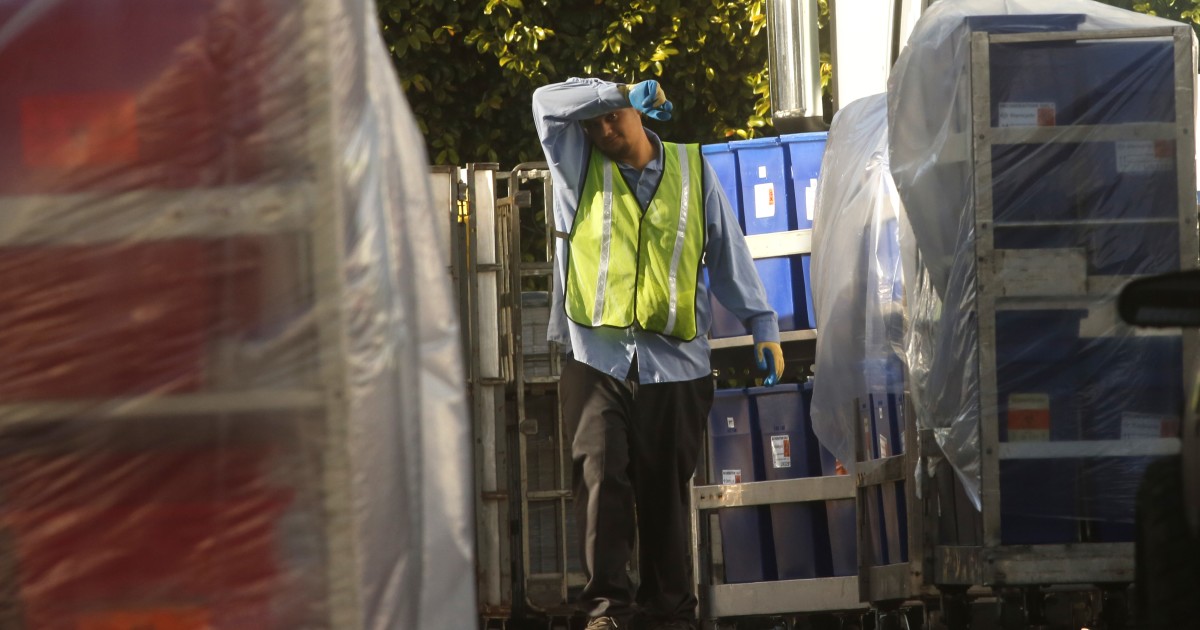

For about two weeks now, red bags of medical waste laden with the coronavirus have been flowing from Southern California hospitals to a squat white building in the city of Paramount, where they are tossed into an autoclave and scorched with pressurized steam.
The novel coronavirus, or SARS-CoV-2, is essentially a string of genetic material encased in a fragile, fatty membrane, and it’s no match for an extended bath in 300-degree steam and 50 pounds per square inch of pressure.
“It kills all the bugs in the garbage,” said Bob Shaw, president of Medical Waste Services. “Then it’s sent to the landfill.”
Shaw’s is among 19 facilities that use enormous steam autoclaves to treat California’s medical debris. So far, they have had little problem handling waste generated in the battle against the coronavirus.
But that could change. If COVID-19 cases continue to spread exponentially, networks of hospitals, waste haulers and treatment centers could be overburdened by a surge of regulated medical waste — masks, gloves, booties, bed linens, cups, plates, towels, packaging and disposable medical equipment. Such a flood of medical waste, industry leaders say, could result in infections among their workers.
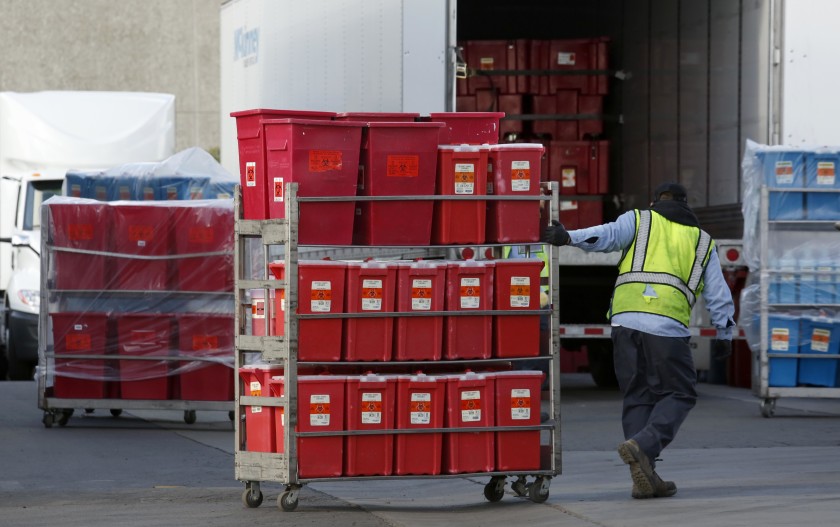
A worker at Stericycle in Vernon pulls a cart stacked with containers of biohazardous waste.
(Genaro Molina / Los Angeles Times)
Now, preparing for the worst, the medical waste industry is requesting relaxation of state and federal rules governing infectious biological waste, including its collection, records, transportation, treatment and disposal.
“Right now, no one is kicking and screaming for help because they’re falling behind,” said Anne Germain, vice president of technical and regulatory affairs for the National Waste and Recycling Assn., which represents more than 700 firms nationwide. “But we have to be ready to respond to an increase in medical waste generated by the pandemic.”
In a world upended by the novel coronavirus, the association is asking for extensions on renewals of expired commercial driver’s licenses, greater leeway on the amount of medical waste that can be stored at treatment facilities and more flexible “hours of service” rules to provide more time to meet their customers’ demands.
Then there’s the growing problem of hospital staffers unwilling to sign the manifests of haulers of regulated medical waste for fear of contaminating a pen and paper or digital notepad with the highly infectious virus.
“If hospitals aren’t going to sign manifests,” Germain said, “we need a formal exemption from regulations requiring their signature on those documents.”
That kind of flexibility is critical to “ensuring that the medical waste industry can continue to operate and deal with the potentially elevated volumes of waste that may be generated by this pandemic,” said Elise Paeffgen, a partner with the law firm Alston & Bird, who specializes in healthcare and environmental regulatory issues.
The Centers for Disease Control and Prevention, the National Institute for Occupational Safety and Health, and the U.S. Department of Transportation have not elevated the level of threat posed by the coronavirus pandemic.
Federal authorities are treating the coronavirus as a Category B threat: a sometimes-fatal respiratory disease like SARS, which spread globally in the early 2000s.
An example of Category A is Ebola, an extremely infectious substance capable of causing permanent disability or death when exposure occurs.
As of Sunday, the pandemic had killed 2,467 people in the United States, which had 140,886 diagnosed cases of coronavirus.
The Centers for Disease Control and Prevention says protective gear and equipment potentially infected with coronavirus can be handled like most regulated medical wastes along the chain of custody from hospitals to landfills.
Contaminated protective gear and disposable equipment are tossed into red plastic bags with a “biohazard” label.
Local medical waste management companies expressed confidence in their ability to handle a significant increase in coronavirus-related waste, if necessary.
“Our network can meet current demands,” said Selin Hoboy, vice president of government affairs at Stericycle, one of the largest medical waste companies in the U.S.
He said, however, that “ongoing communication is critical during this unprecedented and ever-changing time.”
Shaw, who has worked in the regulated medical waste industry for three decades, agrees —up to a point.
“If a volume spike or crisis would suddenly appear, I am very comfortable that state health officials would quickly help our industry find a safe solution for all stakeholders,” he said. “But I don’t think we’re going to need the help.”
Recent Comments