



Last week’s winter meeting of senior members of the International Union of Marine Insurers (IUMI) took place at a significant moment: less than two weeks after Germany’s Federal Bureau of Maritime Casualty Investigation (BSU) had published its report into the cargo fire in January 2019 on board Hapag Lloyd’s 7,510TEU Yantian Express.
Its conclusion was that the fire had started in a container of coconut charcoal, which had been mis-declared as coconut pellets. Tests by Germany’s Federal Institute for Materials Research and Testing found that, when carried in the sort of volume that would fit into a container, coconut charcoal’s self-ignition temperature is about 50°C.
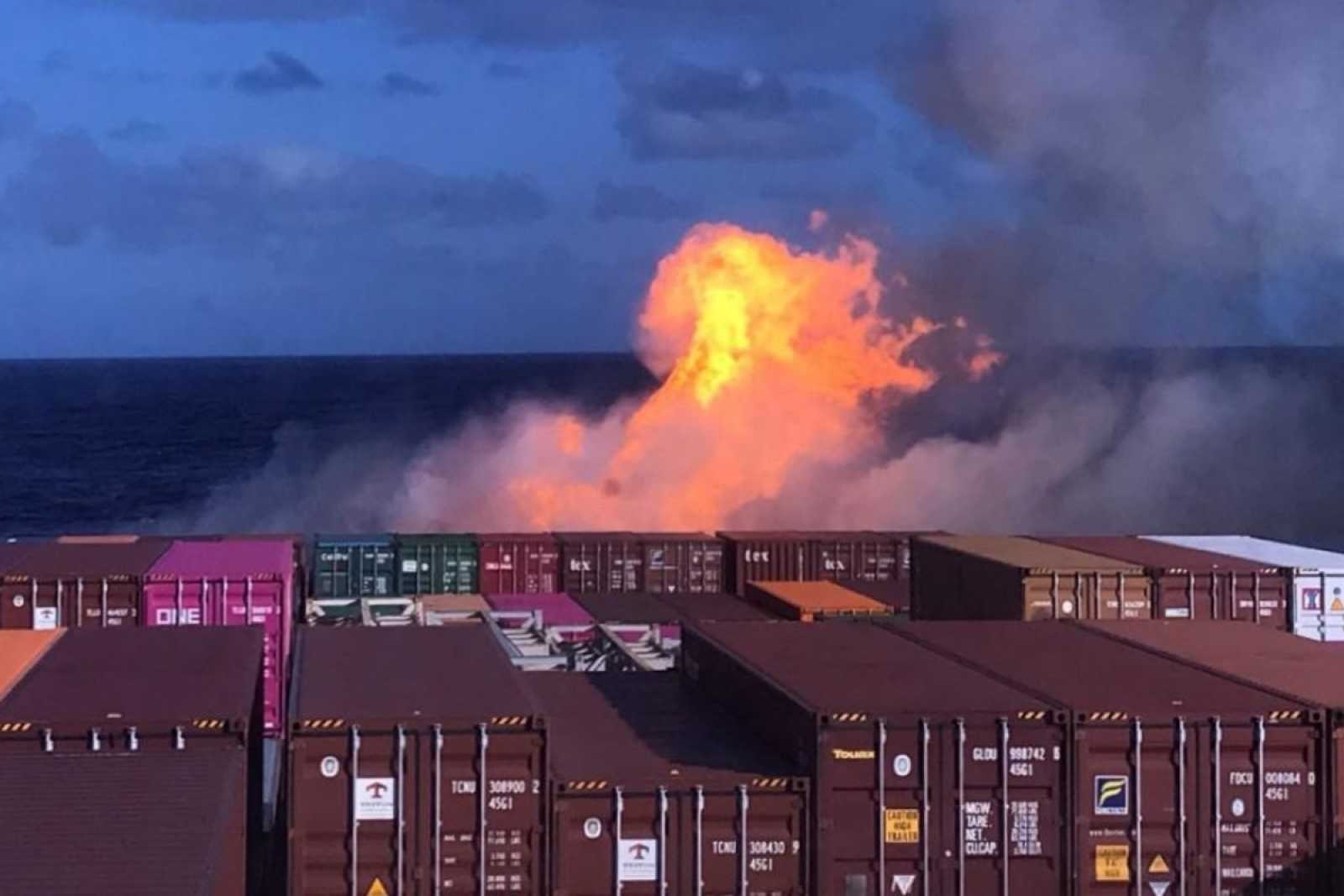
The findings underlined what the chair of IUMI’s Policy Forum, Helle Hammer, said was “the highest priority issue for the Policy Forum and has been for a while”: container fires.
Yantian Express was not an isolated incident. “In 2019 the industry continued to report an unprecedented number of cargo vessel fires,” some briefing notes released at the meeting stated, “which continued into 2020 with recent losses aboard the Cosco Pacific apparently involving a shipment of mis-declared lithium batteries.”
Ms Hammer referred to a 2016 analysis, which can be downloaded from IUMI’s website, that had found 56 incidents of container vessels fires that had starting in the cargo between 2000 and 2015. In all, 8,252TEU had been damaged, causing losses valued at $1.037Bn, not including business losses or vessel repair bills.
“Improperly shipped hazardous materials, including mis-declared shipments are expected to play a role in most of these casualties,” IUMI’s notes said last week and now, it is asking IMO to respond.
It raised its concerns during the 101st meeting of IMO’s Maritime Safety Committee (MSC 101) and has now submitted three documents to MSC 102, which will take place in May this year. Two of those are information papers, but one calls for an ‘output’ from the MSC; in other words, some action. “It is clear that the current SOLAS regulations are not adequate in considering the size of the modern ULCS / VLCS ships and the complexities of fighting a fire aboard these vessels,” IUMI’s briefing paper said.
IUMI has worked with the German Flag State to develop its submission, along with Bahamas, BIMCO and the Community of European Shipyards’ Associations (CESA). In a move that was first signalled in a 2017 position paper – also available via the link above – the partners call for amendments to SOLAS Chapter II-2, which sets out regulations about enhanced provisions for early fire detection and effective control of fires in containerised cargoes stowed under deck and on deck.
I have requested a copy of that submission but it is unlikely to be provided before MSC 102 meets; although organisations submitting papers can authorise them to be made public in advance, these documents were not listed in the public area of IMO’s online document repository, IMODOCS, a week after they had been submitted.
Based on the summary above, it appears that the submission will specifically address firefighting capability, yet at last week’s meeting Ms Hammer appeared to indicate that this is secondary to the more fundamental problem of mis-declared cargo. As ship sizes increase, she said, “the risk [of fires] is increasing … so we cannot only rely on dealing with mis-declaration. We also need to do something about fire protection and how to put that fire out once it occurs.”
But how is mis-declaration being dealt with? Chair of IUMI’s Cargo Committee, Sean Dalton, told the meeting that some carriers have taken “the unprecedented step of imposing fines on mis-declared cargoes” but when asked if he had any evidence of carriers actually carrying out such a threat, he could not cite a specific example. “I would expect that information is fairly tightly held,” he said.
However, there have been instances when “people who mis-declared cargo or improperly shipped hazardous materials have been held legally liable,” he added, mentioning in particular the explosion and fire on MSC Flaminia in July 2012, for which a New York court found in September 2018 that the shipper and container operator were liable.
Actually preventing mis-declarations will require engaging with the shippers and regulators in what Ms Hammer called a holistic approach. In a bid to move in this direction, P&I club Gard hosted a conference in October 2019 that brought key stakeholders across the industry together to address possible measures and further initiatives. IUMI took that opportunity to invite its participants to join an Expert Group on container fires to support a further submission to IMO. So far, more than 30 experts from flag states and across the industry have volunteered to take part.
It is a big problem. Mr Dalton told the meeting about inspections that had been carried out during 2019 by the US-based not-for-profit organisation National Cargo Bureau (NCB) whose findings “were really disturbing.” In a sample of 500 inspections, NCB found that 49% of import containers to the US containing dangerous goods failed its inspection for a variety of reasons, of which mis-declared cargoes contributed 8%. For export containers with dangerous goods, 38% failed, of which mis-declared cargoes represented 5%.
As a result of this study, NCB has seen a marked increase in requests from carriers wanting to implement inspection regimes and the organisation is planning to expand its global network, Mr Dalton said.
I put it to him that it is impossible to know the true scale of the problem since mis-declared cargoes are only discovered if there is an incident or if the container happens to be inspected. He agreed. “That’s what’s driving the need to get better at screening cargo to identify containers that should have a closer examination,” he said.
“Mis-declared cargoes are expected to play a role in the majority of [container ship] fires,” he told me. The element of doubt is because “due to the heat generation and destruction, it’s not possible to determine that with absolute certainty.”
To be a seafarer on a ship with such a conflagration taking hold is clearly a dangerous situation and lives were lost in some of the incidents reviewed in IUMI’s 2016 study, Ms Hammer said. And the dangers will only increase: “The larger the vessel the greater the risk to seafarers,” she said. Once smoke is seen coming out of a container, “that’s too late to stop it on certain cargoes … and then you can’t send seafarers out with hoses to try to solve it.”
Recent Comments