



The average exchange rate of Japanese yen against the U.S. dollar during the first nine months appreciated by ¥1.40 year on year to ¥109.09. The average bunker price during the same period was the same year on year at US$464/MT.
As a result of the above, we recorded revenue of ¥867.2 billion, operating profit of ¥24.3 billion, ordinary profit of ¥49.2 billion and profit attributable to owners of parent of ¥48.4 billion.
The following is a summary of business conditions including revenue and ordinary profit/loss per business segment.
(A) Dry Bulk Business
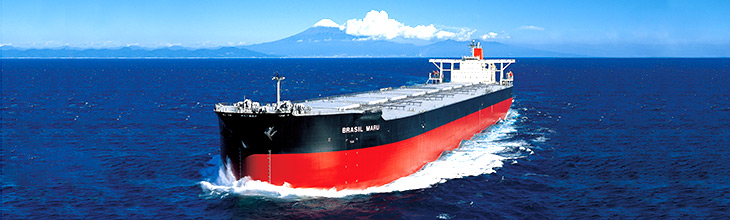
In the Capesize bulker market during the first half of the fiscal year, the charter rate improved from the slump caused by the collapse of a mining dam in Brazil among other factors and was also given a boost by tighter vessel availability due to an increase in the number of vessels going into dry dock for the installation of scrubbers. The rate then maintained a certain firmness due largely to steady crude steel production in China. However, it fell after peaking in early September with factors such as a deceleration in shipments from Brazil from November onwards.
The Panamax bulker market improved in the first half of the fiscal year, reflecting firm grain shipments from South America through the summer. Then, from September, the market remained in a downward trend despite occasional rallies, against the backdrop of continued uncertainty surrounding trade negotiations between the US and China and Chinese restrictions on coal imports. Under such market conditions, the dry bulk business posted an ordinary profit albeit lower year on year.
(B) Energy Transport Business
The very large crude oil carrier (VLCC) market was generally weak during the first half of the fiscal year, reflecting a seasonal decrease in oil demand at the beginning of spring and regular maintenance of refineries in the Far East region. During the third quarter, the market firmed up due to the arrival of the winter demand period in between a sudden rally caused by the rising tensions in the Middle East and an adjustment phase.
On the product tanker market, the charter rate struggled to rise during the first half due to the increase in newly built vessels and regular maintenance of refineries. However, in the third quarter, the market firmed up due to tighter tanker availability affected by the rise in crude oil tanker market and the start of operations at a new refinery in the Far East.
Under these conditions, the tankers division as a whole reported a year-on-year increase in ordinary profit thanks to ceaseless efforts to improve operating efficiency through pool operations and cost cutting, in addition to the stable fulfillment of long-term contracts and steady implementation of contract extensions.
The LNG carrier division performed solidly, building up profit and reporting a year-on-year increase in ordinary profit, reflecting stable profit generated mainly through long-term charter contracts including seven newly built vessels. The offshore business division also recorded ordinary profit, brought about by steady operations of existing projects including FSRU, FPSO and subsea support vessel businesses.
(C) Product Transport Business
Ocean Network Express Pte. Ltd. (ONE), the Company’s equity-method affiliate, continued its profitable streak of the first half and maintained profitability in the third quarter, reflecting greater-than-anticipated progress in cutting costs. While liftings on Asia-North American routes were below the year-ago level and freight rates on these routes also showed slow growth, freight rates for Asia-Europe routes were higher than expected, reflecting a tighter supply-demand balance during the latter half of the third quarter in particular.
Transportation volume in the car carrier business decreased during the first half due to weak shipments bound for Australia and weak coastal Europe shipments, in addition to the impact of tighter emission standards in China and trade tensions between the US and China. Profitability improved in the third quarter, reflecting rationalization of the allocation of vessels, mainly on routes between countries other than Japan, that was initiated the previous fiscal year and efforts to improve service efficiency.
In the business of ferries and coastal RoRo ships, cargo volumes were firm due to the modal shift caused by truck driver shortages and aging, and workstyle reform in the land transportation industry. From early autumn, however, there were signs of weakening due to deterioration in economic conditions in addition to the impact of major typhoons. Meanwhile, the number of passengers remained strong as the concept of casual cruises caught on. The overall results of the ferries and coastal RoRo ships division showed year-on-year growth.
(D) Associated Businesses
The real estate business posted stable ordinary profit because of an increase in the revenue of Daibiru Corporation, which is the core company in the Group’s real estate business, benefiting from a firm office leasing market centered on the Tokyo metropolitan area. The cruise ship business posted a year-on-year decrease in ordinary profit mainly due to higher fuel costs. However, the results of other associated businesses such as the tugboat and trading businesses were generally strong, and the ordinary profit of the associated businesses segment as a whole was almost unchanged year on year.
(E) Others
Other businesses, which are mainly cost centers, include ship operations, ship management, ship chartering, and financing. Ordinary profit in this segment increased year on year.
Regarding the SOx regulations which came into effect in January 2020, the Group had made preparations to obtain and switch to compliant fuel before introduction of the regulations and therefore managed to switch to compliant fuel without any major issue and maintain stable services.
Looking ahead at the dry bulker market in the fourth quarter and beyond, we expect charter rates to weaken, given that iron ore shipments are slowing down due to the start of the rainy season in Brazil and Australia. While decreased transportation volumes due to global economic slowdown could still give cause for concern, the impact on full-year ordinary profit is expected to be limited as there is not much time left before the end of the fiscal year.
The very large crude oil carrier (VLCC) market has weakened following a temporary upsurge in the autumn of 2019, yet we anticipate repeated ups and downs until the end of February, which is the winter demand period, followed by a gradual weakening as we head toward the beginning of spring. We expect that the product tanker market will continue to hold firm, reflecting the winter demand period.
ONE is expected to face the risk of decline in short-term freight rates due to decreased demand after Chinese New Year and incur some costs for reallocating vessels as a result of service restructuring from April. ONE will continue to focus on cost reduction and cargo portfolio optimization including the reduction of frequencies of services. While ONE is expected to post a loss in the fourth quarter, considerable improvement from the same period a year ago is forecasted.
After the SOx regulations came into effect, the Group switched to compliant fuel and has since maintained shipments without any major issues and will continue striving to maintain stable services while monitoring the fuel supply-demand situation.
In consideration of these prospects, for FY2019, we project revenue of 1,140 billion, operating profit of ¥25.0 billion, ordinary profit of ¥50.0 billion and profit attributable to owners of parent of ¥40.0 billion.
5. Financial Position
Total assets as of December 31, 2019 decreased by ¥ 56.0 billion compared to the balance as of the end of the previous fiscal year, to ¥ 2,078.4 billion. This was primarily due to the decrease in Cash and deposits. Total liabilities as of December 31, 2019 decreased by ¥ 59.1 billion compared to the balance as of the end of the previous fiscal year, to ¥ 1,423.7 billion. This was primarily due to the decrease in Short-term bank loans.
Total net assets as of December 31, 2019 increased by ¥ 3.0 billion compared to the balance as of the end of the previous fiscal year, to ¥ 654.7 billion. This was primarily due to the increase in Retained earnings.
As a result, shareholders’ equity ratio increased by 0.6% compared to the ratio as of the end of the previous Fiscal year, to 25.2%.
Source: Mitsui O.S.K. Lines
Recent Comments