It’s reasonable to assume hundreds of dead and billions spent for every extra month Canada’s spends unvaccinated
Author of the article:
Tristin Hopper
Publishing date:
Feb 10, 2021 • 10 hours ago • 4 minute read
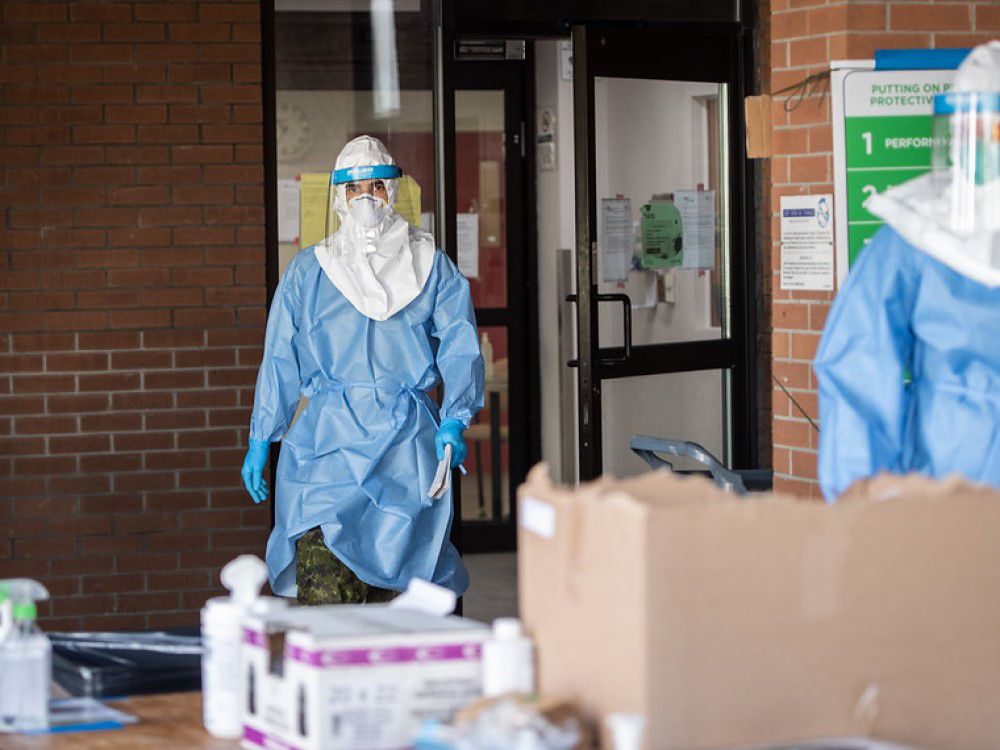
A soldier in PPE exits a Quebec long-term care home during Operation Laser, the Canadian Armed Forces’ response to the early stages of COVID-19. Photo by Department of National Defence
Article content
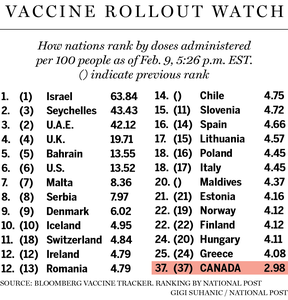
It is now clear that Canada is dramatically behind the rest of the developed world in immunizing its citizens against COVID-19.
One quarter of Israel is now fully vaccinated, and the U.K. has administered 13 million doses. But in Canada, procurement issues and late deliveries have effectively stalled our vaccination program after only one million doses; roughly the amount of shots that the United States administers every 16 hours. It’s now estimated that Canada will not achieve widespread vaccine coverage until mid-2022, nearly six months after the same goal will have been met by the United States, the U.K. and the E.U.
More than any typical policy oversight, Canada’s failure to secure timely vaccines will have a measurable effect on the lives and well-being of its citizens. Each day spent waiting for vaccines is another day of lockdowns, another day of hospitalizations and another day of COVID-19 fatalities. The next 12 months of COVID-19 could take any number of twists and turns, but the National Post assembled a very rough accounting of what it will cost Canada to endure this pandemic longer than almost any other country with similar wealth and resources.
Article content
Every month this pandemic continues, hundreds of Canadians can be expected to die
If Canada did nothing and allowed this disease to simply spread unchecked, it’s conceivable that in addition to the 21,000 already taken by COVID-19, another 46,000 Canadians could ultimately be killed. Some public health researchers suggest that if left unchecked, COVID-19 could start to fizzle out on its own after infecting 66 per cent of a population.
If this happened to Canada, it would mean 24.8 million total cases. Given that the World Health Organization now estimates that COVID-19 has a fatality rate of 0.27%, this would mean 67,000 total Canadian deaths. And given new evidence that unchecked COVID-19 can actually infect up to 76 per cent of a population, that number could potentially be higher still.
Crosses commemorate 50 people who died of COVID-19 at the Camilla Care Community long-term care facility in Mississauga, Ont.Photo by Peter J. Thompson/National Post/File
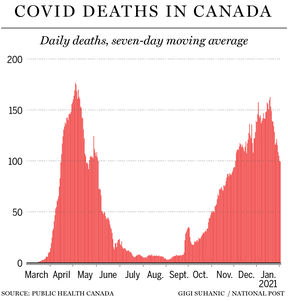
Since COVID-19 first led to widespread lockdowns across Canada, an average of 1,900 people have died from the disease every month. That’s a figure that applies even to the six months since Sept. 1, when Canada had established widespread masking, social distancing, care home quarantines and advanced hospital treatments. If Canada is still being ravaged by community spread at a time when the virus has been crushed in the U.S. and U.K., it would probably be an overestimate to say that it would kill as many as 1,900 per month, but it’s easy to see how the death count could remain in the hundreds.
Article content
Right now, Canada appears to be on the tail end of its second wave of COVID-19. After a January 26 peak of 165 deaths, that figure has gone down each day until, on Monday, only 68 Canadians succumbed to the virus. If this trend continues, Canada could soon be back where it was in the summer with single-digit daily fatality rates. But the question now is whether Canada will be hit with a third wave. Experts with the COVID Strategic Choices Group estimate that, under current conditions, that wave could be underway by late-March.
Each day under lockdown costs us at least $500 million
Most of the economic damage caused by COVID-19 has come from government-imposed lockdowns. So it’s not a given that as vaccinations progress, lockdowns will cease: Any number of political or epidemiological factors could yield a world where vaccinated populations still live under some form of quarantine order.
Nevertheless, a Queen’s University team led by economist Christopher Cotton has attempted to quantify what continued lockdowns do to the Canadian economy. They’ve estimated that COVID lockdowns have imposed a hit on Canada’s economy of between eight and 14 per cent. Given that Canadian GDP was $2.2 trillion in 2019, this roughly represents a hit of between $176 billion and $308 billion. Or, between $500 million and $850 million in missing revenue every day.
Article content
Recent months have seen the curbing of some of these costs, such as the end of CERB, but regardless, even when averaged across an entire year, Canada has easily been able to spend at least $1 billion per day on pandemic relief. Another six months of that, and it’s easy to imagine that the additional cost could easily match the $55 billion deficit that Canada ran up in all of 2008/2009, the worst year of the last great recession.
More time unvaccinated means more time for new variants to form
This is the most speculative result of a prolonged vaccination delay in Canada, but we do know that if given time COVID-19 will mutate into variants that are harder to contain. So far, three known COVID-19 variants have spontaneously cropped up in South Africa, the U.K. and Brazil.
In countries with reliable vaccine procurement, these new variants have provided public health officials with an added impetus to step-up vaccinations to deny the new strains a place to spread. The more time that Canadians spend unvaccinated, the more time these variants have a chance to take root and complicate the country’s efforts to crush its spread. And with every extra infection providing its own infinitesimal risk of a new spontaneous mutation, it’s not impossible that Canada could be combating its own home-grown variant.
This website uses cookies to improve your experience. We'll assume you're ok with this, but you can opt-out if you wish. Cookie settingsACCEPT
Privacy & Cookies Policy
Privacy Overview
This website uses cookies to improve your experience while you navigate through the website. Out of these cookies, the cookies that are categorized as necessary are stored on your browser as they are essential for the working of basic functionalities of the website. We also use third-party cookies that help us analyze and understand how you use this website. These cookies will be stored in your browser only with your consent. You also have the option to opt-out of these cookies. But opting out of some of these cookies may have an effect on your browsing experience.
Necessary cookies are absolutely essential for the website to function properly. This category only includes cookies that ensures basic functionalities and security features of the website. These cookies do not store any personal information.
Any cookies that may not be particularly necessary for the website to function and is used specifically to collect user personal data via analytics, ads, other embedded contents are termed as non-necessary cookies. It is mandatory to procure user consent prior to running these cookies on your website.




![TORONTO, ONTARIO: MAY 11, 2020—PANDEMIC—Crosses placed at the Camilla Care Community long-term care facility where fifty people have died of Covid 19, Monday May 11, 2020.[Peter J Thompson] [For National story by TBA/National]](https://usscmc.com/wp-content/uploads/2021/02/1613011552_227_More-death-more-deficit-The-dire-consequences-of-Canadas-botched.jpg)
Recent Comments