
Tech News, Magazine & Review WordPress Theme 2017
  • Home
  • Supply Chain Updates
  • Global News
  • Contact Us
  • Home
  • Supply Chain Updates
  • Global News
  • Contact Us
No Result
View All Result
No Result
View All Result
Home Supply Chain Updates

Murray River research finds centuries-old ‘sand slug’ in Barmah Choke

usscmc by usscmc
February 1, 2021
Murray River research finds centuries-old ‘sand slug’ in Barmah Choke
Share on FacebookShare on Twitter

The Murray Darling Basin Authority (MDBA) says a “sand slug” accumulating in the Murray River is the result of historic mining practices rather than poor water management.

Key points:

  • The Murray Darling Basin Authority says more than three million tonnes of sand has settled in the Barmah Choke
  • A recent report suggests historic mining practices upstream were responsible
  • Landholders have long claimed the choke’s capacity issues are caused by bank erosion

A report commissioned by the MDBA estimates more than three million tonnes of sand has settled in the Barmah Choke, the river’s narrowest stretch, which is located in southern NSW, reducing its capacity by 20 per cent over the past 40 years.

Nearby landholders have long claimed the choke’s capacity issues are due to bank erosion caused by the river running high.

It was a point of contention during the recent drought that Murray River irrigators frequently had a zero general security water allocation.

Space to play or pause, M to mute, left and right arrows to seek, up and down arrows for volume.

Play Video. Duration: 1 minute 2 seconds

The Barmah Choke restricts the flow of water down the Murray(Trudi Arter and Clint Jasper)

MDBA river management executive director Andrew Reynolds said it was thought the sediment came from mines that processed it through river channels to filter gold.

“We know it’s not sourced locally,” he said.

“It’s very different to the material in the banks in the river, so it’s not eroding from the banks into the bed, it’s coming from somewhere.

“It’s filled some of the holes in the riverbed as much as four metres deep.

“That makes the river that little bit shallower, reduces the amount of water we can see downstream and it’s why we’re seeing a reduction in the capacity of the river.”
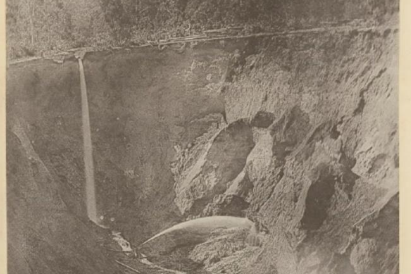
A sepia photo showing a wall of rock that has been subjected to a mining technique.
An example of sluicing on the Mitta Mitta, which the MDBA says may be the cause of silting at the choke.(Supplied: MDBA/State Library of Victoria)

‘Clutching at straws’

But John Lolicato, chairman of the Wakool River Association, is not convinced.

“The MDBA is clutching at straws and doesn’t want to acknowledge that there’s a natural constraint stopping large volumes of water from flowing down the river,” he said.

Murray-Darling controversy explained

Taxpayer investments and the water market are making irrigation more efficient and reducing Murray-Darling’s base flow. QJ Wang and Avril Horne explain what needs to happen next.

Read more

“This whole exercise seems to revolve around trying to find some way to justify putting in something that will allow water to bypass the choke.”

He said the answer was to restrict development downstream of the choke, which would require irrigation.

“Developers and others can’t continue demanding more water downstream, it’s collapsing the system and collapsing societies,” he said.

“If you want to develop, it has to be upstream.”

A narrow river banked with gum trees.
The Murray River narrows at the Barmah Choke.(ABC News: Peter Healy)

Mr Reynolds predicted that the findings would feed into a government investigation looking at how to improve management of the choke, a key part of the Murray-Darling Basin Plan.

He warned there was not an easy solution.

“It’s not as simple as just saying, ‘We’ll dredge the sand out of the river bed,'” he said.

“There’ll be a whole lots of impacts associated with that.

“We’re not looking to increase the amount of water we can get downstream beyond what we’ve had to do in the past — we expect the existing trade limitations will stay in place.

“But what we need to be able to do is make sure we can service all that water demand downstream that’s already there, in a sustainable way, to take pressure off the choke.”

Find more local news

usscmc

usscmc

No Result
View All Result

Recent Posts

  • How Hapag Lloyd captured a major market share in the Container Shipping Industry in USA
  • Why USA’s East Coast is the Favorite Destination for Manufacturing Companies
  • How Trade Relations Between the USA and UK Improved After Keir Starmer Became Prime Minister
  • Tips and Tricks for Procurement Managers to Handle Their Supplier Woes
  • The Crazy Supply Chain of Walmart Spanning Across the Globe

Recent Comments

  • Top 5 Supply Chain Certifications that are in high demand | Top 5 Certifications on Top 5 Globally Recognized Supply Chain Certifications
  • 3 Best Procurement Certifications that are most valuable | Procurement Newz on Top 5 Globally Recognized Supply Chain Certifications

Archives

  • July 2024
  • June 2024
  • May 2024
  • April 2024
  • March 2024
  • February 2024
  • January 2024
  • December 2023
  • November 2023
  • October 2023
  • September 2023
  • August 2023
  • July 2023
  • June 2023
  • May 2023
  • April 2023
  • March 2023
  • February 2023
  • January 2023
  • December 2022
  • November 2022
  • October 2022
  • September 2022
  • August 2022
  • July 2022
  • June 2022
  • May 2022
  • April 2022
  • March 2022
  • February 2022
  • January 2022
  • December 2021
  • November 2021
  • October 2021
  • September 2021
  • August 2021
  • July 2021
  • June 2021
  • May 2021
  • April 2021
  • March 2021
  • February 2021
  • January 2021
  • December 2020
  • November 2020
  • October 2020
  • September 2020
  • August 2020
  • July 2020
  • June 2020
  • May 2020
  • April 2020
  • March 2020
  • February 2020
  • January 2020
  • December 2019
  • November 2019
  • September 2019

Categories

  • Global News
  • Supply Chain Updates

Meta

  • Log in
  • Entries feed
  • Comments feed
  • WordPress.org
  • Antispam
  • Contact Us
  • Disclaimer
  • Home
  • Privacy Policy
  • Terms of Use

© 2025 www.usscmc.com

This website uses cookies to improve your experience. We'll assume you're ok with this, but you can opt-out if you wish. Cookie settingsACCEPT
Privacy & Cookies Policy

Privacy Overview

This website uses cookies to improve your experience while you navigate through the website. Out of these cookies, the cookies that are categorized as necessary are stored on your browser as they are essential for the working of basic functionalities of the website. We also use third-party cookies that help us analyze and understand how you use this website. These cookies will be stored in your browser only with your consent. You also have the option to opt-out of these cookies. But opting out of some of these cookies may have an effect on your browsing experience.
Necessary
Always Enabled
Necessary cookies are absolutely essential for the website to function properly. This category only includes cookies that ensures basic functionalities and security features of the website. These cookies do not store any personal information.
Non-necessary
Any cookies that may not be particularly necessary for the website to function and is used specifically to collect user personal data via analytics, ads, other embedded contents are termed as non-necessary cookies. It is mandatory to procure user consent prior to running these cookies on your website.
SAVE & ACCEPT
No Result
View All Result
  • Home
  • Supply Chain Updates
  • Global News
  • Contact Us

© 2025 www.usscmc.com