

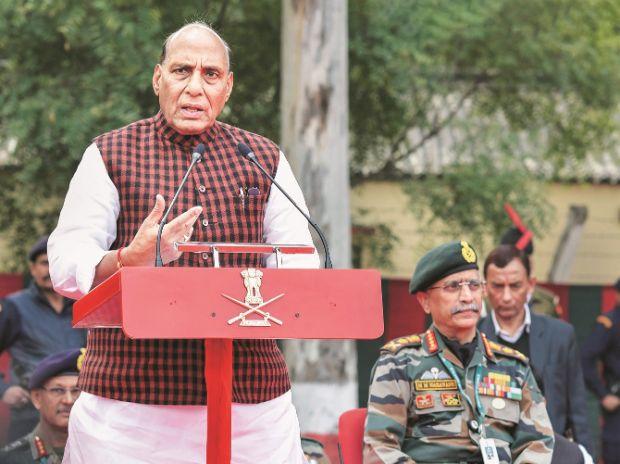

Defence Minister Rajnath Singh on Friday unveiled an updated Defence Procurement Procedure-2020 (DPP-2020) — the procurement manual that has, for the last 18 years, governed the purchase of weapons and equipment from the defence capital budget.
DPP-2020, which is still in draft form, aims to promote higher indigenous content in defence equipment manufactured in India, including under licence from foreign vendors. DPP-2020 proposes to raise by 10 per cent the indigenous content stipulated in the current procedure, DPP-2016, for various categories of procurement. For example, if DPP-2016 currently mandates an indigenisation level of 50 per cent for acquisitions in the “Make” category, DPP-2020 will raise that to 60 per cent.
“A simple and realistic methodology has been incorporated for verification of indigenous content for the first time,” stated the Ministry of Defence (MoD).
In another measure designed to promote “Make in India”, DPP-2020 introduced a new procurement category, entitled “Buy (Global-Manufacture in India)”. For equipment bought from the international market, with the intention to subsequently build it in India with technology transfer, this category stipulates a minimum indigenous content of 50 per cent of the value of the contract. To meet this difficult indigenisation requirement, only the minimum necessary numbers would be bought from abroad in ready-built condition; while a larger number would need to be manufactured in India.
This category would be given a higher preference than the current “Buy Global” category, which involves buying equipment built abroad.
In another innovative addition, DPP-2020 proposed to incorporate “leasing” of equipment as a new acquisition category. Leasing involves periodical rental payments to the lessor country/company, which works out cheaper than buying the equipment outright, which requires huge capital outlays.
“This (leasing) will be useful for military equipment not used in actual warfare like transport fleets, trainers, simulators, etc,” stated the MoD. In fact, India already leases one of its most potent naval combat platforms from Russia — the nuclear propelled attack submarine, INS Chakra. The new DPP will provide a policy framework for more such leases. DPP-2020 also proposed to introduce a new chapter for procuring software and systems related projects. “In such projects, obsolescence is very fast due to rapid changes in technology; and flexibility in the procurement process is required to keep up with the technology,” stated the MoD.
Another new DPP chapter is proposed to deal with “post contract management”, which lays down clear guidelines for issues that arise during the contract period, which typically lasts for several decades in defence contracts. DPP-2020 also proposed to introduce a comprehensive new chapter for the “Make” category of procurement. This deals with equipment designed and built by Indian defence companies, especially start-ups and innovators, and weapons realised through research projects of the Defence R&D Organisation (DRDO).
In a measure that will be welcomed by both Indian and foreign defence firms, DPP-2020 proposes that “field evaluation trials”, in which the military evaluates the equipment before approving it; will henceforth be conducted by specialised trial wings. “The objective of trials will be to nurture competition rather than elimination (of a product) for minor deficiencies,” stated the MoD.
The new policy also proposed new offset guidelines that encourage foreign vendors to discharge offset obligations through building and exporting products rather than components. The policy proposes higher multipliers for procurement from small industry and from units established in the two Defence Industrial Corridors in Tamil Nadu and Uttar Pradesh.
The policy proposed to widen the scope of “product support”, to include contemporary concepts in vogue in modern western militaries. According to the MoD, these include “Performance Based Logistics, Life Cycle Support Contract, Comprehensive Maintenance Contract, etc. to optimise life cycle support for equipment.”
Speaking at the release in New Delhi, Rajnath Singh said, “Our aim is to make India self-reliant and a global manufacturing hub… (We must) strengthen ‘Make in India’ initiative, refine ‘life cycle support’ of procured equipment and platforms and hasten the defence acquisition process by further simplifying the procedures and reducing the overall procurement timelines.”
The draft DPP-2020 was prepared by an MoD committee headed by its acquisitions chief, Apurva Chandra. The committee was set up in August 2019.
The draft of DPP 2020 has been uploaded on the MoD website for further suggestions from all stakeholders by April 17.
Recent Comments