
Tech News, Magazine & Review WordPress Theme 2017
  • Home
  • Supply Chain Updates
  • Global News
  • Contact Us
  • Home
  • Supply Chain Updates
  • Global News
  • Contact Us
No Result
View All Result
No Result
View All Result
Home Supply Chain Updates

New USAID procurement strategy targets increased work with religious groups

usscmc by usscmc
December 1, 2019
New USAID procurement strategy targets increased work with religious groups
Share on FacebookShare on Twitter

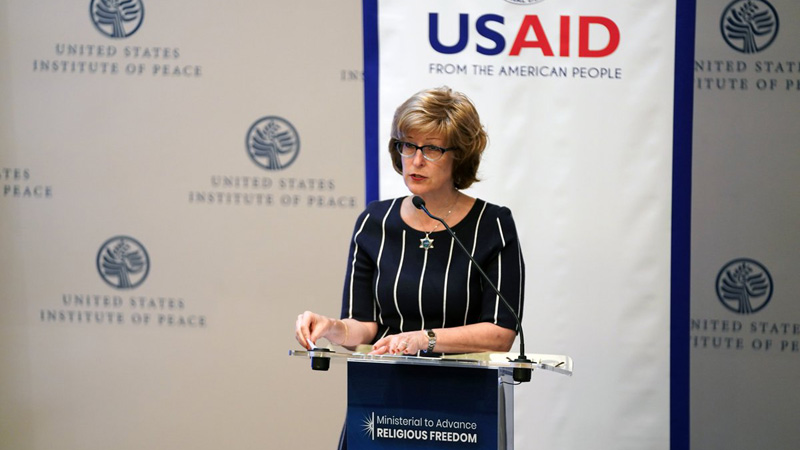
USAID Deputy Administrator Bonnie Glick at the second annual Ministerial to Advance Religious Freedom in Washington, D.C. Photo from: Twitter

WASHINGTON — The U.S. Agency for International Development’s new procurement strategy will help facilitate work with faith-based organizations in conflict and fragile settings, the agency’s Deputy Administrator Bonnie Glick said Wednesday.

USAID takes broader view of local procurement

In its latest procurement reform effort, the U.S. Agency for International Development is foregoing top-line targets and highlighting the links between international organizations and local capacity.

USAID’s New Partnerships Initiative “is designed to lower the barriers to be eligible to receive our funding,” she said. “I don’t mean only faith-based organizations, of course, as a federal agency, our job is to find whoever is best qualified to get the job done. But it’s no secret that very often faith-based groups best fit that description.”

Glick, speaking at the second annual Ministerial to Advance Religious Freedom in Washington, D.C., outlined the agency’s strategy for working with faith-based groups in development and humanitarian contexts. The ministerial brought together religious leaders and civil society members from more than 100 countries for a three-day conference at the Department of State, aimed at expanding freedom of religion around the world.

Religious groups and affiliated NGOs often have the networks, relationships, and grassroots experience necessary to be effective on the ground, particularly following societal breakdown along sectoral, religious, and tribal lines, Glick said.

“The practical reality is that faith-based organizations are indispensable to most community mobilization efforts,” she said. “There is no substitute for your ability to get to and operate in places where we as a government agency often simply cannot.”

USAID’s NPI, introduced this spring, focuses on expanding agency cooperation with “new and underutilized partners.” Direct awards will be given to local organizations, nonlocal organizations with a “strong history” of work in a given country, and to partners that will leverage private funding. Sub-awards will be given to new partners, with prime awardees having “a limited mentorship role.”

Get development’s most important headlines in your inbox every day.

Thanks for subscribing!

Randy Tift, a senior adviser with USAID’s Office of Acquisition and Assistance, said organizations that received less than $25 million in USAID funding in the last five years would qualify.

PEPFAR funding: Taking stock of the latest changes

To help understand PEPFAR’s evolving business model, Devex digs into the available data to uncover key issues and trends shaping PEPFAR activities in Nigeria and Zambia.

Global health is one area where communities of faith have had a particular impact on development efforts, he said, pointing to the U.S. President’s Emergency Plan for AIDS Relief, the President’s Malaria Initiative, and work on tuberculosis and maternal and child health as demonstrating the “enormous value” of expanded engagement with faith-based organizations.

Inclusion of local religious leaders can strengthen humanitarian responses by reducing tensions along religious lines, enhancing the sustainability of humanitarian efforts and reducing risks of future conflicts, Tift said.

“In USAID’s humanitarian portfolio, we have also learned over the decades that assistance policies should more effectively encourage and facilitate the participation and partnership of local and national and international religious communities in meeting specific needs of vulnerable religious minority individuals and communities,” he said.

“The New Partnerships Initiative … is fully committed to increasing the scope and frequency of direct engagement with faith-based, faith-inspired, and civil society organizations to ensure their equities are fully represented in USAID’s programming,” Tift said.

usscmc

usscmc

No Result
View All Result

Recent Posts

  • How Hapag Lloyd captured a major market share in the Container Shipping Industry in USA
  • Why USA’s East Coast is the Favorite Destination for Manufacturing Companies
  • How Trade Relations Between the USA and UK Improved After Keir Starmer Became Prime Minister
  • Tips and Tricks for Procurement Managers to Handle Their Supplier Woes
  • The Crazy Supply Chain of Walmart Spanning Across the Globe

Recent Comments

  • Top 5 Supply Chain Certifications that are in high demand | Top 5 Certifications on Top 5 Globally Recognized Supply Chain Certifications
  • 3 Best Procurement Certifications that are most valuable | Procurement Newz on Top 5 Globally Recognized Supply Chain Certifications

Archives

  • July 2024
  • June 2024
  • May 2024
  • April 2024
  • March 2024
  • February 2024
  • January 2024
  • December 2023
  • November 2023
  • October 2023
  • September 2023
  • August 2023
  • July 2023
  • June 2023
  • May 2023
  • April 2023
  • March 2023
  • February 2023
  • January 2023
  • December 2022
  • November 2022
  • October 2022
  • September 2022
  • August 2022
  • July 2022
  • June 2022
  • May 2022
  • April 2022
  • March 2022
  • February 2022
  • January 2022
  • December 2021
  • November 2021
  • October 2021
  • September 2021
  • August 2021
  • July 2021
  • June 2021
  • May 2021
  • April 2021
  • March 2021
  • February 2021
  • January 2021
  • December 2020
  • November 2020
  • October 2020
  • September 2020
  • August 2020
  • July 2020
  • June 2020
  • May 2020
  • April 2020
  • March 2020
  • February 2020
  • January 2020
  • December 2019
  • November 2019
  • September 2019

Categories

  • Global News
  • Supply Chain Updates

Meta

  • Log in
  • Entries feed
  • Comments feed
  • WordPress.org
  • Antispam
  • Contact Us
  • Disclaimer
  • Home
  • Privacy Policy
  • Terms of Use

© 2025 www.usscmc.com

This website uses cookies to improve your experience. We'll assume you're ok with this, but you can opt-out if you wish. Cookie settingsACCEPT
Privacy & Cookies Policy

Privacy Overview

This website uses cookies to improve your experience while you navigate through the website. Out of these cookies, the cookies that are categorized as necessary are stored on your browser as they are essential for the working of basic functionalities of the website. We also use third-party cookies that help us analyze and understand how you use this website. These cookies will be stored in your browser only with your consent. You also have the option to opt-out of these cookies. But opting out of some of these cookies may have an effect on your browsing experience.
Necessary
Always Enabled
Necessary cookies are absolutely essential for the website to function properly. This category only includes cookies that ensures basic functionalities and security features of the website. These cookies do not store any personal information.
Non-necessary
Any cookies that may not be particularly necessary for the website to function and is used specifically to collect user personal data via analytics, ads, other embedded contents are termed as non-necessary cookies. It is mandatory to procure user consent prior to running these cookies on your website.
SAVE & ACCEPT
No Result
View All Result
  • Home
  • Supply Chain Updates
  • Global News
  • Contact Us

© 2025 www.usscmc.com