

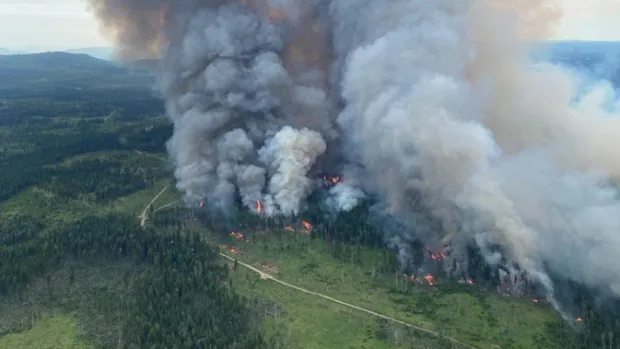

More than 200 active wildfires were blazing across British Columbia as of Thursday, with the majority burning swaths of land in the province’s interior.
They’re among the 786 that have engulfed nearly 1,000 square kilometres of land this year alone, more than three times the 10-year average for this time of year.
The already devastating fire season begs the question — is there any way for us to fireproof towns and cities at nature’s edge?
Not exactly, says Kelly Johnston, technical advisor at FireSmart Canada, a national program that helps adapt communities to fire and reduce their wildfire risk. But we can make them more resilient.
“Wildfire is going to be a natural occurrence that communities all across Canada will have to deal with in most cases,” he said. “It’s about learning how to become resilient and adaptive to that particular situation [communities] are dealing with.”

Sparks Lake fire evacuees in Kamloops, B.C., describe what it was like to flee the fire, and what they found when they went back. 2:40
In some cases, that starts with keeping a close eye on an area called the wildland-urban interface. It’s where fire can transition between and through vegetation and human development — for example, a town that borders thick forest.
Interface fires can be fatal and cause tremendous economic and structural damage when fire spreads from forest to town, or vice versa. The 2016 Fort McMurray wildfire, for example, spread over 500,000 hectares and consumed 2,400 structures. To this day, it is the largest ever insured loss in Canada.
Keep the ‘fuel load’ low
One way to manage them is by reducing what fire experts call “fuel load” — essentially, combustible material such as vegetation — that can help reduce a fire’s intensity, making it easier to fight and sometimes even cause it to die out.
Amy Cardinal Christianson, a fire research scientist with the Canadian Forest Service and a Métis woman from Treaty 8 Territory, says it’s something that Indigenous people in Canada have been doing for thousands of years through cultural burning.
“Cultural burning is always for cultural practices or for cultural reasons,” said Christianson.
This low-risk activity is performed by communities at times of the year when fire has a low chance of escaping, she said.
“But one of the side benefits of that is that you basically reduce fuel load or the litter on the forest floor around communities and in the forest.”
Climate change is causing extreme weather conditions that can make fires burn bigger and spread faster. But failing to manage vegetation also increases risk, because a greater fuel load can mean disaster if and when a fire strike, Christianson said.
“With Indigenous fire, lots of times we would use fire to create meadows or kind of open spaces in the forest, what you could call mosaics,” she said.
Without these cleared patches, “you see just these blanketed coniferous or spruce fir forests and you’re almost creating a monoculture, which wildfire loves.”
Build with fire in mind
So how do we manage interface fires? By changing the conditions in which fire burns in a developed area, says Johnston.
That means building houses that can better resist fires, and managing the fuel load and how it’s spaced out between buildings and forests.
“Addressing how structures are built with regards to materials and design, how they’re situated on the landscape, how the vegetation on the landscape is modified, all that can be incorporated into planning,” Johnston said.
He says designating and managing vegetation within a 30-metre zone between wild and urban spaces reduces the likelihood a fire will spread.

Using siding materials that resist fire better, such as stucco, brick, concrete blocks, cement fibre board or tempered glass for windows can also better protect a home. Fires often begin with airborne embers landing on a roof or deck, so keeping roofs clear of debris is another important step communities and homeowners can take to reduce the risk.
Canadian wildland fire management agencies have invested billions in wildland fire protection. That includes fire preparedness, mitigation, response and recovery costs. But as the impacts of climate change become more widely seen and felt across the country, some experts say authorities will need to rethink how we prepare for seasons of these magnitudes.
“The fire season is extending, so we’re having to commit resources for a much larger length of time throughout the season,” said Johnston. “And the intensity of fires is becoming much greater.”
Recent Comments