

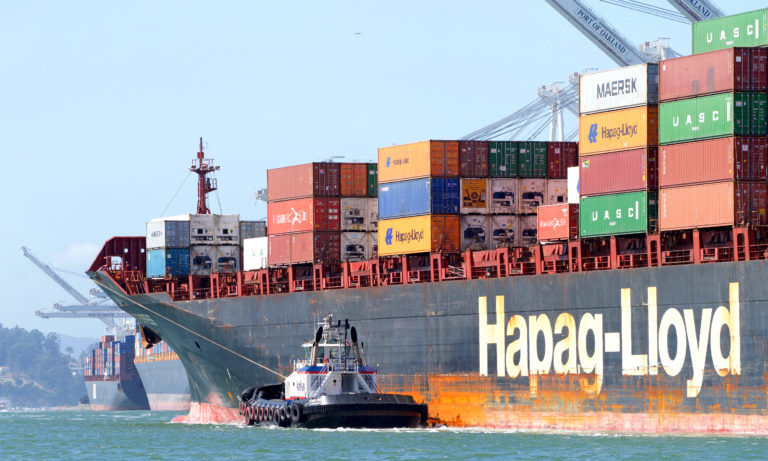

The Agriculture Transportation Coalition’s Peter Friedmann took exception to what Hapag-Lloyd’s CEO didn’t say during a recent videoconference with media from around the world.
“It is one thing for ship schedule reliability to be at all-time low levels, but quite another for carriers to profit so handsomely by such collapse in dependable service,” Friedmann, executive director of the Washington-based AgTC, told American Shipper after reading about Rolf Habben Jansen’s press conference.
Habben Jansen said that port congestion, particularly in Los Angeles and Long Beach, California, coupled with a container shortage and COVID-19 outbreaks among longshore workers had formed the perfect storm, and as a result, “schedule reliability is at a very low level.”
Friedmann argued that the “lack of schedule integrity” as well as ocean carriers’ failure to provide reliable updates “has directly led to the demurrage and detention charges imposed on their customers — the importers and exporters. That revenue — in the hundreds of millions of dollars — has contributed tremendously to the record-setting carrier profits, while pushing their customers into real financial trouble, some towards bankruptcy.
“In fact the current carrier, chassis and terminal dysfunction is so profitable for the carriers that there is little incentive for them to take the actions available to reduce the current service failures,” Friedmann said. “The carriers’ record profits also come while declining export bookings, hauling containers back to Asia empty to chase the import freight rates and preventing U.S. exporters from supplying our foreign customers. This will generate federal intervention that the carriers may regret.”
Demurrage and detention charges have been points of contention between shippers and carriers for years — long before COVID-19 spread around the globe — and have attracted government attention, most recently with the Federal Maritime Commission pushing for enforcement of a Shipping Act rule on “reasonable” demurrage and detention practices.
Demurrage pertains to the time an import container sits at a terminal, with the carrier responsible for collecting a penalty on behalf of the marine terminal. Detention relates to shippers holding containers for too long outside the marine terminals.
During the Feb. 18 press conference, Habben Jansen argued that Hapag-Lloyd wasn’t using detention charges to bolster its profits.
“We’ve also allowed people to get detention rates at a very much discounted rate because we do appreciate that people sometimes need longer to get stuff back,” he said.
Profits soar during pandemic
Undeniably, the COVID-19 pandemic has been good for business for the shipping lines. Hapag-Lloyd’s earnings before interest, taxes, depreciation and amortization (EBITDA) climbed $900 million in 2020 to $3.1 billion, up from $2.22 billion in 2019.
Maersk, the world’s largest container line, reported in February that its 2020 ocean EBITDA jumped 48% year-over-year to $6.5 billion. HMM announced it had made a billion-dollar turnaround in 2020 to record its highest operating profit ever. Ocean Network Express also reported incredible numbers, announcing its net quarterly profit had escalated by $939 million year-over-year.
Hapag-Lloyd won’t publish its final figures for the first quarter of 2021 until May 12, but gave an indication of what to expect in mid-February, when the German carrier said it expects EBITDA to be “significantly higher” than Q1 of 2020. The estimate is for EBITDA of “at least” $1.8 billion — more than double the profit of $517 million in the first quarter of 2020.
“We will see a very strong result in the first quarter, but we anticipate a normalization as the year progresses,” Habben Jansen said in a statement released with Hapag-Lloyd’s forecast. “We are still seeing slower container turn times, significant congestion in ports around the globe, capacity constraints in rail and truck, and the risks of the coronavirus pandemic remain.
“Nevertheless, we do also expect that the result for 2021 as a whole will be significantly higher than the prior-year level,” he said.
Spot rates also are significantly higher. FreightWaves Senior Editor Greg Miller reported that as of last Tuesday, the Asia-U.S. West Coast spot rate was at an all-time high of $4,922 per forty-foot equivalent unit.
“These rates become very, very high when capacity is tight. Typically only about 20% of the freight moves at spot rates and the rest is contracted,” Jansen said during the Feb. 18 press conference.
He agreed that during the import surge, space on container ships is difficult to come by and “you would have to pay a premium for that in this market.”
In response to a question regarding reports of contracted rates 50% to 75% higher than the prior year, Habben Jansen contended the contract rate in 2020 was up only about 4% until the fourth quarter, when it increased again.
“But we also saw that it was pretty flat and down at times early on” in the pandemic, he said. “I think that’s where you have to look at the long period of time.”
He granted that contracts Hapag-Lloyd has “closed for the upcoming year are generally up compared to the previous year. I wouldn’t comment exactly on the percentage, but they are up fairly significantly. … If you look at them in historical standards, you would look at a little more than just the last few years. They’re still at a reasonable level.”
‘Shipper unhappiness’
He also was asked to respond to reports of “shipper unhappiness” with the ocean carriers, particularly since their businesses have been “extremely profitable” during the coronavirus crisis.
Habben Jansen said currently “overall capacity in the market cannot keep up with demand. That of course causes frustration and also especially for those that didn’t decide to contract early on.”
On Thursday, Hapag-Lloyd unveiled its fifth “quality promise,” this one that volume agreements would be honored.
In its announcement, Hapag-Lloyd said it was taking steps “to significantly improve the stability of shipping processes.” To help achieve that, the ocean carrier set “the goal of confirming bookings in at least 90% of the volumes agreed with its mid- and long-term customers.”
“Going forward, Hapag-Lloyd and its customers will clearly commit themselves to volume agreements for a specific period of time linked to a specific geographical scope. Consequently, the carrier will be able to reduce the number of booking rejections, while customers need to fulfil their part of the agreement by placing bookings up to the agreed volume as scheduled beforehand. The mutual commitment on volume agreements will allow both parties to enjoy much more effective planning, which will result in significant cost savings,” the announcement said.
As the Feb. 18 press conference neared the end, Habben Jansen disagreed with a reporter’s assertion that the pandemic has been a “great benefit” to Hapag-Lloyd.
“In the end, it’s important for us that everybody continues to move as many goods as possible,” he said. “Moving containers has always been the most economical way to transport goods, especially internationally and over long distances. That also means that needs to be done at a competitive cost. That’s also why everything we do today is … to make sure that in two, three, four, five years from today, we are able to provide container transportation at a very competitive cost and also in a way that’s more sustainable than we have in the past.
“It is also in our interest we get a little more back to normalcy in this market and yes, there’s now a peak in freight rates; we benefit from that. But in fairness, if you look back at the last 10 years, there have also been many, many [instances] where we were moving boxes for $50 or $100,” Jansen said. “Over time it is very much in our interest container shipping remains economically attractive.”
Hapag-Lloyd CEO: COVID, congestion, container shortage form ‘perfect storm’
HMM makes billion-dollar turnaround from loss to record profit
Click here for more American Shipper/FreightWaves stories by Senior Editor Kim Link-Wills.
Recent Comments