


Price swings in the largest market for marine fuel are filtering down the supply chain as major ocean carriers ask customers to cover costs for using low-sulfur fuel blends.
Maersk last week said in a customer advisory that ocean freight tariffs across all trade lanes will increase by $50 to $200 per forty-foot equivalent unit (FEU) starting March 1 due to a price spike for low-sulfur fuel in Singapore. The International Maritime Organization mandated fuel with a 0.5% sulfur cap be the global standard effective this year.
The “trigger” for the tariff surcharge, Maersk said, is a swing in fuel prices in the largest global marine fuel market. Low-sulfur fuel prices increased “substantially” in Singapore, exceeding $700 per metric ton, more than 20% higher than previous benchmark fuel prices.
“The average increase in January thus is expected to exceed $50 per metric ton,” Maersk said.
Hapag-Lloyd is also said to be considering a similar surcharge, according to ShippingWatch, although its surcharge amount has not yet been determined.
Yet in the same week that Maersk announced the new surcharges, Singapore fuel oil prices dropped close to $100 per metric ton, from a Jan. 7 peak of $740 per metric ton to $641 on Jan. 22, according to international shipowner association BIMCO.
Another closely watched indicator of marine fuel prices is the spread between low-sulfur fuel and the cheaper high-sulfur fuel, which can still be used in ships equipped with sulfur scrubbers.
In the lead-up to 2020, the spread ranged between $300 and $350 per metric ton. It was last at $284 per metric ton in Singapore.
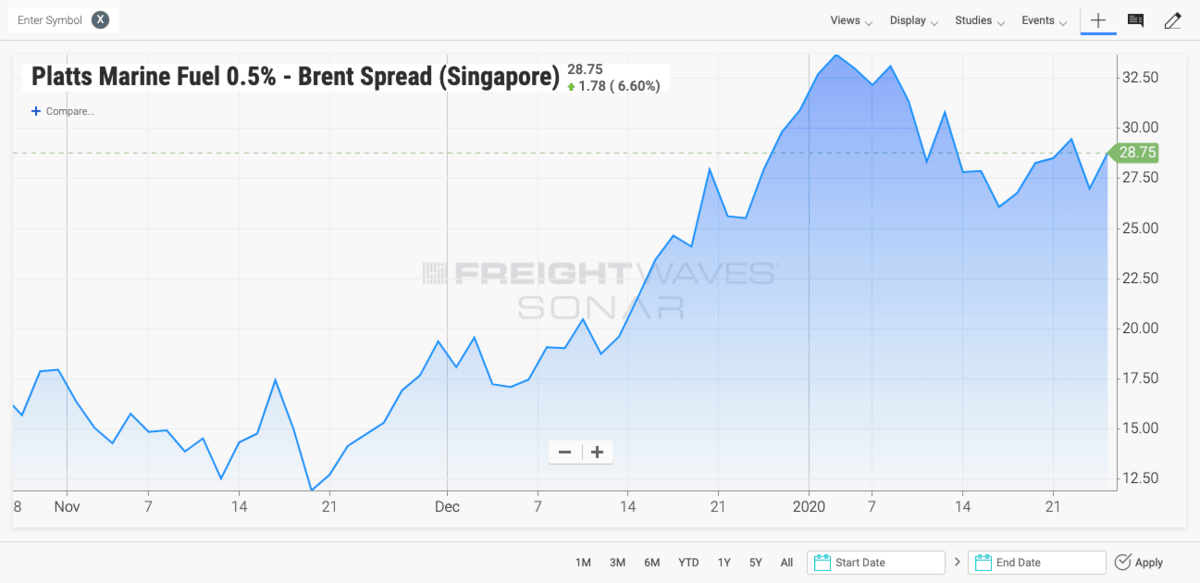
Low-sulfur marine fuel prices can also be viewed relative to the price of North Sea Brent crude oil, a global benchmark. The spread as of Jan. 24 (SONAR: MF5B.SNG) indicated low-sulfur marine fuel was trading at $89 per barrel in Singapore.
BIMCO chief shipping analyst Peter Sand said the price volatility “marked the first wave” of shipowners buying low-sulfur fuel oil at the mandate’s start. He said the price spike could stem from the lack of available barges to bring marine fuel, also called bunker, to ships.
But there does not appear to be systemic shortage in the market, he added. Rather the outset of the new rule means buyers are at the mercy of sellers.
“This is a bunker suppliers market 100%,” Sand said. “The suppliers are having a good time in the market right now.”
The most recent spread between the wholesale price and the delivered price of low-sulfur marine fuel in Singapore is just under $100 per metric ton, according to Adrian Tolson, director of 20|20 Marine Energy, the maritime fuel consultancy of Blue Insight.
The spread represents the potential margin that bunker suppliers are making currently and is much larger than sub-2% margins more common in the industry. Tolson said the higher spread reflects the natural disruption of a market undergoing a huge change.
Bunker suppliers “are making a much better margin than they usually make,” Tolson said. “Ultimately, it’s going to come down, but that takes a while to work itself out.”
Tolson said one surprise in the Singapore market has been low-sulfur marine fuel trading higher than regular diesel, which has 0.001% sulfur.
Regular diesel theoretically should trade at a premium based on even lower sulfur content, Tolson said. But the reversal of the spread could throw off how ocean carriers purchase or hedge their fuel.
“If those spreads are not where they were expected to be, there might be significant hits on the costs of fuel,” Tolson said. “The break in the normal relationships is a bit of a shocker.”
Despite the price spike, BIMCO members, which represent about two-thirds of shipping tonnage, are reporting “so far, so good” on the transition to IMO 2020, Sand said.
He said the volatility should lessen in the coming months — but only until a “second wave” of price spikes occur as shipowners and suppliers that bought low-sulfur fuel ahead of 2020 step back into the market to stock up again.
“When they need to refuel at some point in time over the coming months, that’s when we expect another surge in volatility and another price jump,” Sand said.
Another major marine hub in Northwest Europe saw some fuel price volatility, but not the extent seen in Singapore, Sand said.
Tolson said there are indications of tight supply of low-sulfur marine fuel on the U.S. West Coast. But Chinese and Korean refiners have signalled they are building more capacity to produce low-sulfur marine fuel, which can be shipped to suppliers on the U.S. West Coast.
For shippers trying to get their head around IMO 2020 surcharges, Sand says it’s best to watch the absolute price in the major fuel hubs. The spread between high- and low-sulfur fuel offers some indication, but is more suited to shipowners’ own economics about using scrubbers.
“Shippers are offered a service that runs very much on low-sulfur fuel and should not consider the odd ship is scrubber fitted,” Sand said.
Customers of the container lines should be in better shape to weather IMO 2020 as most of those vessels call at major, well-supplied ports. It’s the customers of the “tramp” ships, such as tankers and dry bulk, that can be more exposed to fuel price volatility as those ships can call smaller ports with less access to refineries.
He understands that shippers may be having a hard time keeping up with price swings in remote markets affecting rates. But with an estimated $10 billion in higher fuel costs for the maritime industry, “this is a cost that will end up further down the supply chain.”
Recent Comments