

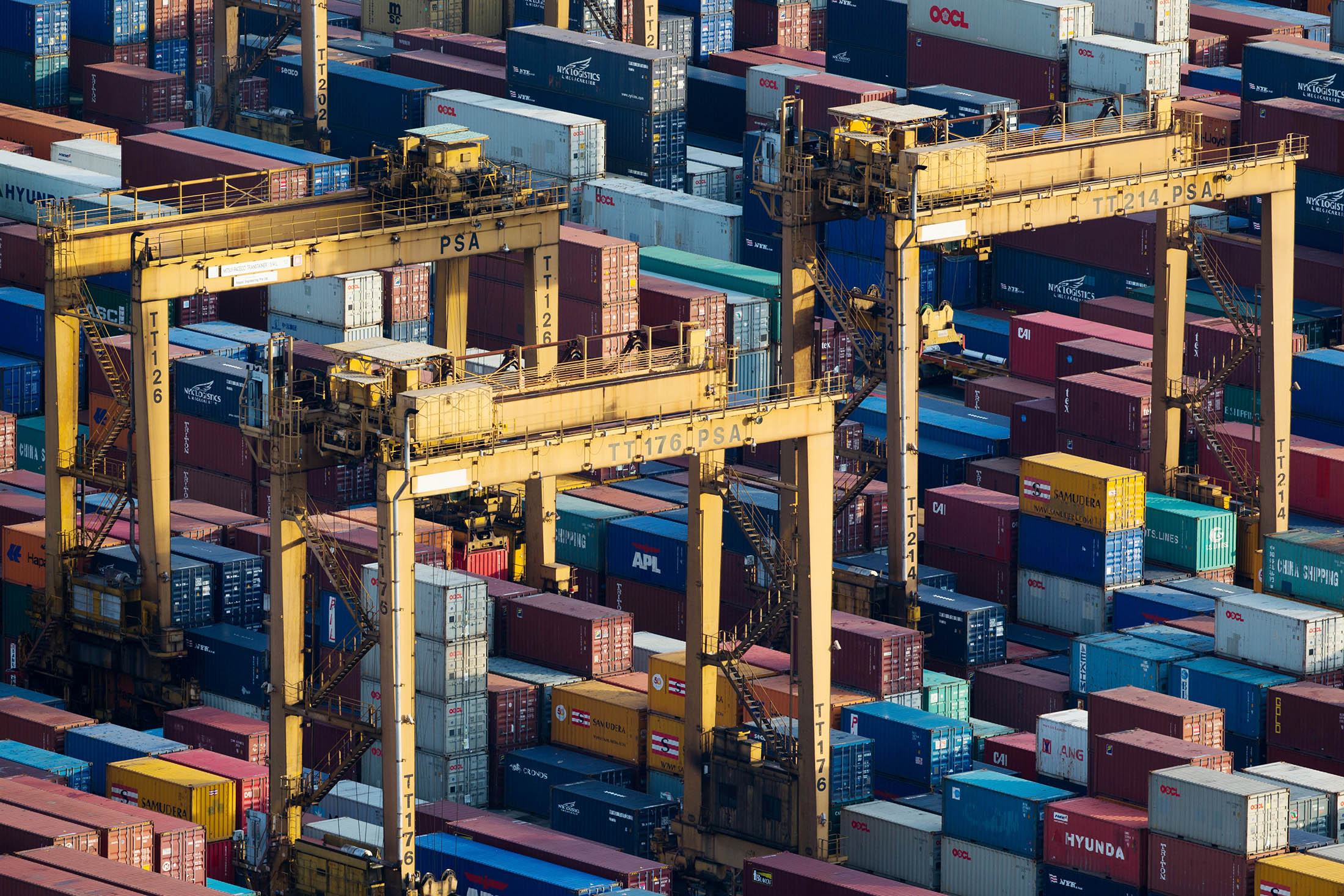

OnePort 365 is a digital platform that is revolutonarising how import and export are facilitated on the African continent. Hio Sola-Usidame, Lead Partner of the Lagos-based startup speaks on the vision of the company, how it makes international trade more seamless and what the freight forwarding industry in Africa will look like in the next five years.

OnePort 365 optimises trade operations for African businesses, ensures seamless freight forwarding while also offering other related services including shipping. How do you achieve all of these?
Freight forwarding, simply put, is helping companies move their cargo from Point 1 to Point 2. However, in reality, it is a complex network of unstructured processes involving handing over cargo from vendor to vendor.
Consider the freight forwarding process of a Ginger exporter. From the farm, a trucking company transports the cargo to a warehouse for consolidation. Another trucking company moves the freight to a transloading warehouse for transportation to the port terminal via barge and then loaded on to a vessel going to China. This process is repeated in reverse from the destination port. Now imagine a company with several shipments in transit. Keeping track of all this manually is chaotic, let’s not consider trying to optimise manually.
As you rightly mentioned, OnePort 365 provides a solution to this chaos by streamlining and optimising companies’ end-to-end freight processes. We achieve this by using technology to structure and automate a majority of the manual labour involved in freight management. This gives companies operational efficiency through greater visibility and control over their shipments. In turn, they are able to scale their trade operations while minimising the associated costs of scaling.
What exactly makes OnePort 365 different from the competition?
We differentiate ourselves from the competition in three ways.
First, in line with our customer experience optimisation model rather than offer silo services, we provide fully digitised end-to-end freight services. You can call it a one-stop-shop. Our platform integrates and coordinates the value chain services from origin to load port, providing convenience, transparency, and accountability.
Secondly, we are heavily invested in our clients’ trade success. At OnePort 365, a watchword we emphasize is scalability. We continually ask “How can we help our clients scale their trade operations?”, “How can we scale how we help our clients?”. Our solutions and platform is designed to ensure African companies can benefit from scalable growth through operational efficiency and cash flow management.
Finally, we are a group of seasoned professionals in the freight industry. We previously operated as Logigrains providing freight management services to a wide range of industries. This, in addition to the management team’s several decades of combined industry experience, forges a solid technical and operational advantage. We are freight forwarders using technology to simplify freight management.
Access to your services is through an online platform. Is there any provision for customers who still prefer face to face interactions?
Companies can count on us for optimised freight forwarding success and round the clock support. Yes, beyond the platform, we have a dedicated team of experts that are available to help clients at every stage of the shipment. The process remains the same except instead of the client, the client’s account manager inputs all client’s queries, make the bookings via the platform while both the client and the account manager receives update reports.
While we provide support, we guide the client towards embracing the digital transformation the freight management and trade industry is undergoing.
In a world where cybersecurity remains a major concern, what measures have you put in place and what assurances do you have for customers?
Cybersecurity will continue to be a priority for updating our platform. We take a proactive approach to client confidentiality and data security. Some of the measures we have in place include data encryption which obfuscates the intelligible content to those who are not authorized to access information in transit and at rest; multi-factor authentication for access control; https/ssl was used to establish an encrypted link between our server and a browser to ensure information remains private, and we ensure that error messages are not actual system messages verbatim.
The application was tested end-to-end following all necessary protocols. We also periodically perform penetration tests to confirm stability and to ensure that there are no loopholes that can allow compromise.
What inspired the OnePort 365 model and how successful has it been since inception?
The OnePort 365 model was largely inspired by the system inefficiencies and heightened costs we experienced moving cargo on behalf of clients. Africa is the most expensive continent to ship from and to. The establishment of the Africa Continental Free Trade Area is expected to boost intra-African trade by 52.3% by 2022. The successful expansion of trade across Africa is heavily dependent on the efficiency of trade operations. Unfortunately, it is currently largely inefficient due to low end-to-end visibility, poor infrastructure, lack of transparency in charges, the susceptibility of cargo to loss, theft or accidents, extensive manual hours in negotiating quotes, keeping track of documents, and so on.
How do we optimise efficiency? How do we efficiently grow the volume of freight we transport? How do we help our clients (African businesses) efficiently manage their freight transportation so they can benefit from scalable growth? How can we be a part of the solution to enhancing Africa’s participation in global trade?
In addition to freight transport, our clients require human knowledge and local landscape intelligence which we provide but how does one unlock this intelligence and make it available on a large scale backed by real-time technology and verifiable data.
Our model has been a success for us so far using demand, affordability, and impact as metrics. Companies need what we do. We are simplifying freight management and optimising trade operations. It’s a double win, cheaper and better. The model does not make all the difficulties of freight logistics disappear, especially in Africa with extensive infrastructural challenges. Trade operations and logistics are still demanding business functions. However, users of our platform have visibility of shipments, better freight planning, improved cash flow management, and access to our extensive infrastructure network. The OnePort 365 platform is optimised for ease and powered by technology.
What is your capacity at the moment and how has the market responded to your service delivery and product?
We doubled volumes shipped during the lockdown earlier this year and in fact, could have tripled shipments from clients if not for interstate border closures and ocean vessel blank sailings which led to multiple rescheduling. We are receiving bookings and are always open to more volumes as we expand capacity.
The platform is open to select beta clients. The market response has been positive with over 13,000 tonnes containerised cargo booked within a period of 8 months. We are innovating a very traditional industry. While we have on one hand clients that took an early leap, there are also those clients that are slightly apprehensive, prefer the traditional methods and face-to-face interactions.
Infrastructure has been identified as one of the biggest problems of freight forwarding in Nigeria. How are you working around this?
Yes, underdeveloped infrastructure in Nigeria and several countries across Africa remains a challenge. As a nation, we have under-invested for decades. Nigeria’s inland infrastructure for freight movement is underdeveloped by international standards. This amplifies the costs of moving cargo in the hinterlands, contributes to unpredictable transit times locally, at the ports as well as uncertain working capital cycles plus a host of other problems.
On the other hand, we are optimistic about forthcoming investments in Nigeria’s unutilised infrastructure. A typical example is inland container depots such as the Calabar Port. There is no reason the port cannot be fully functional once necessary dredging is completed. Another example is the Kaduna ICD. This was built with a rail system to transport cargo into the port, however not sure how often a rail rake calls Kaduna ICD.
From a client’s perspective, technology is a great tool in combating some of the infrastructural challenges. Our digital solution involves the engineering of an optimal sequence of multimodal transportation for client shipments to minimise disruptions. In addition, our real-time tracking solution also lets clients monitor their shipments from anywhere in the world.
Can you project what freight forwarding in Africa will be five years from now?
Digitalisation is the next big step for Africa. I believe in five years’ time, platforms that offer online bookings will become the minimum standard in the sector. It would become easy to book export/import services, just the way we currently book flights via online travel agencies. From process automation to data analytics to the internet of things (also called the physical internet), these will gradually become the new standard of trade operations.
I see more consolidations or collaborations in varying forms amongst freight forwarders, as the industry realises the strength in collaborating using technology. This could also further standardize processes in logistics operations.
Also, client expectations will increase significantly as the industry becomes more digitalised. Expectations of quicker and more flexible cargo movement, all at reduced costs.
In addition, for the African Free Trade Alliance (ACFTA) to be successfully implemented, I believe customs standards across borders in Africa will need to be standardized and up to global standards. Africa remains the most expensive continent to ship from or to, cost of trade is significantly high due to infrastructure challenges and the complex processes. Can technology solve all infrastructural challenges? not necessarily, but technology can simplify bureaucratic challenges which can lower the cost of trade.
At OnePort 365, we are excited to be part of the digital revolution that will optimize trade operations for Africa.
Recent Comments