

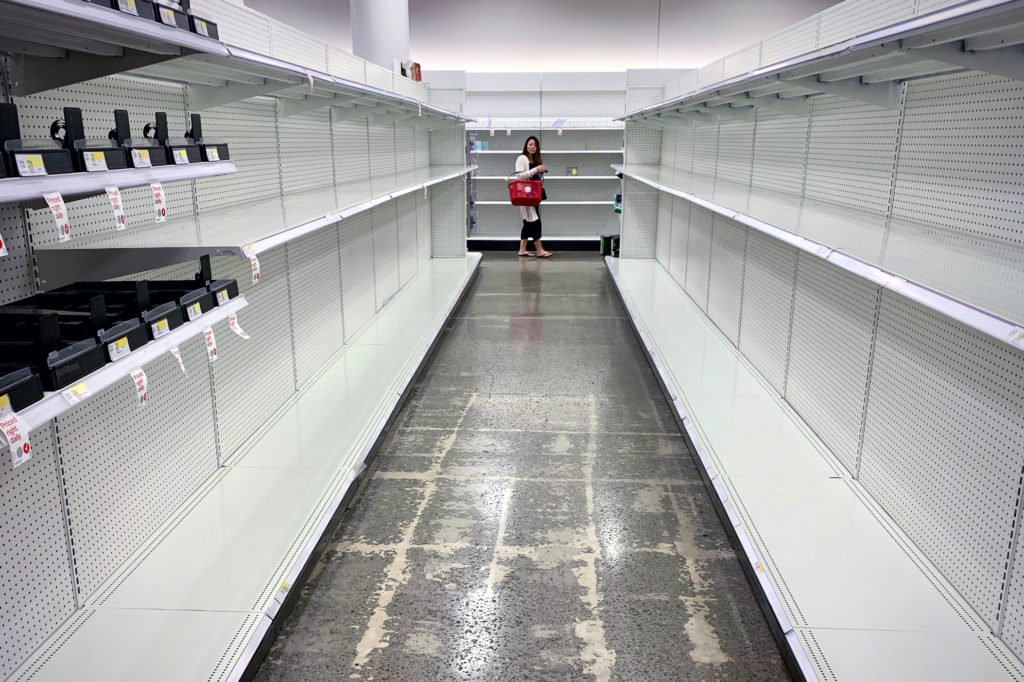
In recent weeks, I’ve seen empty shelves in a few supermarkets: Walmart, Target, Safeway and Whole Foods.
 Last week, a line of carts waited to enter the Iwilei Costco. Employees let customers in a few at a time to avoid overcrowding.
Toilet paper and bottled water get scooped up whenever there’s a hurricane warning, but this round of retail ransacking is different. Other shelves are empty. Medicine, canned foods, frozen vegetables.
The shortages aren’t limited to brick-and-mortar stores. Last week, Amazon was sold out of thermometers (ear, oral and forehead), leaving shoppers to choose between meat and rectal options. In addition, many nonperishable foods are out-of-stock or wait-listed.
Survival foods are scarce. Stocks are low at Mountain House, a producer of freeze dried food. Wise Company, a popular food choice among people preparing for the apocalypse, is sold out.
The coronavirus pandemic has exposed the fragility of the supply chain for consumer goods. Empty shelves are a warning sign: The more we depend on goods shipped from afar, the more vulnerable we are during crisis.
Broken Supply Chains
Large retailers like Walmart, Amazon and Costco don’t want goods sitting idle on the shelves, so they use big data analytics to streamline procurement. Deliveries from suppliers arrive when needed and not before. Thus, retailers pay minimal costs for inventory storage.
To compete on price, even small retailers have adopted similar approaches. Thus, few retailers keep large stockrooms. Instead, most goods go from delivery truck straight onto the shelves.
When things calm down, you should stock up if you can afford it to relieve pressure on retailers in the next crisis.
Cory Lum/Civil Beat
Suppliers have adapted to suit the needs of retailers. When demand increases, suppliers scale up production.
This approach to supply chain management produces cost-efficient outcomes, but increases vulnerability in two ways.
First, it produces acute shortages of goods when demand increases. Because stores keep small inventories, they run out quickly. This is fine if thermometers become popular in Seattle. Supplies from nearby areas can be redirected to Seattle. However, if demand increases everywhere at the same time, then shortages become widespread.
Second, this approach assumes that supply can increase to meet demand. However, if manufacturers close to promote social distancing, they may not be able to rapidly increase supply. In a severe pandemic, shipping could become difficult because of fear of contagion. Delays throughout the supply chain can cause long-term retail shortages.
Retailers are scrambling to adapt. Consider Amazon, the world’s largest. Large and small companies supply goods to Amazon fulfillment centers, where they are warehoused and shipped to customers. But increased demand because of coronavirus is overwhelming Amazon’s fulfillment centers. They can’t handle the sales volume.
In response, Amazon is suspending shipments of all non-essential products to its warehouses. This measure will help the company focus on stocking household staples and medical supplies. However, it hurts small businesses that rely on sales through Amazon fulfillment centers.
Amazon is hiring 100,000 new full-time and part-time workers to meet surging demand, but too late to hide the truth: In the event of a major disruption, retailers aren’t capable of providing basic goods to the people.
Import Dependency
Many states rely on imported food. Hawaii is an extreme case, importing about 90% of our food.
The global economy is premised on interdependence. In general, countries export the goods that they can produce most efficiently. They import the goods they cannot. For example, South Korea imports crude petroleum and exports electronics, including integrated circuits. Hawaii exports tourism and imports, uh, everything.
National governments may encourage local production of vital goods such as food and guns, but the profit motive exerts a gravitational pull, bringing factories to rest wherever they can produce at least cost.
Coronavirus has highlighted the extent to which the United States relies on pharmaceuticals imported from China. China is a leading manufacturer of basic medical supplies including antibiotics, pain medicines and surgical masks. When coronavirus disrupted supply chains in China, shortages resulted in the United States.
We can prepare by diversifying our local economy and by seeking redundancy.
International trade is an “efficient” system. With specialization, costs decrease and profits increase.
However, an efficient system is not always resilient. During a crisis, a bit of inefficiency can be beneficial. For instance, it’s incredibly inefficient to produce everything your country needs within its borders. However, if you ever need to close the borders, you’ll be well equipped to survive.
Preparing For The New Normal
Severe Acute Respiratory Syndrome started spreading in 2002. Middle East Respiratory Syndrome took hold in 2012. The novel coronavirus started spreading in 2019.
Pandemics like coronavirus will recur, and they’ll spread easily through global networks of travel and trade. The next pandemic will produce the same supply chain disruptions, causing empty shelves at your local retailer.
We can prepare by diversifying our local economy and by seeking redundancy.
First, we need to diversify our local economy. The crisis facing tourism will repeat every time global travel is disrupted by pandemic.
Our eggs are in one basket. Tourism is too big to fail, and the state needs to reconsider whether it is capable of propping up the industry in the long term.
We should do everything we can to assist those who are personally affected, but we can’t afford to go back to business as usual.
Second, we need to seek redundancy as individuals and as a society.
Of course, it’s not efficient to keep a month’s worth of emergency food on hand. But these reserves may be necessary during a pandemic.
Empty shelves should be a wake-up call that when the next panic hits, you won’t be able to waltz into the local supermarket and restock your pantry.
Not everyone can afford to stock up in advance. If you can, you should prepare in advance to reduce the burden on retailers when the next crisis hits. That way, those who need food won’t find the shelves empty.
As a society, we need to prepare for regular disruption. Gideon Linchfield, the editor of the MIT Technology Review, predicts that routine social distancing may be necessary for up to 18 months. Future pandemics will require the same response. A more virulent strain of coronavirus may require even more stringent restrictions on movement.
We can plan now. Can’t have physical classes? Better have contingency plans for online instruction. Planning a large social gathering? Have a digital or dispersed meeting option ready.
Coronavirus isn’t the last pandemic, and empty shelves will return. We can adapt now, or suffer in the future.
Want more information on COVID-19 in Hawaii? You can read all of Civil Beat’s coronavirus coverage, find answers to frequently asked questions or sign up for email newsletter updates — all for free.


Recent Comments