

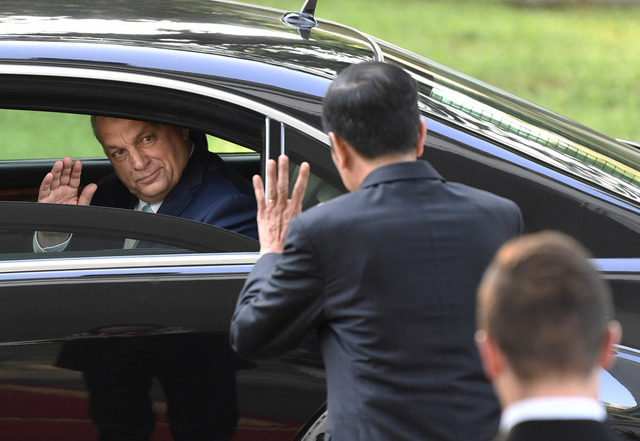

“We don’t see these people as Muslim refugees. We consider them Muslim invaders,” Viktor Orban, Hungarian Prime Minister.
If the aforementioned interview quote from Bild was well-known among Indonesians and wide-spread among bapak-bapak‘s Whatsapp groups, Viktor Orban would have been welcomed differently in his latest three days visit to Indonesia.
The Hungarian Prime Minister Viktor Orban has been in Indonesia conducting his diplomatic tour in Asia, including his visit to Jakarta and Yogyakarta. This is not his first time landing on Indonesia’s soil as previously he was welcomed by President Joko Widodo (Jokowi) in 2016.
His latest visit to Indonesia is officially stated to strengthen 65 years standing bilateral ties between the two countries, especially by deepening cooperation on economic, infrastructure, trade, health, and people-to-people contact. Orban also attended CDI (Centrist Democrat International), an international centrist and Christian democratic party alliance, Executive Meeting hosted by Muhaimin Iskandar’s National Awakening Party (PKB) in Yogyakarta.
Orban himself is the Vice-President of CDI. Jokowi looked happy with his Hungarian counterpart’s visit as Orban pledged attractive investment and diplomatic commitments. Muhaimin Iskandar also seemed to be pretty much enjoying Orban’s visit, judging from his multiple Instagram stories.
It appeared that nobody really cares about Victor Orban’s erratic political footprints, especially on contentious issues such as multiculturalism, refugees, and Islam. Orban is widely known as the beacon of European populism, a poster boy of the rise of right-wing movements in the West as he staunchly criticizes the European Union’s Immigration policies, refuses refugees, and denounces multiculturalism.
Fidesz, his political party, is associated with anti-Islam and anti-Semitism narratives in Hungary and Central Europe. He repeatedly mentions the danger of multiculturalism and liberalism to Hungarian Culture by referring to the “Muslim refugees invasion” in “mass scale” as an example.
Given his political stance and discourse, it is intriguing to observe how Orban, the proponent of so-called “Christian and Illiberal Democracy”, engages in closer diplomatic partnership with the biggest Muslim nation in the world.
This is not to mention his partnership with PKB, the biggest Islamic party in Indonesia, under the CDI platform. Lest we forget that PKB is strongly popular with its multiculturalism and pluralism notions inherited by Abdurrahman Wahid’s thoughts.
Indeed, strategic and material considerations play profound roles as the main driver of Orban’s intention visiting Indonesia. In 2011, he launched Opening to the East Policy to diversify Hungarian economic ties by paying more attention to Russia and Asian countries.
Although it has been navigated since nine years ago, this ambitious foreign policy direction has not managed to be meaningful as Orban has not fully utilized Hungarian engagement to Asian countries. Visiting Indonesia, then, would be pivotal to spur Hungary’s footing in Southeast Asia.
Under his administration, the central European country has been enjoying the relatively enviable economic performance with an average 4.5 percent gross domestic product growth in the last three years, surpassing most of its neighbors in Europe.
Hungarian industries, infrastructure developments and services have been quite vibrant. It massively provides opportunities for Indonesia to be a strategic partner in trade and investment. Hungary also has advanced and sophisticated water management shown in Budapest and across the Danube river — an important know-how for future Indonesia’s new Capital city plan.
This is aligned with Jokowi’s vision to attract more foreign investment to Indonesia.
Getting closer to Hungary also means that Indonesia might open a new perspective export market to central and eastern Europe. Those regions are not only posed as alternative markets needed for Indonesian economic diplomacy. They also are increasingly pivotal in the geopolitical landscape in Europe.
However, Orban’s negative discourse on Islam and multiculturalism should not be left unnoticed. Orban’s negative discourse has, directly and indirectly, inspired Islamophobic notions in Europe.
Hence, Jokowi must not only take merely on Hungary’s economic and political variables into his account. These increasingly closer ties with Hungary should be used as a means to overcome xenophobia and anti-Islamic sentiment rooted in Hungary and Orban’s mind. Jokowi must follow up on Orban’s diplomatic commitment with efforts to promote interfaith understanding.
Indonesian Ministry of Foreign Affairs shall offer people-to-people diplomacy emphasizing multiculturalism, pluralism, and interfaith dialogues embedded in bilateral economic and political cooperation with Hungary.
The exchange of political and religious leaders is desperately needed to gradually foster a better understanding of Islam and multiculturalism in Hungary. This must be followed by Indonesian Fidesz counterpart, PKB to delve into deeper communication with Hungary.
PKB should have more moral responsibility and be the first loudest voice to speak up against anti-pluralism and Islamophobic to Fidesz through direct contact or using the CDI platform. It is not enough to take Instagram stories and only be a nice host for CDI’s event.
PKB can elevate its level and quality by being the biggest proponent against Islamophobia and anti-multiculturalism, not only in Indonesia but also in the heart of anti-Islamic sentiment. Indonesia rightfully has the legitimacy and credibility to communicate that democracy, pluralism, and religious values are possible to harmonize.
These values are not counter-intuitive with each other as believed by Orban and his party. These, in fact, are proven to be the source of a nation’s strength as demonstrated by Indonesia and it should be demonstrated to Hungary.
Because bilateral cooperation built upon solely on material benefits would not last sustainably, diplomacy must be developed perpetually upon constructive values. There must be efforts to ensure both countries embarking on the right side of history against hatred and xenophobia.
Both Indonesia and Hungary can work together on these constructive values while enjoying better economic cooperation, for the good of both regions, for the welfare of both nations, in the present and the future.
Abid A. Adonis is currently pursuing a dual master’s degree program in international affairs at the Paris School of International Affairs, Sciences Po, France and London School of Economics and Political Science (LSE), United Kingdom. He holds a bachelor’s degree from the department of international relations, Universitas Indonesia.
Recent Comments