


In Part 1 of this series, Associate Professor in the Forest Engineering and Management Department of Oregon State University’s College of Forestry, Kevin Bladon, helped illuminate the massive costs wildfires can accrue long after their flames have been put out. There is a dizzying effect to thinking about each and every impact to the hydrology cycle that happens post-fire, and how this all can total to between a ten- and eleven-digit dollar figure of loss.
In the second of this two-part series, Bladon informs me of some concrete management actions humans can take to lessen the burden, and I learn that these are not necessarily constrained to the hands of trained scientists or land managers alone.
One Thing You Can Do
To start, covering the barren soil surfaces of forests that have faced wildfire with easy to come by supplies like weed-free straw, wood chips, and other mulch materials, can protect the forest floor from the energy of precipitation that hits it, and if any erosion does begin, there will be “some surface roughness…to stop that and detain it,” before potentially entering any water bodies, explains Bladon.
For one example, Bladon says that the Eugene Water and Electric Board has been very strategic in utilizing erosion barriers to protect the drinking water source of the City of Eugene – the McKenzie River. By placing straw waddles at the bottom of steep hillslopes that burned in close proximity to the river during the Holiday Farm fire, sediment inputs can be prevented or reduced.
Following the Echo Mountain fire in Otis, community volunteers and members of 350 Oregon Central Coast, Timber Unity, Lincoln County Solid Waste District, Lincoln Soil and Water Conservation District, and Lincoln County Emergency Management collaborated to put related techniques to work on Saturday, November 14. While the day’s weather included almost an inch of rainfall and wind gusts up to 22 miles per hour, about 20 people participated over four fairer-weather hours in the morning to cover burned homesites in the Panther Creek neighborhood with thick layers of straw.
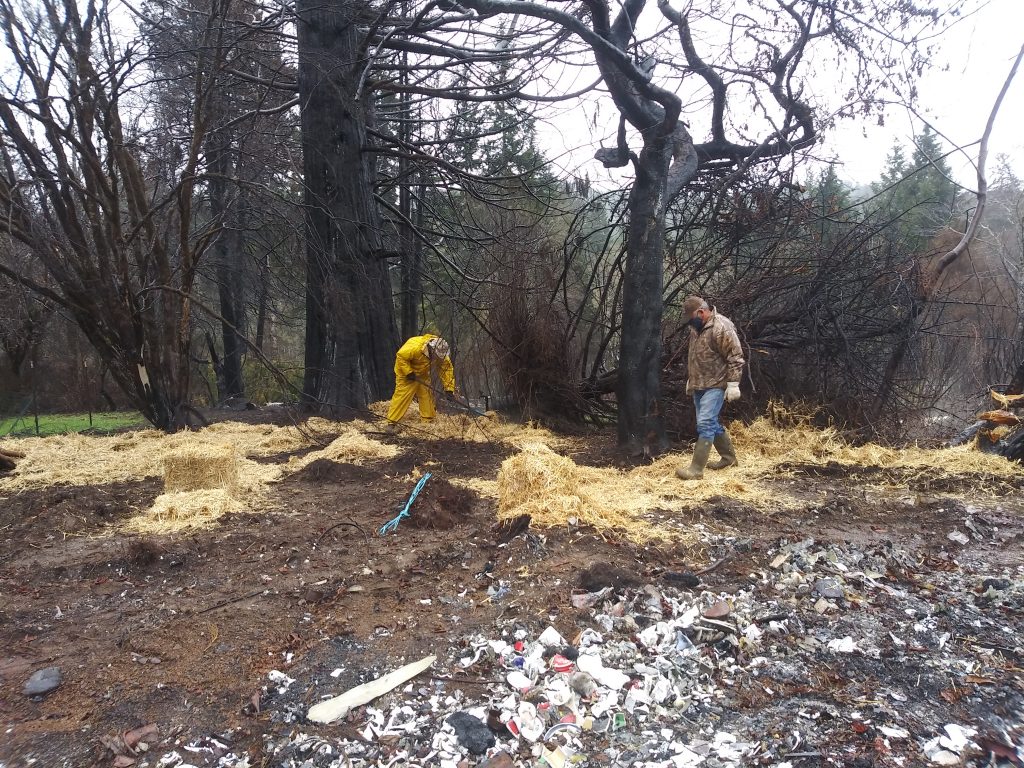
“There’s been a lot of restoration work done on the Salmon River,” Group organizer and Toledo City Councilor Betty Kamikawa say., “A lot of these properties are on creeks that feed that river…and we don’t want to have all that erosion happening while the fish are trying to spawn.”
Uniting by Boots on the Ground

That salmon and their watersheds may act as a unifying force of seemingly disparate groups may come as a surprise to some, but it is nothing shocking to Kamikawa. While she affirms her role as a city councilor in Toledo doesn’t have anything to do with organizing the volunteer event, it did play a part in initially bringing the group together.
350 Oregon Central Coast – an affiliate of the global climate organization called 350.org –had recently given a presentation during a Toledo City Council meeting about climate change and the benefits of potential carbon cap and trade policies for the state. Given that Toledo is “a very big Timber Unity area,” Kamikawa saw an opportunity to get the two groups together and talking.
“People don’t believe environmentalists and Timber Unity have anything in common,” she says, but “Timber Unity people, a lot of them, are stewards of the land; they are landowners, they’re farmers, they’re fishermen, and timber people—so they all have a connection to the land and to the environment.”
Following the Toledo City Council meeting, 350 and Timber Unity members agreed to collaborate on a focused project. After the Echo Mountain fire was put out, group members recognized they may be of service in the recovery process. The group connected with people from local government entities and special districts, learned how they could help once the hazardous waste in the area was cleared, and got permission from landowners to work on their properties. The Lincoln Soil and Water Conservation District put together site prescriptions for properties to help control erosion. Lincoln County fronted the costs for ordering 400 bales of straw and other supplies, to later be reimbursed through FEMA.
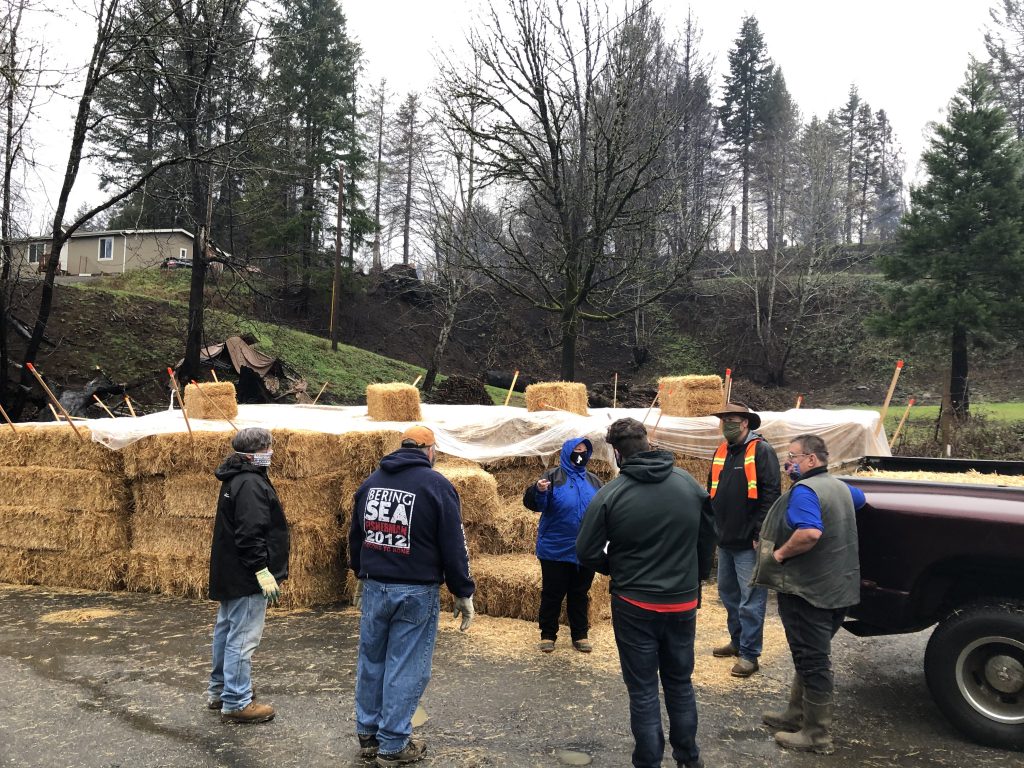
Kamikawa expressed pride that the group was able to work with so many different agencies, and that largely as volunteers, were perhaps able to get this work done faster than if it had been entirely left to various government bodies that have more red tape to contend with. In her eyes, the next steps for the area will be “getting native plants and trees available to people up there, and hopefully this spring do a planting restoration up there for people to help them get that back.”
Kamikawa’s optimism for landscape recovery is due in part to the lesser severity of the Echo Mountain fire than those constituents of the Big Five – Riverside, Beachie Creek, Lionshead, Holiday Farm and Archie Creek. However, the loss of homes and other structures shouldn’t be confused for being lessened here; driving through the neighborhoods of Otis it is shocking to see once familiar, charming country homes reduced to their hearths and foundations, warped metal laying haphazardly alongside them.
Yet, it is true that the remaining forest in the area doesn’t look quite as devastating—as moonscaped—as the photos Bladon had shared from the other fires for Part I of this series. Along much of the Salmon River’s riparian corridor, the trees and understory are as representative of the rich temperate rainforest here as they ever were. And farther out from the river in the fire’s path, many of the trees that burned are still standing. Kamikawa says, “yes, they’re burned, but some of them are still green.”
A Salmon Story
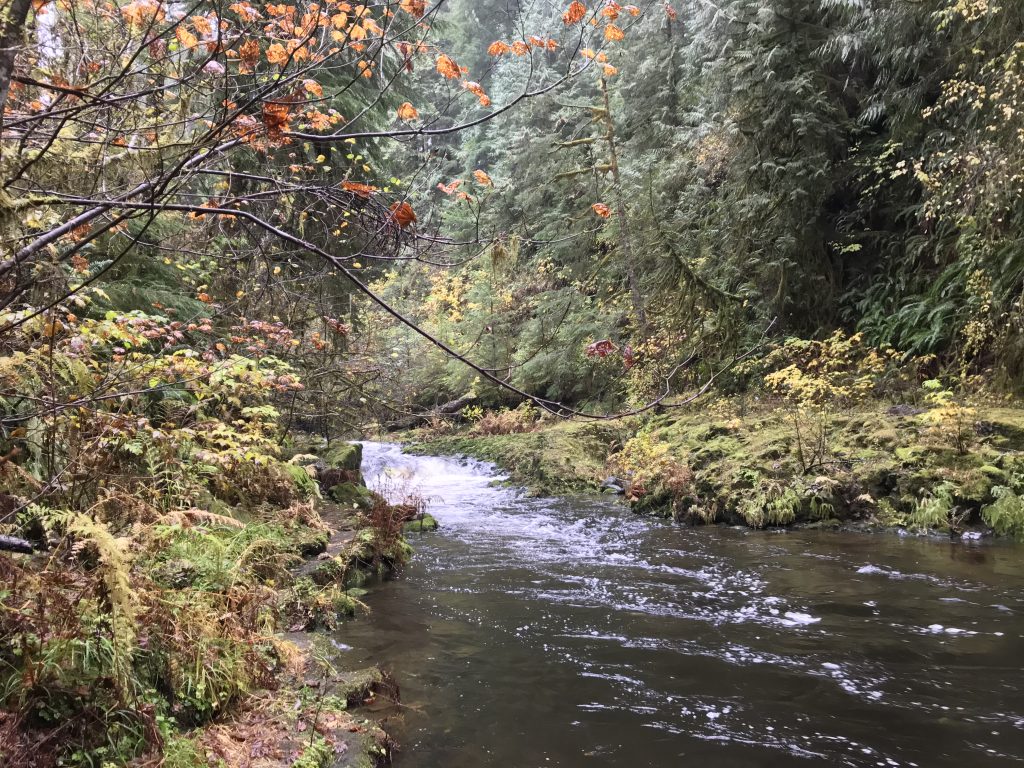
While the water flowing down the Salmon River isn’t exactly crystal clear when I visit the area, it’s not as turbid as I’ve seen it before following heavier rain events. I decide to head far upstream from where the fire burned to check in on some of the salmon spawning grounds.
On the drive east up Highway 18, what looks like the vehicles of recreational fishermen line the road in select areas, and sure enough, I see some people carrying poles, heading to or from the river. This far up, it’s like it could be any fall day, any year. There’s a guilty shard embedded in my rejoicing that not all has been lost, when for many, their worlds as they knew them have. And, as devastated as Oregon may be, other parts of the West are still burning in these last months of 2020. It is a strange thing driving with the state of the country, the state, this locality, and my personal experience all apparently at odds. Yet, it does not surprise me too much when a story older than time immemorial follows.
After pulling my car over in a turnaround along Highway 18, I walk down to the river above the fishing deadline for a closer look. It always takes ones’ eyes some time to adjust to seeing through dark water, especially when the surface is being obscured by rain drops as it is today. Eventually, differences in the cobble riverbed can be made out. Some of those rocks are lighter than others around them, and a mound is built up behind a depression. It is a redd, a salmon nest.
Indeed, eyes eventually find that two dark fishy forms hover over the redd. They occasionally rotate to their side and thwack at it with their tails, making it deeper, cleaner. Another fish is noticed among the pair, as they all dart in and out, swimming to and from apparently calmer waters to rest, then returning to their life’s work. One of the fish is so small it might be a Jack, a two-year-old adult male Chinook returning to spawn earlier than most do, so that it might “sneak” some of its genetic contribution into the mix of eggs and gravel while the larger Chinook is unaware.
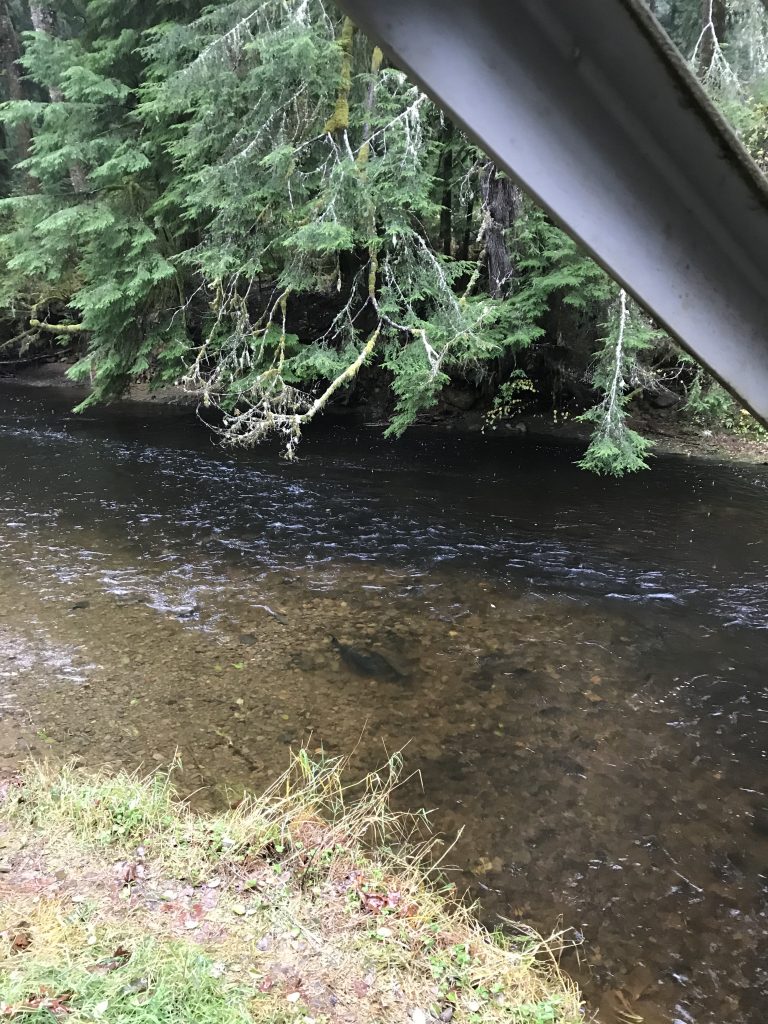
At one point, the largest and darkest of all the fish propels upstream, then suddenly makes a c-shaped turn to drift back towards the redd. Body still curved, a bright yellow leaf from a Bigleaf maple tree floats along its back, for a moment resting on that scaly surface, held there by the curvature. In a moment, the leaf will slide off and continue downstream past the fish, past the redd. The fish will straighten its body out, return to the redd as others leave it.
That this all happens is nothing significant in the grand scheme of things, yet it is absolutely transfixing in the moment. Humankind has faced a lot of loss in 2020. I hope we remember both what we lack and what we have left as we move into this new year.
After much of his home on the McKenzie River burned in the Holiday Farm Fire, writing from the late Barry Lopez was published on LitHub to introduce a book of photography called American Geography, just days before he passed away. He wrote: “I would ask you not to give in to the temptation to despair, not to retreat into cynicism or to settle into disaffection, but to recognize in these photographs the resilience, determination, and concern for the fate of humanity that these photographers possess.”
If you are interested in making a monetary or material contribution to support the needs of local communities impacted by September’s wildfires, consider donating to the following organizations:
By Ari Blatt
Recent Comments