


March 6th, 2020 by Michael Barnard
Blaring headlines about new solar panel chemistries are rife in the cleantech press, but they are moderately irrelevant. I’m not entirely innocent of this, of course, given my that one of the machine learning + cleantech articles I published recently was entitled Researchers In US & China Use Machine Learning To Make Better Solar Panels and dealt exactly with the chemistry combinations of solar panels. At least that had a useful hook and context, unlike the average article. Imagine ones entitled Perovskite Solar Cell Fever Reaches Fever Pitch or Super Secret Perovskite Solar Cell Company Bursts Out Of Stealth Mode. Or don’t, as those are actual titles of actual articles published recently.
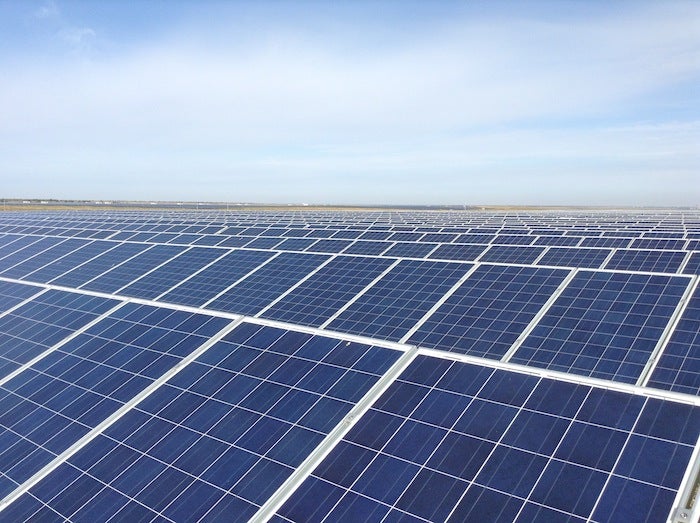
Photo by Zach Shahan | CleanTechnica
What is relevant? Global supply chains and policy that stimulates solar markets. That’s what has been the leading cause of decreases in solar panel prices since 2012 or so.
This was obvious years ago, of course. An old Quora answer of mine from early 2015 surfaced recently, What are some facts everyone should know about renewable energy? The things I thought were important then were the much faster growth than analysts such as the IEA were predicting, faster scaling of renewables than alternatives, the cheapness (the point of this article), easy grid integration, low need for storage any time soon, and the already disrupted legacy energy set. All of these points remain true today and it seems as if most people still don’t understand most of them.
What was a key factor I cited in 2015?
“The combination of massive parallelization and highly efficient manufacturing and supply chains means that China, for example, has built 27 GW of wind energy in two years, but is still struggling to get more than a GW of nuclear turned on in a year despite a much longer nuclear program than a wind program.”
That massive parallelization and highly efficient manufacturing is still something a lot of people can’t seem to get their heads around. And right now we’re going through a resurgence of anti-globalism sentiment that is just wrong-headed, even among people who should know better on the left hand side of the dial.
After all, globalism has increased life expectancy, reduced population growth, reduced global conflicts massively, increased global food supplies, reduced global poverty massively, is preventing COVID-19 from killing hundreds of millions of people, and is responsible for the Paris Accord and Kigali Amendment, two key international treaties that are combating global warming.
And globalism has dropped the price of solar panels massively. Not that you have to take my word for it. You can take the word of MIT PhDs Goksin Kavlak, James McNerney, and Jessika E. Trancik. They did a deep analysis of price drops on solar panels and published the excitingly named Evaluating the causes of cost reduction in photovoltaic modules in the journal Energy Policy a couple of years ago. I’ve referenced that journal before many times in pieces I’ve published. It’s a high-impact factor journal that publishes excellent and wonky studies on what works and what doesn’t in energy.
What are a couple of the major highlights of the study?
“Since 2001, increasing plant size enabled economies of scale to reduce costs.
Market-stimulating policies were responsible for a large share of PV’s cost decline.”
Yeah, boring title, no screaming about perovskite or the other chemistry of the day. Just manufacturing ramping up, global supply chains delivering massive numbers of panels, and markets being stimulated by government policy. No wonder we keep getting annoying, hyperbolic, and inane headlines in the cleantech press about new solar panel chemistries and the hydrogen economy.
Since 2012, technical improvements in solar cell chemistries have been dwarfed by economies of scale. And economies of scale in the 21st Century are global economies of scale, not local ones.
Psychologically, we’d all like to believe in magic bullets, just as we used to believe in our cultural variants of Santa Claus or the Tooth Krishna when we were 3 years old. Thankfully there are many people digging into the weeds of policy, manufacturing and distribution to make them as efficient as possible.
That’s what’s going to stop global warming. Globalism and a bunch of dry people doing very dry things with spreadsheets. Not a mad scientist in a lab.
So next time you see an article with a blaring headline about solar panel chemical breakthroughs or something like Renewable Hydrogen Will Drink The Fossil Fuel Milkshake or If You Can’t Do Nuclear, Try (Concentrating) Solar Power Instead, consider giving them a pass and reading about actually useful advances that are making a difference to the world.
 Follow CleanTechnica on Google News.
It will make you happy & help you live in peace for the rest of your life.


About the Author

Michael Barnard is Chief Strategist with TFIE Strategy Inc. He works with startups, existing businesses and investors to identify opportunities for significant bottom line growth and cost takeout in our rapidly transforming world. He is editor of The Future is Electric, a Medium publication. He regularly publishes analyses of low-carbon technology and policy in sites including Newsweek, Slate, Forbes, Huffington Post, Quartz, CleanTechnica and RenewEconomy, and his work is regularly included in textbooks. Third-party articles on his analyses and interviews have been published in dozens of news sites globally and have reached #1 on Reddit Science. Much of his work originates on Quora.com, where Mike has been a Top Writer annually since 2012. He’s available for consulting engagements, speaking engagements and Board positions.
Recent Comments