

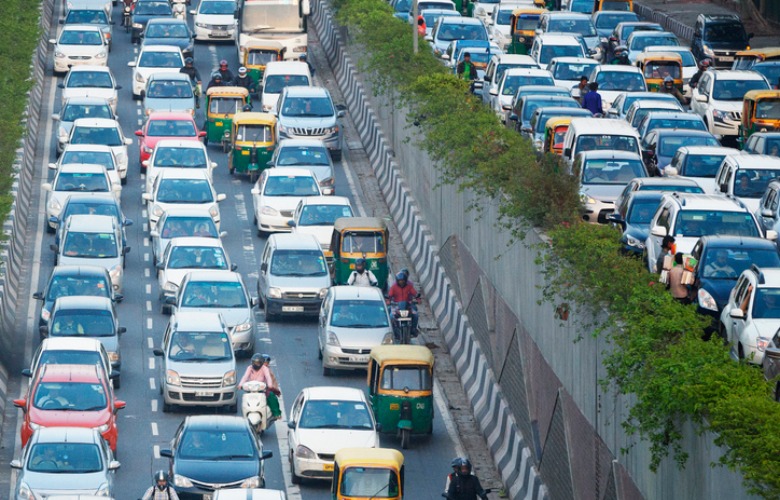

The automobile industry in India is going through one of its worst slowdowns in decades. The industry is struggling to manage its inventory with the approaching ban on the sale of existing BS IV vehicles from April 2020. There are many speculations on the causes of this slowdown, from preferences for electric vehicles, ambiguity in government signals to the industry and consumers to millennials preferring cabs to owning vehicles. However, with rising income levels, relatively lower private vehicle ownership, inadequate public transit and huge transportation costs as a share of income levels, India has a long way to go in automobile purchase and consumption. Hence, it cannot be concluded that preference for vehicle ownership has permanently come down.
The current consumer behaviour might be a result of framing effect under uncertainty widely discussed in the emerging field of behavioural economics. Nobel Laurette Daniel Kahneman has dedicated an entire chapter in his book “Thinking, Fast and Slow” discussing framing effects. These are situations where the economic rationality of individuals is side-lined by the framing of situations. There is strong literature from the field of psychology, behavioural economics and neuroeconomics backing this. The following is an example popularly known as the Asian disease problem, originally developed by Kahneman and Tversky in 1981.
Consider the set of options for two programs to tackle a disease outbreak which is expected to kill 600 people:
If Program A is adopted, it will save 200 lives
If Program B is adopted, there is 1/3 probability that 600 lives will be saved and 2/3rd probability that no people will be save.
Which program will you choose?
Now consider the following set of options:
If Program A is adopted, 400 lives will be lost.
If Program B is adopted, there is 1/3 probability that no life is lost and there is 2/3 probability that 600 lives are lost.
Which Program will you choose now?
Experiments revealed that most people chose Program A in the first case and Program B in the second case even though both the cases present the exact same options which are also equal to each other! The theory of framing effects says that human choices are remarkably susceptible to how the options are presented. More specifically, it has been proven that when the framing is positive, people may choose the sure outcome, and when the framing is negative, people may prefer the gamble. The positive and negative framing of the options is through the perspective of the consumer.
Such a preference reversal is due to framing effect where the decision maker opts for a sure option (is risk averse) when the outcomes are framed positively and opts for the gamble (is risk seeking) when the outcome is framed negatively. Hence, the response of a decision maker deviates from rational behaviour based on the framing of the outcomes. Now what relevance does this have with the auto slowdown? Let us consider the example of an automobile consumer planning on purchasing a two-wheeler. The consumer has to make a decision whether to buy the two-wheeler now or post March 31, 2020 (the cut-off date for registration of BS IV vehicles). The following is the current frame in the consumer’s mind:
Buy BS VI later, cause lesser pollution, face no consequence from regulator.
Buy BS IV now, cause more pollution, maybe face consequences from regulator later.
Consumer chooses the sure thing and decides to wait for BS VI vehicles. This frame of the options does not invoke the consumer to rationally assess the consequences of choosing a BS IV vehicle.
Now consider the following frame in the consumer’s mind:
Buy BS VI later, lose 7k, cause less pollution, face no consequence from the regulator.
Buy BS IV now, save 7k, cause more pollution, maybe face consequences from the regulator.
In this case the frame is negative as the consumer is aware about the monetary loss he or she will face by stalling the purchase. This nudges the consumer to think harder to measure the consequences of choosing BS IV vehicle. The two examples of options created here do not necessarily translate to positive and negative, but the option in which the consumer is made aware about the monetary loss is certainly a more negative representation of the decision frame. The deconstruction of this example may clarify how this matches with framing effects discussed by Kahneman and other scientists in the multi-disciplinary fields of psychology, neurology, and economics.
The theory of framing effects says that human choices are remarkably susceptible to how the options are presented. More specifically, it has been proven that when the framing is positive, people may choose the sure outcome, and when the framing is negative, people may prefer the gamble. In the example cited above, choosing to purchase a BS VI vehicle is a ‘sure’ outcome with no uncertainty and choosing BS IV is a ‘gamble’. The decision frame in the consumer’s mind is formed by communication from the government and the automobile Industry. Presently, the government in India has been communicating its preference for cleaner vehicles, with signals of subsidies, bans and taxes. The industry has been communicating in terms of discounts, assurances of no uncertainty for BS IV buyers etc. The present consumer can choose between the BS VI (sure option) and BS IV (Gamble) taking into the account the communications from the government and the industry.
Very few original equipment manufacturers (OEMs) have communicated BS VI vehicle prices yet. Let’s consider that this communication is made now, 3 months before the ban of BS IV. Now, the decision frame in the consumer’s mind has expanded to quantitatively include the monetary loss in choosing BS VI (sure outcome). This communication from the Industry would lead to a more negative framing of situations in the consumer’s mind. As the framing is more negative, the theory suggests that the consumer is more likely to choose the gamble (buy BS IV now) over the sure option (buy BS VI later).
According to the argument made in this article, all that the industry has to do to nudge users who are delaying their purchase in wait of BS VI vehicles is “release their BS VI prices now”. The industry has to highlight the monetary loss the consumer would face after the ban of BS IV in April 2020. The consumer’s options would appear more negative and the consumer is more likely to choose the gamble of purchasing BS IV versions. This will certainly aid manufacturers to clear their BS IV inventory before April without spending excessively on discounts to buyers.
DISCLAIMER: The views expressed are solely of the author and ETEnergyworld.com does not necessarily subscribe to it. ETEnergyworld.com shall not be responsible for any damage caused to any person/organisation directly or indirectly.
Recent Comments