


The following is the Nov. 25, 2019 Congressional Research Service report, Coast Guard Cutter Procurement: Background and Issues for Congress.
From the report
The Coast Guard’s program of record (POR) calls for procuring 8 National Security Cutters (NSCs), 25 Offshore Patrol Cutters (OPCs), and 58 Fast Response Cutters (FRCs) as replacements for 90 aging Coast Guard high-endurance cutters, medium-endurance cutters, and patrol craft. The Coast Guard’s proposed FY2020 budget requests a total of $657 million in procurement funding for the NSC, OPC, and FRC programs.
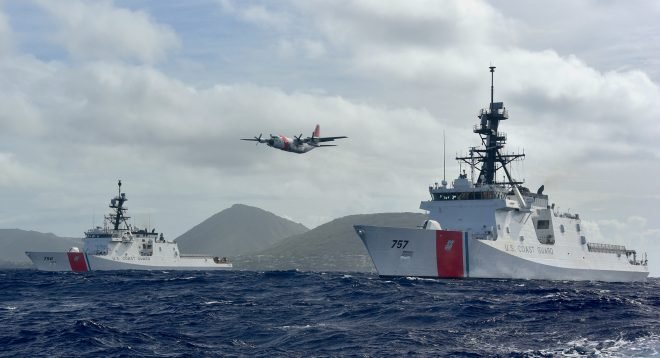
NSCs are the Coast Guard’s largest and most capable general-purpose cutters; they are intended to replace the Coast Guard’s 12 aged Hamilton-class high-endurance cutters. NSCs have an estimated average procurement cost of about $670 million per ship. Although the Coast Guard’s POR calls for procuring a total of 8 NSCs to replace the 12 Hamilton-class cutters, Congress through FY2019 has funded 11 NSCs, including the 10th and 11th in FY2018. Eight NSCs have entered service; the seventh and eighth were commissioned into service on August 24, 2019. The 9th through 11th are under construction; the 9th is scheduled for delivery in 2021. The Coast Guard’s proposed FY2020 budget requests $60 million in procurement funding for the NSC program; this request does not include funding for a 12th NSC.
OPCs are to be less expensive and in some respects less capable than NSCs; they are intended to replace the Coast Guard’s 29 aged medium-endurance cutters. Coast Guard officials describe the OPC program as the service’s top acquisition priority. OPCs have an estimated average procurement cost of about $421 million per ship. The first OPC was funded in FY2018. The second OPC and long lead time materials (LLTM) for the third were funded in FY2019. The Coast Guard’s proposed FY2020 budget requests $457 million in procurement funding for the third OPC, LLTM for the fourth and fifth, and other program costs. On September 15, 2016, following a competition among multiple shipyards, the Coast Guard awarded a contract with options for building up to nine OPCs to Eastern Shipbuilding Group (ESG) of Panama City, FL. Under this plan, the Coast Guard anticipated conducting, years from now, a follow-on competition for ships 10 through 25 in the program.
On October 11, 2019, the Department of Homeland Security (DHS), of which the Coast Guard is a part, announced that DHS had granted extraordinary contractual relief to ESG under P.L. 85-804 as amended (50 U.S.C. 1431-1435), a law that authorizes certain federal agencies to provide certain types of extraordinary relief to contractors who are encountering difficulties in the performance of federal contracts or subcontracts relating to national defense. ESG reportedly submitted a request for extraordinary relief on June 30, 2019, after ESG’s shipbuilding facilities were damaged by Hurricane Michael, a hurricane that passed through the Florida panhandle on October 10, 2018. The Coast Guard announced that the contractual relief is limited to the first four hulls in the OPC program. DHS stated that the Coast Guard reportedly will immediately transition to conducting a follow-on competition for subsequent in the OPC program. Under P.L. 85-804 as amended, Congress has 60 days of continuous session to review the announced contractual relief, with the 60-day period in this case starting October 11.
FRCs are considerably smaller and less expensive than OPCs; they are intended to replace the Coast Guard’s 49 aging Island-class patrol boats. FRCs have an estimated average procurement cost of about $58 million per boat. A total of 56 have been funded through FY2019, including 6 in FY2019. Four of the 56 are to be used by the Coast Guard in the Persian Gulf and are not counted against the Coast Guard’s 58-ship POR for the program, which relates to domestic operations. Excluding these 4 OPCs, a total of 52 FRCs for domestic operations have been funded through FY2019. The 35th FRC was commissioned into service on October 26, 2019. The Coast Guard’s proposed FY2020 budget requests $140 million in acquisition funding for the procurement of two more FRCs for domestic operations.
Download the document here.
Recent Comments