1. Introduction
Clostridioides difficile infection (CDI) is the leading cause of antibiotic associated gastrointestinal disease causing significant morbidity and mortality [
1
- Freeman J.
- Bauer M.P.
- Baines S.D.
- Corver J.
- Fawley W.N.
- Goorhuis B.
- et al.
The changing epidemiology of clostridium difficile infections.
]. Clinical response to antibiotic treatment of CDI is 80% in the primary episode [
2
- Wenisch C.
- Parschalk B.
- Hasenhündl M.
- Hirschl A.
- Graninger W.
Comparison of vancomycin, teicoplanin, metronidazole, and fusidic acid for the treatment of Clostridium difficile-associated diarrhea.
] and rapidly falls to only 30–40% in recurrent disease [
3
- McFarland L.V.
- Surawicz C.M.
- Rubin M.
- Fekety R.
- Elmer G.W.
- Greenberg R.N.
Recurrent Clostridium difficile disease: epidemiology and clinical characteristics.
]. Faecal Microbiota Transplant (FMT) is highly successful for the treatment of recurrent CDI with significantly improved efficacy rates compared to antibiotic therapy [
4
- van Nood E.
- Vrieze A.
- Nieuwdorp M.
- Fuentes S.
- Zoetendal E.G.
- de Vos W.M.
- et al.
Duodenal infusion of donor feces for recurrent Clostridium difficile.
,
5
- Hvas C.L.
- Dahl Jørgensen S.M.
- Jørgensen S.P.
- Storgaard M.
- Lemming L.
- Hansen M.M.
- et al.
Fecal microbiota transplantation is superior to fidaxomicin for treatment of recurrent clostridium difficile infection.
]. It has also been used for the treatment of severe CDI [
6
- Hocquart M.
- Lagier J.-C.
- Cassir N.
- Saidani N.
- Eldin C.
- Kerbaj J.
- et al.
Early fecal microbiota transplantation improves survival in severe clostridium difficile Infections.
]. The National Institute for Healthcare and Excellence recommend FMT for the treatment of recurrent CDI, in patients failing to respond to antibiotics and other treatments [
7
National Institute for Health and Care Excellence (NICE)
Faecal microbiota transplant for recurrent Clostridium difficile infection.
].
Prior to 2015, it was believed that FMT would fall under the Human Tissue (Quality and Safety for Human Application) Regulations 2007 and be regulated by the Human Tissue Authority (HTA). This perspective changed in England in 2015, when FMT was defined as a medicinal product under The Human Medicines Regulations 2012 [
8
Medicines and Healthcare products Regulatory Agency (MHRA). Faecal microbiota transplantation (FMT) MHRA’s position. 2015.
]. In the USA and Canada, FMT is considered a biologic drug, while in Europe, without a formal position from the European Medicines Agency, a mixture of regulatory frameworks exist [
9
- Terveer E.M.
- van Beurden Y.H.
- Goorhuis A.
- Seegers J.F.M.L.
- Bauer M.P.
- van Nood E.
- et al.
How to: fstablish and run a stool bank.
]. As a medicinal product under regulation by the Medicines and Healthcare products Regulatory Agency (MHRA), FMT can be prescribed and produced locally by a medical practitioner for a named patient under a pharmacy exemption. However production and supply to a third party, via a stool bank, requires a Specials licence.
A UK survey showed that only 28% (36/130) of hospitals reported using FMT for CDI. Barriers to uptake were a lack of facilities and understanding of how to establish FMT services [
10
- Quraishi M.N.
- Segal J.
- Mullish B.
- McCune V.L.
- Hawkey P.
- Colville A.
- et al.
National survey of practice of faecal microbiota transplantation for Clostridium difficile infection in the UK.
]. Both European and UK FMT guidelines for good clinical practice and standardisation have been published [
11
- Cammarota G.
- Ianiro G.
- Tilg H.
- Rajilić-Stojanović M.
- Kump P.
- Satokari R.
- et al.
European consensus conference on faecal microbiota transplantation in clinical practice.
,
12
- Mullish B.H.
- Quraishi M.N.
- Segal J.P.
- McCune V.L.
- Baxter M.
- Marsden G.L.
- et al.
The use of faecal microbiota transplant as treatment for recurrent or refractory Clostridium difficile infection and other potential indications: joint British Society of Gastroenterology (BSG) and Healthcare Infection Society (HIS) guidelines.
,
13
- Cammarota G.
- Ianiro G.
- Kelly C.R.
- Mullish B.H.
- Allegretti J.R.
- Kassam Z.
- et al.
International consensus conference on stool banking for faecal microbiota transplantation in clinical practice.
], and there have been commentaries describing the practical and logistical requirements for stool bank operation [
9
- Terveer E.M.
- van Beurden Y.H.
- Goorhuis A.
- Seegers J.F.M.L.
- Bauer M.P.
- van Nood E.
- et al.
How to: fstablish and run a stool bank.
,
14
- Costello S.P.
- Tucker E.C.
- Brooy J.La
- Schoeman M.N.
- Andrews J.M.
Establishing a Fecal Microbiota Transplant Service for the Treatment of Clostridium difficile Infection.
], however there is little guidance regarding the specific methodology compliant with the production of a safe and quality assured medicinal product.
We have worked with the HTA and then the MRHA to create a licenced FMT service, using a banked supply of FMT for the treatment of CDI within the National Health Service (NHS). We present outcome data for the first 124 patients treated under HTA approval and present the methodology framework which supported MHRA licencing. Our licenced service is currently supplying FMT to the population of England free of charge under an NHS innovation tariff. The production framework presented will be of value to practitioners in other countries wanting to establish a regulated service for the treatment of CDI and other conditions.
4. Discussion
This is the largest UK series presenting FMT outcome data for the treatment of CDI and the first of methodology which meets the requirements of a MHRA specials licence. In our uncontrolled retrospective case series, we found using a single FMT protocol clinical response at day 7 (83·9% [95% CI 76·0%–90·0%]) and response without recurrence at 90 days (78·2% [95% CI 67·4%–89·0%]) was broadly similar to that observed previously [
4
- van Nood E.
- Vrieze A.
- Nieuwdorp M.
- Fuentes S.
- Zoetendal E.G.
- de Vos W.M.
- et al.
Duodenal infusion of donor feces for recurrent Clostridium difficile.
,
19
- Ianiro G.
- Maida M.
- Burisch J.
- Simonelli C.
- Hold G.
- Ventimiglia M.
- et al.
Efficacy of different faecal microbiota transplantation protocols for Clostridium difficile infection: a systematic review and meta-analysis.
,
20
- Tariq R.
- Pardi D.S.
- Bartlett M.G.
- Khanna S.
Low cure rates in controlled trials of fecal microbiota transplantation for recurrent clostridium difficile infection: a systematic review and meta-analysis.
]. Administration in our cohort was predominantly via the upper gastrointestinal (GI) route, however one patient received FMT by colonoscopy. A specific administration procedure was available to clinicians, but protocol deviation may have occurred in this real world setting, possibly introducing centre specific bias. Meta-analysis comparing FMT administration routes, have observed a trend toward higher efficacy rates with lower GI compared to upper GI administration, but this often does not reach statistical significance [
19
- Ianiro G.
- Maida M.
- Burisch J.
- Simonelli C.
- Hold G.
- Ventimiglia M.
- et al.
Efficacy of different faecal microbiota transplantation protocols for Clostridium difficile infection: a systematic review and meta-analysis.
,
20
- Tariq R.
- Pardi D.S.
- Bartlett M.G.
- Khanna S.
Low cure rates in controlled trials of fecal microbiota transplantation for recurrent clostridium difficile infection: a systematic review and meta-analysis.
]. The low numbers of lower GI administration precluded analysis here. This series included both fresh FMT and frozen FMT, reflecting the development of the service over time. Similarly to that previously reported [
19
- Ianiro G.
- Maida M.
- Burisch J.
- Simonelli C.
- Hold G.
- Ventimiglia M.
- et al.
Efficacy of different faecal microbiota transplantation protocols for Clostridium difficile infection: a systematic review and meta-analysis.
,
21
- Lee C.H.
- Steiner T.
- Petrof E.O.
- Smieja M.
- Roscoe D.
- Nematallah A.
- et al.
Frozen vs fresh fecal microbiota transplantation and clinical resolution of diarrhea in patients with recurrent Clostridium difficile infection.
], we observed no significant difference in FMT outcome between these groups, although the study was not powered to assess such differences and fresh FMT comprised only 25% of cases (31/124). Frozen supply was found to be advantageous over fresh FMT on the basis of logistics, turnaround time and minimising the donor screening window, factors which have also been highlighted by others [
9
- Terveer E.M.
- van Beurden Y.H.
- Goorhuis A.
- Seegers J.F.M.L.
- Bauer M.P.
- van Nood E.
- et al.
How to: fstablish and run a stool bank.
,
21
- Lee C.H.
- Steiner T.
- Petrof E.O.
- Smieja M.
- Roscoe D.
- Nematallah A.
- et al.
Frozen vs fresh fecal microbiota transplantation and clinical resolution of diarrhea in patients with recurrent Clostridium difficile infection.
].
The indication for FMT was recurrent CDI in 57% of cases; the remainder were defined as refractory cases. While other studies have included refractory cases [
21
- Lee C.H.
- Steiner T.
- Petrof E.O.
- Smieja M.
- Roscoe D.
- Nematallah A.
- et al.
Frozen vs fresh fecal microbiota transplantation and clinical resolution of diarrhea in patients with recurrent Clostridium difficile infection.
,
22
- Bang B.W.
- Park J.-S.
- Kim H.K.
- Shin Y.W.
- Kwon K.S.
- Kwon H.Y.
- et al.
Fecal microbiota transplantation for refractory and recurrent clostridium difficile infection: a case series of nine patients.
,
23
- Youngster I.
- Russell G.H.
- Pindar C.
- Ziv-Baran T.
- Sauk J.
- Hohmann E.L.
Oral, capsulized, frozen fecal microbiota transplantation for relapsing Clostridium difficile infection.
], the overall numbers are small and this report presents one of the largest refractory case series to date, particularly in the primary and secondary episode of infection. The use of FMT in refractory CDI is complicated by the absence of accepted standard definitions. In some published studies recurrent and refractory are used interchangeably or poorly defined [
22
- Bang B.W.
- Park J.-S.
- Kim H.K.
- Shin Y.W.
- Kwon K.S.
- Kwon H.Y.
- et al.
Fecal microbiota transplantation for refractory and recurrent clostridium difficile infection: a case series of nine patients.
,
24
- Bamba S.
- Nishida A.
- Imaeda H.
- Inatomi O.
- Sasaki M.
- Sugimoto M.
- et al.
Successful treatment by fecal microbiota transplantation for Japanese patients with refractory Clostridium difficile infection: a prospective case series.
,
25
Treatment of refractory/recurrent C. difficile-associated disease by donated stool transplanted via colonoscopy.
]. It has been defined as CDI not responding to conventional therapy without specific symptom duration thresholds [
26
- van Beurden Y.H.
- Nieuwdorp M.
- van de Berg P.J.E.J.
- Mulder C.J.J.
- Goorhuis A.
Current challenges in the treatment of severe Clostridium difficile infection: early treatment potential of fecal microbiota transplantation.
]. Others have defined it as ongoing diarrhoea despite at least five days of oral vancomycin 125 mg given six hourly [
27
- Lee C.H.
- Belanger J.E.
- Kassam Z.
- Smieja M.
- Higgins D.
- Broukhanski G.
- et al.
The outcome and long-term follow-up of 94 patients with recurrent and refractory Clostridium difficile infection using single to multiple fecal microbiota transplantation via retention enema.
]. In this series the clinical response to FMT, measured at day seven, was higher in recurrent CDI compared to refractory cases (91·0% vs. 73·0%, p = 0·007), however at day 90 no difference was observed in outcome between these groups. A recent meta-analysis found lower cure rates in studies which included both recurrent and refractory patients, compared to studies including only recurrent cases (weighted pooled rate 63.9% vs. 79%; P
19
- Ianiro G.
- Maida M.
- Burisch J.
- Simonelli C.
- Hold G.
- Ventimiglia M.
- et al.
Efficacy of different faecal microbiota transplantation protocols for Clostridium difficile infection: a systematic review and meta-analysis.
], particularly in complicated or refractory cases [
28
- Weingarden A.R.
- Hamilton M.J.
- Sadowsky M.J.
- Khoruts A.
Resolution of severe Clostridium difficile infection following sequential fecal microbiota transplantation.
].
Only microbiologically confirmed and clinically symptomatic patients were offered FMT, this approach aimed to avoid using FMT in asymptomatic C. difficile carriers. Those who were negative for C. difficile toxin in stool by EIA but positive for toxigenic C. difficile by PCR may have been more likely to have alternative reasons for ongoing diarrhoea, which could have limited our findings; however these patients were being treated clinically as CDI cases at the time of request for FMT. By definition the refractory group had failed to respond to antibiotics for CDI, which may increase the possibility of other contributing causes of diarrhoea in these cases, particularly as the incidence of resistance to vancomycin and fidaxomicin in C. difficile is thought to be low.
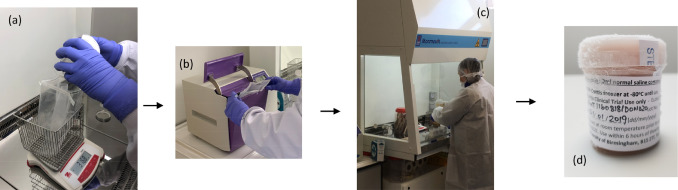
Under MHRA regulation in England FMT stool banks are now required to satisfy detailed manufacture requirements which adds complexity and cost of production. Within a Specials licence FMT can only be released for use by the Qualified Person when specified donor screening, production and storage criteria are satisfied. Integration of the service into a Quality Management System (QMS) is critical to successful operation of a licenced FMT facility. The QMS ensures that core components of the service are delivered consistently with appropriate quality assurance activity. It necessitates audit, risk management, thorough facilities management, quality improvement via the investigation of non-conformance, training and competence assessment of personnel, and document control. The minimisation of microbial contamination is a key component of GMP compliant FMT production. We have developed a closed fully disposable system for the preparation of FMT in a class two microbiological safety which minimises the risk of external microbial contamination. Other published methodologies have used external filtering systems and blenders, which may fail to minimise the risk of potential contamination [
11
- Cammarota G.
- Ianiro G.
- Tilg H.
- Rajilić-Stojanović M.
- Kump P.
- Satokari R.
- et al.
European consensus conference on faecal microbiota transplantation in clinical practice.
,
14
- Costello S.P.
- Tucker E.C.
- Brooy J.La
- Schoeman M.N.
- Andrews J.M.
Establishing a Fecal Microbiota Transplant Service for the Treatment of Clostridium difficile Infection.
]. Further to this FMT production is conducted in a dedicated clean non-sterile manufacturing room, which environmental monitoring has shown complies with grade D clean room recommended limits. This level of environmental review has not previously been commented on in international guidelines and is an evolving area for consideration. Control measures utilised to minimise the environmental contamination of the production facility are validated decontamination protocols, physical barriers (Tack-mats), limited personal access, the use of personal protective equipment (laboratory coats, hair nets and overshoes), and limiting material in the facility which supports microbial growth. The aim of the above GMP processes is to standardise and maintain the quality of FMT production as far as practically possible. However, the inherent variability in composition of human faeces between donors and within the same donor over time prevents true consistency and reproducibility control across FMT batches, as would be expected for the production of a drug-based medicinal product. In addition there is currently an absence of accepted profiling standards to quality assure donated faeces. Although it has been shown that higher bacterial diversity in donor faeces is associated with improved FMT clinical outcomes, the precise mechanisms of action of FMT are not fully understood, which limits the adoption of quality assurance testing during production. The selection of infectious agents screened for during FMT donor assessment varies between institutions [
29
- Woodworth M.H.
- Nolsh E.M.
- Miller N.S.
- Dhere T.
- Burd E.M.
- Carpentieri C.
- et al.
Laboratory testing of donors and transplantation for recurrent clostridium.
] and until recently has not been expressly specified by regulating agencies, particularly those regulating FMT as a biological drug. However, a general consensus is emerging with the publication of guidelines for FMT production and use [
11
- Cammarota G.
- Ianiro G.
- Tilg H.
- Rajilić-Stojanović M.
- Kump P.
- Satokari R.
- et al.
European consensus conference on faecal microbiota transplantation in clinical practice.
,
12
- Mullish B.H.
- Quraishi M.N.
- Segal J.P.
- McCune V.L.
- Baxter M.
- Marsden G.L.
- et al.
The use of faecal microbiota transplant as treatment for recurrent or refractory Clostridium difficile infection and other potential indications: joint British Society of Gastroenterology (BSG) and Healthcare Infection Society (HIS) guidelines.
]. These guidelines recommend screening for multidrug resistant organisms (MDRO), in particular those producing Extended Spectrum β-lactamases (ESBL) and Carbapenemase producing Enterobacteriaceae (CPE), although other centre’s protocols do not always specify MDRO screening [
29
- Woodworth M.H.
- Nolsh E.M.
- Miller N.S.
- Dhere T.
- Burd E.M.
- Carpentieri C.
- et al.
Laboratory testing of donors and transplantation for recurrent clostridium.
]. This topic has become relevant with the recent Food and Drug Administration (FDA) safety alert reporting two immunocompromised patients transplanted from the same donor who became colonised from the FMT with ESBL producing E. coli, with the death of one patient [
30
- DeFilipp Z.
- Bloom P.P.
- Torres Soto M.
- Mansour M.K.
- Sater M.R.A.
- Huntley M.H.
- et al.
Drug-resistant E. coli bacteremia transmitted by fecal microbiota transplant.
]. The FDA has mandated all holders of Investigational New Drug applications for FMT to not only test for ESBL and CPE, but also methicillin resistant Staphylococcus aureus (MRSA) and vancomycin resistant Enterococci (VRE). The diagnostic methods used to screen for MDROs and other pathogens should be validated and demonstrate acceptable sensitivity and specificity, to ensure the accuracy of donor testing. Although many guidelines specify the pathogens to screen for during donor selection, they often do not address which testing methodology to use. To maintain the quality of results, donor testing should be undertaken by accredited diagnostic laboratories following standard methods, such as those described in the UK Standards for Microbiological Investigation. In our own service, the donor screening algorithm continues to develop dynamically. For example to improve the diagnostic sensitivity of testing for enteric pathogens, culture methods will be replaced with Polymerase Chain Reaction (PCR) based tests. This will also enable the detection of pathogens not previously screened for such as all Shiga toxin producing E. coli (STEC) and rotavirus. The repertoire of screening tests for FMT to be given to immunocompromised patients has been discussed [
9
- Terveer E.M.
- van Beurden Y.H.
- Goorhuis A.
- Seegers J.F.M.L.
- Bauer M.P.
- van Nood E.
- et al.
How to: fstablish and run a stool bank.
,
12
- Mullish B.H.
- Quraishi M.N.
- Segal J.P.
- McCune V.L.
- Baxter M.
- Marsden G.L.
- et al.
The use of faecal microbiota transplant as treatment for recurrent or refractory Clostridium difficile infection and other potential indications: joint British Society of Gastroenterology (BSG) and Healthcare Infection Society (HIS) guidelines.
]. The groups concluded that caution should be exercised and the use of Cytomegalovirus (CMV) and Epstein-Barr Virus (EBV) negative donors should be considered for seronegative recipients, the role of other potential pathogens being considered on a case by case basis. This is an evolving area with a need for research, particularly with the potential use of FMT in patients post bone marrow transplantation.
Prior to the re-classification of FMT as a medicine in the UK, stool banks were being developed to widen FMT supply locally and regionally [
31
- Bicknell K.
- Fogg C.
- Fowell A.
- Porter R.
- Bannister O.
- Flatt A.
OC-014 a regional frozen faecal transplant service for the treatment of chronic recurrent clostridium difficile infection: a review.
,
32
- Quraishi M.N.
- McCune V.L.
- Iqbal T.
- Pathmakanthan S.
- Struthers J.K.
- Moran E.
- et al.
Faecal microbiota transplantation via nasogastric route for the treatment of recurrent and antibiotic refractory clostridum difficile infection: the UK experience.
]. Since the introduction of the revised regulatory position, FMT availability has been limited to intra-institution supply only. The systems described here now enable frozen FMT supply across institutions within a Specials licence, the first service of its kind in the UK. It is notable that encapsulation methods had been described for FMT administration and shown to be non-inferior to liquid FMT delivered via colonoscopy for the treatment of recurrent CDI [
33
- Kao D.
- Roach B.
- Silva M.
- Beck P.
- Rioux K.
- Kaplan G.G.
- et al.
Effect of oral capsule- vs colonoscopy-delivered fecal microbiota transplantation on recurrent clostridium difficile infection: a randomized clinical trial.
]. The procedures and control measures that have been described here could be applicable to FMT banks preparing liquid or encapsulated FMT to medical product standards in other parts of the world.
Access to pre-screened FMT via larger centres is desired by clinicians in the UK, particularly as many perceive that lack of facilities restrict local production [
10
- Quraishi M.N.
- Segal J.
- Mullish B.
- McCune V.L.
- Hawkey P.
- Colville A.
- et al.
National survey of practice of faecal microbiota transplantation for Clostridium difficile infection in the UK.
]. A move towards FMT stool banks, where FMT is produced to GMP standards under a Specials licence will reduce costs through economy of scale and promote standardisation, safety and quality [
9
- Terveer E.M.
- van Beurden Y.H.
- Goorhuis A.
- Seegers J.F.M.L.
- Bauer M.P.
- van Nood E.
- et al.
How to: fstablish and run a stool bank.
,
11
- Cammarota G.
- Ianiro G.
- Tilg H.
- Rajilić-Stojanović M.
- Kump P.
- Satokari R.
- et al.
European consensus conference on faecal microbiota transplantation in clinical practice.
]. This approach will also widen access of treatment and reduce inequity of access in the NHS. However, to ensure the resilience of FMT services in the NHS steps need to be taken to develop a networked hub and spoke model of supply under appropriate licencing. Careful management of such a network would enable efficient use of resources across the NHS, while maintaining flexible and adaptable access to this life saving treatment. This will require further engagement with the MHRA to develop this unique regulatory framework appropriately.
Author contributionsVM, PH and MQ had full access to all of the study data and take full responsibility for data analysis. VM and PH were responsible for drafting the manuscript. MQ completed the statistical analysis. VM, SM, PH, TI, and CM planned and delivered the FMT service. CM, TI, MQ, DM, KB, GT and HS oversaw the clinical management of patients. VM, SM, DM, KB, GT, TI, MQ and HS contributed to the data collection. All authors critically revised the manuscript.



Recent Comments