


An increasing need for supply chain redundancy, faster time to market, and underused retail assets … [+]
Getty, Sanford Stein
Retail supply chains and supply chain redundancy, or lack there-of, have been under the microscope during the current pandemic. I suspect retailers, distributors and even manufacturers will be spending considerable time on the subject once we’ve gotten through the worst of the virus outbreak. Not only did demand outstrip supply in many areas across the supply chain, but in many cases a plan B was not immediately obvious.
Reasons for this are complex, and not easily remedied. They’ve been exacerbated by global politics, tariffs, and even the lack of competition in many categories. Limited access to capital, and ever-tightening margins, have led to a washout of many small and mid-sized players across all manufacturing and distribution channels. At the same time, survivors are under pressure from skyrocketing materials, shipping and labor costs. Further complicating matters are the effects of climate change that are creating once in a hundred-year calamities, nearly yearly.
Feeding an Over-populated Planet
There are other forces creating new demands on our increasingly challenged food supply. Among them, advocacy around supply chain transparency, the broad-based demands for natural, organic, and non-GMO containing products, as well as the farm-to-table movement.
A study published in the journal Bioscience suggests that food production on the planet will need to increase between 25-70% by 2050, because of population growth. At the same time over 80% of suitable, arable land is already being used. The United Nation’s Food and Agriculture Organization (FAO) tells us that a third of food produced, about a trillion dollars-worth, is lost or wasted each year. While I’m no expert, I suspect a considerable amount of the waste may take place between harvest and table. This is also where significant food costs are incurred.
Solving Complementary Problems
I was recently reading a fascinating article on vertical farming carried on by enterprising Malaysian farmers, and I had an aha moment. Vertical farming is often talked about when it comes to food sustainability. It involves growing vegetables, herbs, even fruit in highly controlled environments, where light, humidity, temperature, air, even wind are controlled and monitored. The advantages of these hydroponic, aeroponic, or hybrid systems are substantial. Besides being highly efficient, it reduces water consumption (which we are running out of) by 70% or more. Additionally, it eliminates the need for pesticides or herbicides, which are making both us and the planet sick.
Without getting way into the weeds on the subject, one of Malaysia’s CityFarm sites, in Kuching China, manages to grow 12,000 plants in 5,000 square feet, stacked 5 layers high. This is accomplished in a space that appears to be no taller than eight feet.
Repurposing Mall Assets
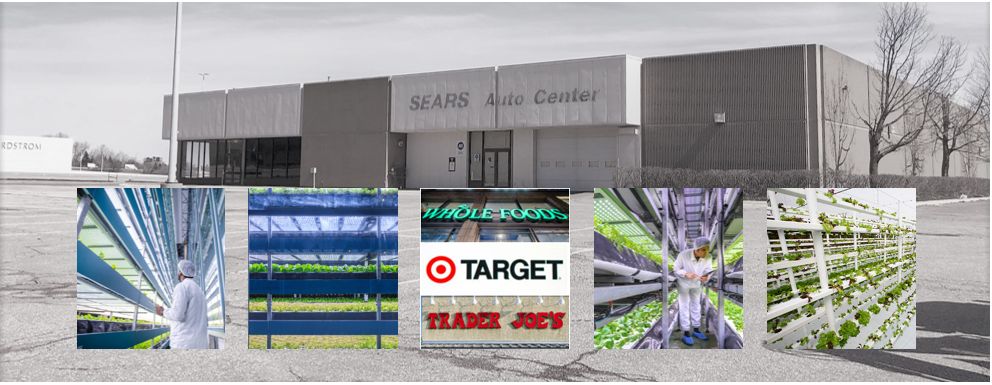
While I was preparing my last Forbes.com post, entitled “After the Pandemic: New Values, Habits, And a Retail Reset”, I was wandering the perimeter of our closest regional mall, Ridgedale Center, which is just minutes from my home in suburban Minneapolis. Besides the J.C. Penney, that graced the masthead of that article (sans vehicles, due to the virus), the mall remains tethered to a vacant Sears, and its Sears Auto Center outbuilding. The latter I estimate to be approx. 30,000 square feet.
Also, within a stone’s throw of the mall (with a particularly good arm) lies a Whole Foods, a Target, a Trader Joe’s, and one of the area’s premium grocers, Lunds & Byerlys. Given that we have a combination of underutilized asset capacity in one area, and an inability to sustainably meet demands in another, I thought there may well be a complementary solution, in plain sight.
Why not take the unoccupied Sears Auto Center building, gut it, and build out a Malaysian-like vertical farm, just yards away from four major grocers that depend on a constant supply of fresh fruits and vegetables? And in this case, they not only would be sustainably grown, but the distance from seed to market can be measured in yards, rather than hundreds of miles.
The capacity of the auto center building, at six-time the footprint and twice the height of the Kuching China site, would provide room to grow about 144,000 plants in a growing cycle. And while the start-up cost is not insignificant, the savings in transportation, waste elimination, reduced handling and time to market would be astronomical. And I’m not even factoring the carbon-offsets from cutting thousands of miles of transportation.
Localizing the Supply Chain and Reimagining the Malls
Localizing the production of goods wherever possible, is one way of introducing supply chain redundancy as well as a key component of cutting carbon emissions. And in this particular case, it also contributes to the complex process of reimagining the shopping malls (not eliminating them). We know that one side-effect of unified commerce and the rapid growth of online selling is that the mall is no longer an efficient place for product storage and distribution; rather it is becoming a place of previously unimaginable experiences, goods and services. Monetization will happen in unique and very different ways; and, that was true before the pandemic, but is stunningly more apparent now.
It seems like a one-off “repurposing” of a mall asset such as I’m imagining, would be well worth testing, perhaps by a consortium of grocery retailer’s mentioned. Certainly, the circumstances at the mall in question are repeated throughout the country. Ultimately, such an undertaking wouldn’t amount to an annual expense rounding error – at least for a one of the retailers in particular.
Recent Comments