


Editor’s note: This is part of a series about ongoing risks and evolving labor issues in the recycling industry. Click here for details about persistent safety hazards and how MRF operators are responding. Click here to learn about the firsthand experiences of California workers and the complex medical claim process they face.
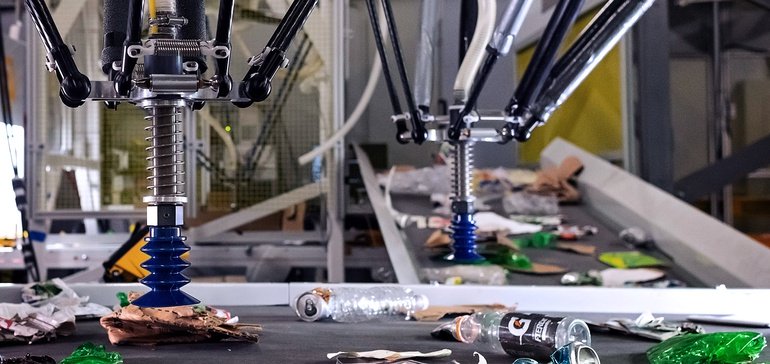
In MRFs across the U.S., dozens of arms hover over conveyors and appear to be in nearly constant motion sorting incoming materials. Previously, those arms exclusively were attached to humans. Now, a shift is occurring. Increasingly, more of those are arms attached to robots that use pincers or suction cups, instead of fingers, and move much faster.
Advanced MRF automation and robotics weren’t widely adopted concepts up until about five years ago, according to equipment manufacturers. A large proportion of this technology only went live within the past two years. But growth within the automated equipment sector is taking off in a large part because of labor shortages for sorters, as well as more MRF operators becoming familiar with the technology and exploring the benefits of adding it to their system.
“As people start to … see the robots for our existing MRF clients get better, I think that becomes more convincing. We’re seeing more and more of them take the plunge,” AMP Robotics CEO Matanya Horowitz told Waste Dive.
The global advanced recycling technology and robotics field is becoming more crowded. Some of the leading manufacturers showcasing robotic offerings in the North American market include AMP Robotics, Bulk Handling Systems, Machinex, Waste Robotics and ZenRobotics.
The terms “automation” and “robotics” prove rather nebulous for recycling industry participants who use them interchangeably. Some refer to advanced ballistic separators and optical sorters as automation, whereas others believe automation only refers to full-fledged sorting robots. “Robotics” is sometimes also synonymous with “robots,” while at other times the term covers a wider technological space.
One rule that holds true universally is “automation” and “robotics” involve mechanizing a manual process. What this really means for MRFs is machinery that can identify and sort different materials from incoming streams, often more efficiently than humans.
Performance upgrades
Incorporating robots into industrial settings is not a new concept — car manufacturers, for example, have been using them for decades — but their use in the recycling industry is different. One reason for the holdback has been designing equipment tough enough to withstand a beating in harsh recycling environments. Another factor is the expansive nature of the material stream.
“The problem in our industry is you can have anything and everything on a conveyor belt. The machine is identifying dozens and dozens and dozens of types of material. What’s allowed us to apply robots to the waste and recycling space is artificial intelligence for identifying materials,” Peter Raschio, marketing manager for Bulk Handling Systems (BHS), told Waste Dive.
Artificial intelligence and machine learning are the core pieces of technology underlying the modern MRF automation movement. Unlike other industrial robots that are simply programmed to do repetitive tasks, according to Raschio and others interviewed, sorting robots use AI-enabled “visioning” to sharpen their performance.
Many traditional MRFs rely on negative sorting processes, but advanced robotics often are configured for positive sorting — extracting the valuable, recyclable fraction instead of removing the contamination from the stream. Users indicate this produces a cleaner commodity stream.
Optical sorters and identification systems have grown more sophisticated from early versions. The most advanced systems employ “vision” that gathers material data with high-resolution or 3D cameras. The cameras recognize different material colors, shapes, sizes and textures to correctly identify items. Using so many characteristics eliminates the challenges with previous machines, such as screens displaying flat, black-and-white, unclear images or infrared systems’ difficulty with picking out black plastics.
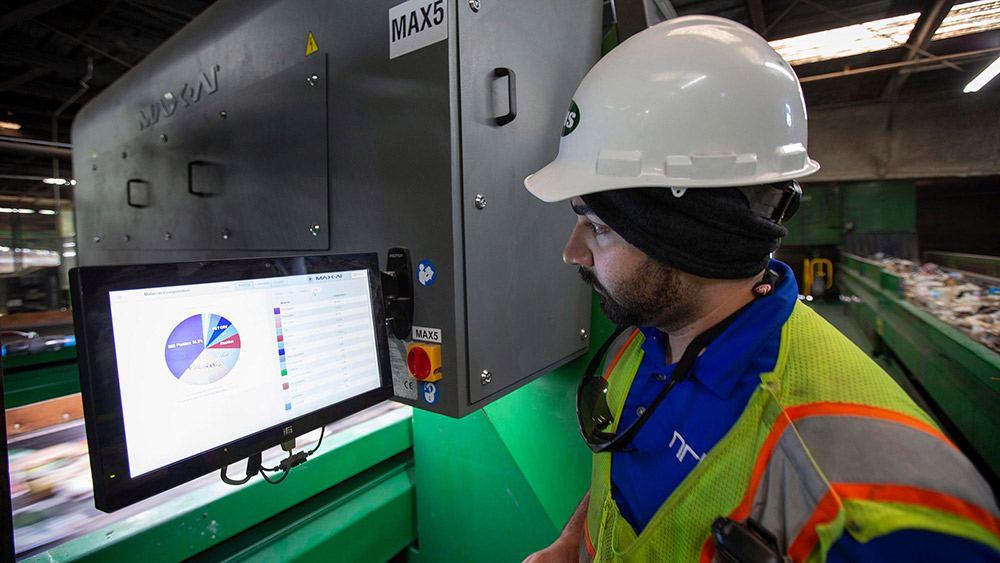
Much modern sorting equipment incorporates numerous sensors along with the cameras, and data gathered from the devices is analyzed to increase efficiencies along the line. Automated sorters can identify individual pieces of material and monitor how they flow through the system. They compare new and historical data, as well as data from different pieces of equipment. Some suppliers report putting users’ anonymized data into their database for further analysis, allowing customers to learn how their streams compare to greater trends throughout the industry.
“The interesting thing about the automation is … the machines are actually talking to each other about what they’re seeing. They’re constantly doing audits on what’s coming through certain parts of the system. If certain (materials) aren’t supposed to be there, that part talks to something else in a control room that says essentially, ‘Hey, we’ve got a problem,’” Brent Bell, Waste Management’s vice president of recycling, told Waste Dive.
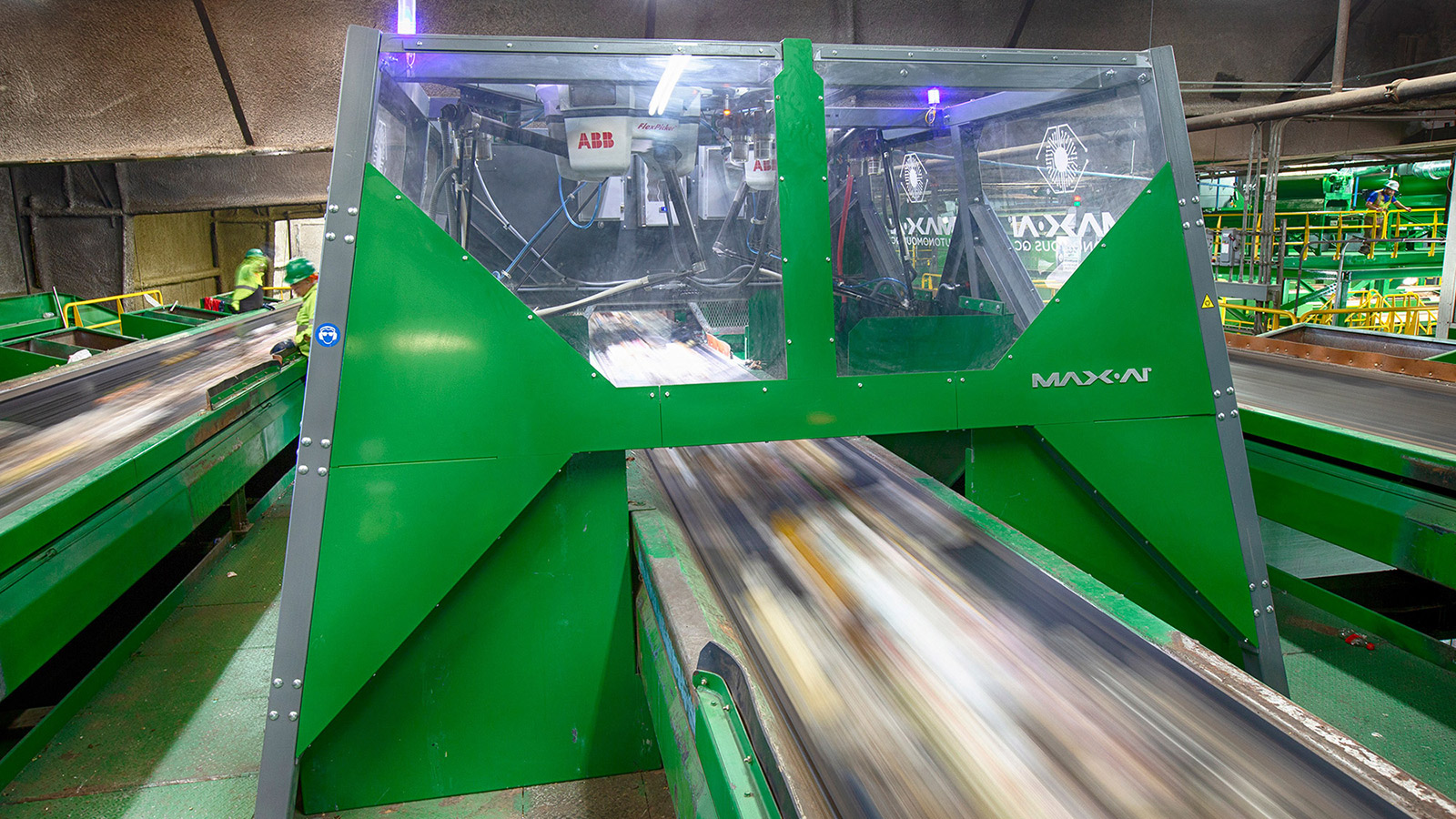
BHS
Robots typically are not viewed as a replacement for optical sorters, but rather a supplement that can work collaboratively to achieve a higher-quality output. They often are placed on a line after optical sorters to serve as quality control.
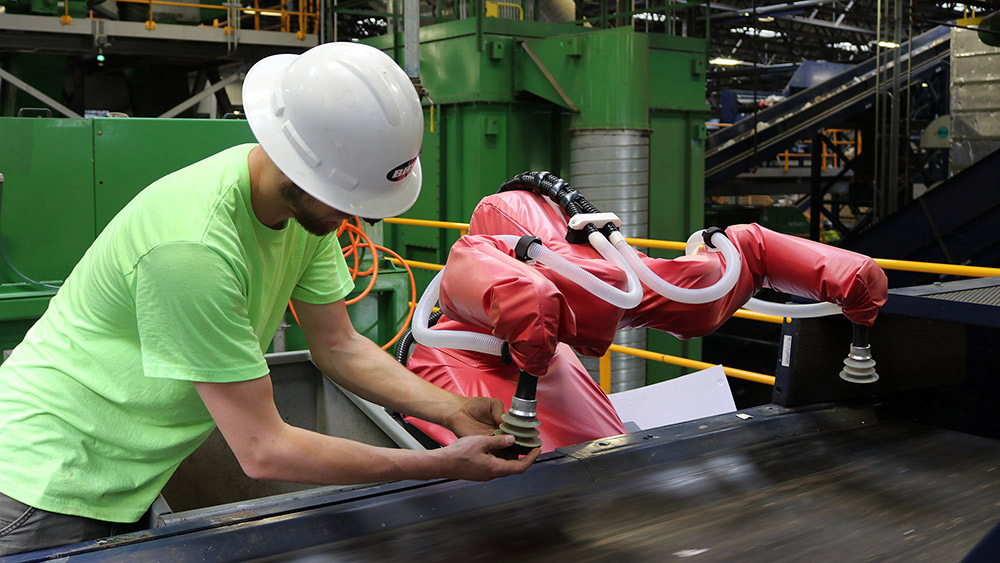
“Robots have more relaxed requirements than optical sorters” for operating conditions including conveyor belt speed, ZenRobotics Chief Commercial Officer Rainer Rehn said at the MRF Operations Forum in October. They most frequently use suction cups to grab material, but some versions use movable tongs or grippers that resemble fingers.
Industry participants estimate the average human makes about 20 to 40 picks per minute, depending on the material stream, and the average robot sorter matches or exceeds that number. Manufacturers say previous models made 40 to 60 picks per minute, while the newer ones make 60 to 80 picks per minute.
Where it’s happening
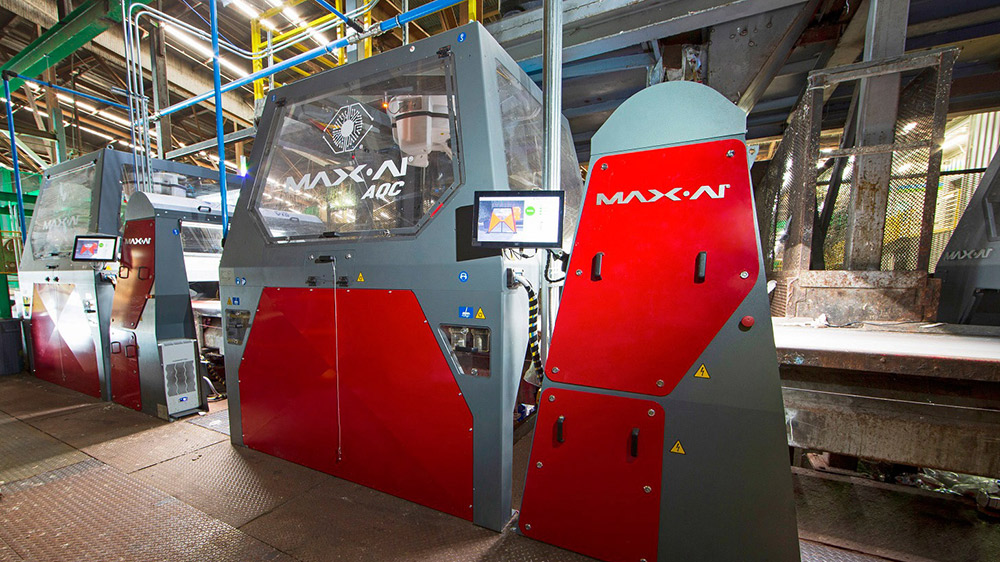
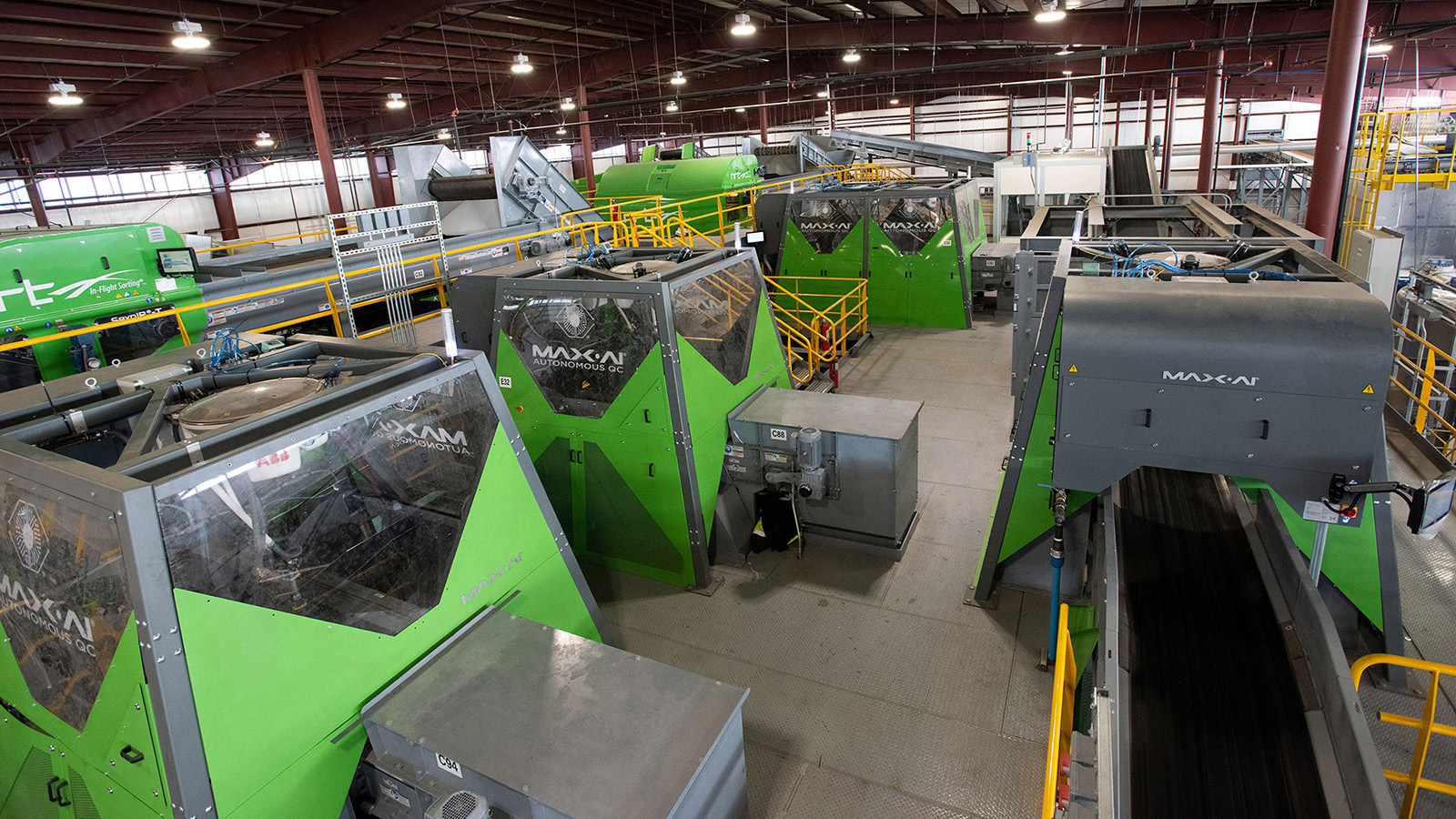
Equipment manufacturers and suppliers differ on which country was the very first to lead the trend, but they generally indicate the United States is “really in line with what the rest of world is doing in terms of recycling automation,” Raschio said. His company, BHS, has installed 110 Max-AI robots globally so far, and roughly two-thirds of those are in the U.S.
Robots are integrated into North American systems via both retrofitting existing facilities and completely new builds. MRF operators should weigh the cost of each option and what they’re trying to achieve before committing to a certain model, suppliers say. At times, technology retrofits can become more costly than starting from scratch with an entirely new system.
“We probably install the most robotic sorters into new systems because they can be planned and installed with the rest of the equipment,” Raschio said. “But we expect customers to eventually retrofit entire facilities.”
Alpine Waste & Recycling in Welby, Colorado was among the first U.S.-based MRFs to incorporate a sorting robot into its facility, through a 2016 collaboration with AMP Robotics and the Carton Council. It was programmed to grab a variety of food and beverage containers and separate them from the rest of the recycling stream.
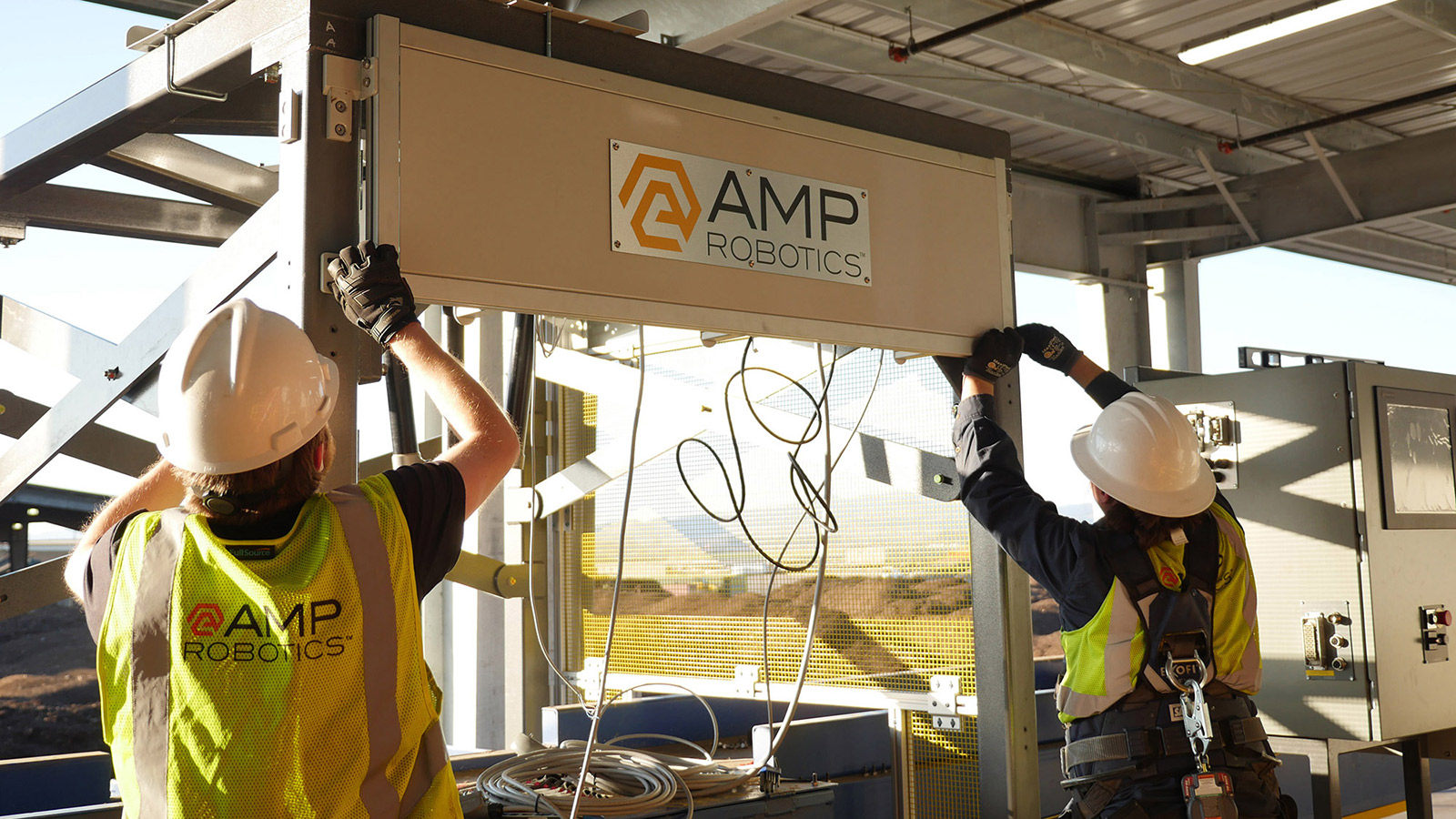
AMP Robotics
Randy’s Environmental Services was also an early robotics adopter when it installed a Waste Robotics sorter at its transfer station in Delano, Minnesota two years ago. The sorter senses and picks out blue bags of organic material from other waste as they pass the machine on a conveyor. It’s capable of processing about 15 tons of material an hour, at 30 picks a minute, with the ability to scale up that capacity.
“Anybody can wait and see what happens, but we think it was the right time to lead the implementation of that technology,” Matt Herman, business and public relations manager at Randy’s Environmental Services, told Waste Dive. “We’ve had very good success with the system,” with upward of 80% target material identification and separation.
Recology’s Recycle Central in San Francisco has also undergone numerous equipment upgrades from various vendors in the past couple years. BHS recently provided the facility with a visual identification system and four Max-AI robots for autonomous quality control.
Single Stream Recyclers opened a new plant in Sarasota, Florida this year designed to process 50 tons of curbside material per hour. In the fall, it began running 14 robots — the most of any MRF in North America so far.
“We decided on robots pretty quickly after we opened Sarasota,” Co-Owner John Hansen said at the MRF Operations Forum. All of the units are on the container line or at the end of lines as quality control.
Last year, the Lakeshore Recycling Systems Heartland Facility in Forest View, Illinois added a Machinex SamurAI robot to pick natural HDPE, colored HDPE and aseptic containers from single-stream material. AMP Robotics designed the computational “brain” of the robot while Machinex manufactured its other componentry, Lakeshore Site Manager Jon Schroeder told Waste Dive. The unit is “doing what it is supposed to do” and the company already is “pretty close” to achieving ROI, he said.
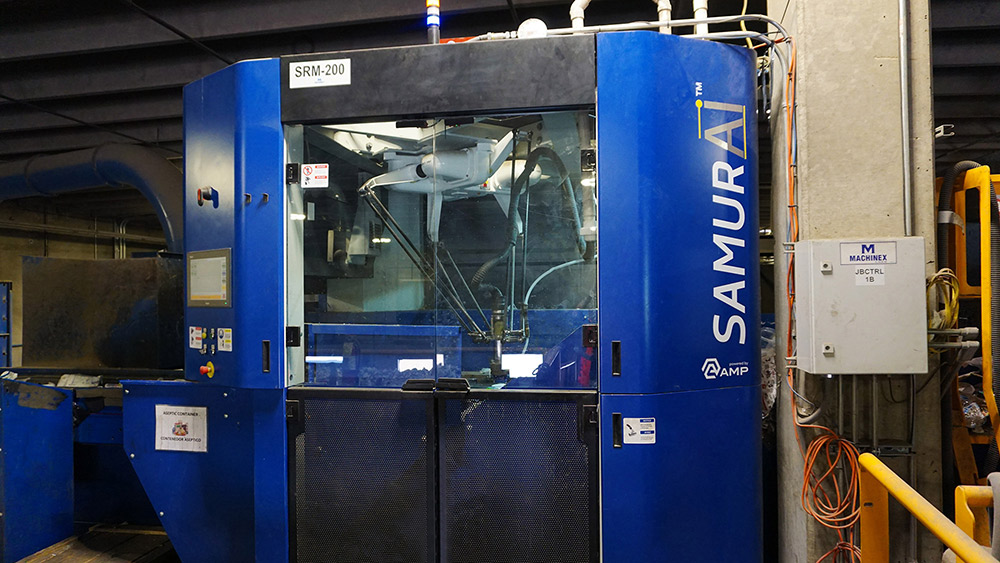
Machinex SamurAI
Lakeshore Recycling Systems
Max-AI robot
BHS
Waste Management similarly expanded the number of robots being tested at its facilities across the country and anticipates eight will be in operation by the end of this year. The company is building a new plant just outside of Chicago, in Hodgkins, Illinois, that it dubbed the “MRF of the Future.” Test runs are occurring at the highly automated facility and full operation is expected in spring 2020.
That facility includes multiple pieces of advanced technology, but it doesn’t contain any robots. However, “robots are a big part of our plan to invest in technology moving forward for other facilities,” Bell said. “Even though it’s a down cycle in terms of the economics of it, we know investing in technology today — creating this infrastructure — is really going to help us out in the future.”
This spring, Republic Services opened its own $30 million “Next-Gen” recycling facility in Plano, Texas that incorporates automation including optical sorters. The facility (which replaces one that was destroyed in a fire) uses “half the labor that we had in the previous one. And I see that as a further trend,” Republic Services President Jon Vander Ark told Waste Dive earlier this year.
More recently, in a WASTECON speech about the changing business model of recycling, Vander Ark addressed Republic’s reasoning for the new investments and mentioned robots among upcoming plans.
“We are putting in more capital-intensive recycling centers because it’s producing a better product on the back end — less contaminated — and it’s improving our working conditions,” he said.
Why it’s happening
A confluence of events on the labor front — especially increasing wages and worker shortages — makes robotic investments especially attractive right now. MRF operators say the machines plug gaps with vacant sorting and picking positions they experience difficulty filling otherwise.
“Right now, we’re at one of the all-time lows in unemployment, and it’s hard to find people willing to work in this environment,” Lakeshore’s Schroeder said. In addition, he said, “we were increasing laborers to help keep the material clean, and the robot was able to reduce that need.”
“It’s hard to get [sorters] to show up for work,” said Bell. Waste Management has 2,500-3,000 sorter positions throughout the company and it cycles through an estimated 14,000-15,000 people from temporary staffing agencies each year to fill them. “That only counts for people who have stayed there longer than a day,” Bell said.
A common refrain from both MRFs and equipment manufacturers is that worker concerns in other industries about machines eliminating human jobs don’t really pertain to the recycling industry. MRFs across the board, but especially small plants, are “having difficulty getting the labor” they need to continue operating, Nat Egosi, president and CEO of RRT Design & Construction, said at the Paper and Plastics Recycling Conference in October.
“With this automation we’re not trying to eliminate jobs, we’re trying to eliminate a workforce that doesn’t like this type of work,” Bell said. “At the recycling centers of the future, I think you’re going to see a lot more automation in those types of jobs.”
High turnover adds up financially for employers due to the cost of recruiting paying staffing agencies, and onboarding and training new workers. Boosting employee satisfaction is known to correlate with higher employee retention, and thus, lower ongoing recruiting and hiring costs. MRFs that add sorting line automation can move employees to more skilled and more desirable jobs, such as equipment maintenance technicians or automated equipment oversight.
Earlier this year, Waste Management COO John Morris told Waste Dive that its soon-to-open “MRF of the Future” will involve “people watching a series of computer screens instead of watching belts … I think that is much more of a desirable job.”
Machines can work multiple shifts, don’t lose their focus, don’t need days off and don’t tire or need breaks. By that metric alone, according to industry professionals, one robot could at least do the work of two people on different shifts. That’s especially advantageous considering finding workers for non-traditional shifts presents an even greater challenge. At times, MRFs also experience variations in material types and seasonal volume changes, but automation’s consistency eases challenges related to such fluctuations.
“It just runs in the background when we’re doing other things. It’s a constant, reliable, predictable way to do separation,” Herman of Randy’s Environmental said.
BHS
BHS
Equipment also adapts to changing conditions and variables better than humans, and the greater consistency improves quality control. That’s a boon in an industry where higher-quality materials increasingly are in demand, a worldwide trend acutely brought to light by China’s tighter contamination standards.
Just as humans can be taught to recognize different resins, AI allows machines to learn how to identify individual items, right down to a specific brand’s packaging. Automation thus enhances a MRF’s efficiencies, quality and throughput, users say. And it provides a more reliable, consistent output.
“We’re getting the same amount of material processed through our robotic system with less time and fewer employees than when we used to put it through a manual system,” said Herman.
When facilities need to upgrade their equipment, an ongoing process, robotics don’t require a complete overhaul because so much of the system is based on software. Even increasing a robot’s pick rate from 40 to 60 per minute occurs via a system update that gets pushed through the cloud.
“Once this equipment is in, a lot of the updates to it are software based,” Raschio said. “That’s part of the total intelligence platform.”
The system continually learns from its performance to move in more intelligent ways, identify materials better or determine where to pick up items better.
“A lot of facilities that already have this equipment will be able to ride that wave of technology … There’s no risk of being stuck with the last generation’s robot. As long as the ROI is there for them today, there really isn’t a reason to put it off,” Horowitz said.
Safety is another frequently mentioned reason to automate MRF sorting lines. Waste streams, conveyors and processing equipment create an environment that’s ripe for potential health and safety hazards.
“Employees avoiding contact with raw garbage is a good thing. And the robot won’t get pricked by a needle,” Herman said.
Working out the kinks
Robotics can benefit MRFs, but as with any emerging technology, it is not perfect.
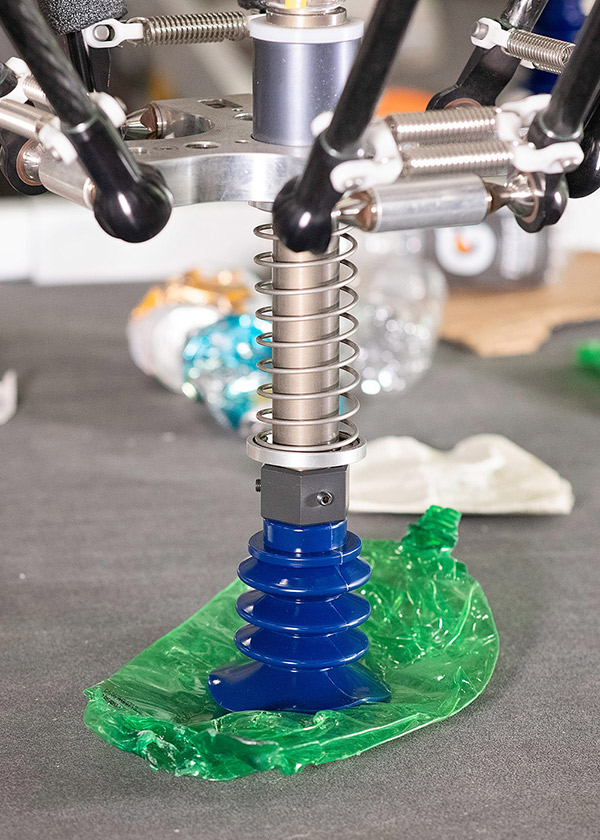
A prevalent user gripe about robot sorters is the wear rate on the suction cup grippers. The grippers require a low-cost replacement, but they wear out somewhat frequently. Suppliers all report continuous work on making sturdier, longer-lasting suction grippers.
“The gripping technology is not done. We’re working on things. The pick success will go up over the next year,” AMP Robotics’ Horowitz said. “We’re working very hard to close any performance gaps that the robots might have.”
Manufacturers also aim for increasingly faster throughput while maintaining sorting accuracy and machine integrity. Technology is delicate and recycling facilities’ environments are harsh, but designers try to devise upgrades to boost robustness.
AMP Robotics
Users would also like to see improved lightweight material identification. For example, enhancements could prevent lightweight packaging from getting picked along with paper a greater proportion of the time. Fiber, in its own right, is another iffy area for automation users.
“I’m still looking for the answers on the paper side of robotics … But there are challenges on the paper side … The AI is not a problem, it’s the picking,” Bill Moore, president of Moore & Associates, told Waste Dive. “I think there are some robotic applications for picking small pieces of OCC. But there’s a big tissue industry out there that runs on office papers.”
Some MRF operators have noticed paper picking challenges as well. While cartons get picked “crazy fast,” the fiber-sorting units aren’t at the same level, said Single Stream Recyclers’ Hansen, adding that “I don’t think they’re quite as advanced.” But new data entering those lines and ongoing system updates means they “will get to the same pick rates as on the container lines shortly.”
While suppliers cite progress with fiber picking robotics, some users still demonstrate varying degrees of hesitation.
“I would have to see it to believe it before we would go forward with something like that” and replace human labor on paper lines, Lakeshore’s Schroeder said. His company’s robot functions very well on flat, aseptic containers or flattened plastics, but he’s less sure about how it would perform on the thicker burden depth of a fiber belt.
Burden depth is a significant consideration for automated sorting equipment, with many in the industry saying a consistent monolayer is optimal but generally unachievable.
“A singularized monolayer is the dream,” ZenRobotics’ Rehn said, “but I never have seen it.”
The equipment also works best when conveyors are flat, although some can handle shallow angles, suppliers say. Feed styles matter, as does where automation appears on the line.
For instance, robotics isn’t ideal for presorting because “it’s hard to teach a robot to pull things like a bicycle or a fire hose,” Horowitz said. And Rehn notes that robots “can’t pick wire or rebar. It’s not possible. Never.” Thus, presorting is one area where humans still are viewed as more valuable than robots despite the safety hazards, at least for the foreseeable future.
Another important factor when installing advanced sorting equipment is connectivity because the automated components must communicate with each other, MRF managers and the manufacturer through cloud computing. System updates also are pushed from manufacturers to users through the cloud. Lacking strong and reliable internet connectivity for data transfer prevents robotics from receiving problem solving with real-time oversight, functioning optimally or obtaining system updates.
In a MRF setting, “it’s really difficult to get the quality of internet that the robots need,” Rehn said.
Given the tight profit margins MRFs work under, cost is another commonly raised issue for adding robots, as it is with all large capital investments. But suppliers and MRF operators alike indicate the efficiencies gained and money saved from robotics usually make long-term sense.
Some companies offer financing options so the MRF essentially leases the equipment and a number of states offer grants for recycling equipment upgrades. But Moore suggests grants aren’t a suitable answer in the long run, noting that MRF operators must ensure equipment purchases continue to be practical and sustainable under their business’ economic model.
“These things are not inexpensive,” Moore said. “Although people aren’t inexpensive either.”
BHS
The next decade, and beyond
The amount of planning, operational adjustments and financial investment that goes into adding MRF automation can seem daunting. Yet those who resist making the leap likely will find themselves left behind in the coming decade, suppliers and consultants say.
“Smaller plants have difficulty keeping up with the capital investment necessary for technology,” Egosi said. “Business needs to be dynamic. Facilities must solve the problems of today, but also tomorrow … I’m not talking about three- to five-year payback, but five-plus years from now.”
Equipment manufacturers and suppliers also intend to expand their machinery’s AI applications to other recyclable materials and uses, making the investment an increasingly appealing option.
“Artificial intelligence is a really powerful tool and we’re only using it in one way right now,” Horowitz said. “Over the next five to 10 years I think we’re going to see a lot of different sorting technologies combine with AI for more specialized tasks. Maybe for sorting specific materials, focused on more specific throughputs, or expanding into things like automotive scrap.”
Automation will be used in “more niche areas” and “we’re going to see screens, the whole method of separating based on size and shape and those characteristics … dwindle and disappear,” Egosi said. “We need to pinpoint exactly what the object is as it moves through this technology and then we can go after it with a robot or optical sorter.”
Others agree that advanced technology increasingly will replace traditional equipment that quickly is becoming obsolete.
“Old-style screens are not effective anymore because of the dirty stream,” Pieter Eenkema van Dijk, CEO of Van Dyk Recycling Solutions, said at the Paper and Plastics Recycling Conference.
Others suggest that MRFs will eventually be fully automated as well as self-actualized, meaning machines will ingest data, automatically perform actions and make operational adjustments to maximize results without always requiring input from humans. At the very least, sorting lines are predicted to be fully automated.
“We really see it as a completely automated process in the future. People won’t have any contact with the waste stream and can run a system 24/7,” BHS’ Raschio said.
MRF operators agree that the number of humans on a sorting line will lessen in the next few years, but generally speaking, they don’t believe facilities will run completely without humans.
Even Hansen, whose facility has more robots than any other in North America right now, points out that equipment maintenance and housekeeping represent two main areas where humans are needed for the foreseeable future. As for a day of full automation, he says, “I don’t think we’ll ever do it.”
Recent Comments