

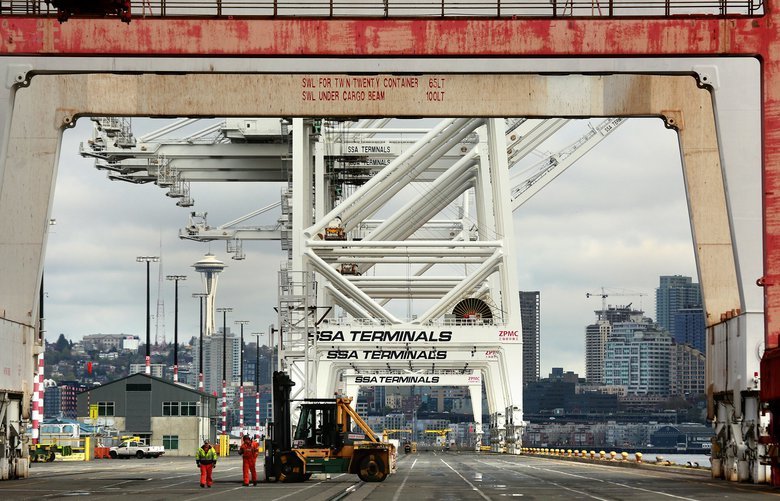

Port operators and the longshore union have asked Gov. Jay Inslee’s office to make sure dock workers have enough protective equipment and cleaning supplies to slow the spread of the novel coronavirus at seaports and minimize disruption to supply chains.
The first case of COVID-19 at the Port of Seattle was reported last week, in a worker at Georgetown’s Terminal 18.
The employee was last at work March 9, terminal operator SSA Marine wrote in March 18 letter to dock workers, meaning other employees “may have been exposed to the virus.” However, the letter said, the employee is not believed to have been in close contact with any other workers and “the risk of you becoming ill is low.”
SSA Marine, which manages all three of Seattle’s cargo terminals, last week began handing out gloves and disinfecting wipes for workers to clean equipment before the start of shifts.
However, many are concerned that amid a nationwide shortage of health safety equipment, even in hospitals, terminal operators like SSA Marine may not be able to keep enough gloves and wipes in stock for workers to use going forward.
SSA Marine, the longshore union and the Northwest Seaport Alliance (NWSA), the public entity overseeing cargo operations at the ports of Seattle and Tacoma, have been working with state and federal authorities to make sure that dock workers have enough sanitizing supplies to keep supply chains moving, NWSA CEO John Wolfe said in a Monday conference call. “It’s important our industry have adequate (sanitizing) supplies so we can keep commerce moving through the gateway,” he said.
The challenge, said Josh Berger, the governor’s maritime lead, is that “there is no clear procurement or supply chain for this kind of equipment.” SSA Marine has “good supply contacts and network to replenish our supplies, but … it’s a fluid situation which requires constant attention,” SSA Marine senior vice president Bob Watters wrote in an email.
The governor’s office is also developing guidelines in the case of a coronavirus outbreak within essential industries, but, Berger said, “to be honest, there are no clear guidelines.”
After learning about the infection of the Terminal 18 worker, SSA Marine sanitized the machine shop where the employee worked. The company is providing hand sanitizer to all employees, has asked foremen to address the virus in their regular pre-shift safety talks, and has changed how it assigns longshore workers’ shifts to minimize close contact between workers.
When a dock worker in Houston tested positive for the coronavirus last week, the Port of Houston suspended all operations at two terminals for nearly two days — raising questions about whether the Northwest Seaport Alliance (NWSA) ought to have done the same.
The decision whether to close a terminal is made by the terminal operator, Wolfe said. And what happened in Houston was very different than what happened at Terminal 18, according to SSA Marine’s Watters.
“Houston had a live case on their terminal and as we understand, the person in question had extensive circulation around the terminal with both people and equipment,” Watters wrote in an email. “At T-18 the mechanic in question was working alone, repairing a piece of equipment and was only on site for a short period of time. He was not confirmed to have the virus until much later.”
Shutting down port operations has huge costs — to terminal operators, who could owe late fees to shipping companies for holding vessels at dock, and to consumers reliant on international supply chains for products like electronics, housewares, cars and clothing.
Even without an official port shutdown, supply chains could still snarl if a large number of dock workers become ill, said Peter Ku, Seattle-based branch manager at OEC Group, a global freight forwarder.
“It’s really the longshore workers and truckers I worry about,” he said. “If they’re not there to receive freight or move freight, it’s going to start stacking up at the terminal.”
Longshore workers in Oakland threatened to walk off the job Friday because they said SSA Marine was not doing enough to ensure that equipment at the terminal it operates at the Port of Oakland was clean and safe to operate. Other terminal operators in Oakland — but not SSA — employed separate staff to clean equipment between shifts, a longshore spokesperson told the San Francisco Chronicle.
The privately held company headquartered on Harbor Island, one of the largest terminal operators in the world, has twice in years past been flagged as a “severe violator” of employee safety regulations by the Occupational Safety and Health Administration, the federal workplace safety regulator. The company was removed from the program last year after follow-up inspections found that the issues behind those violations, which did not take place in Seattle, had been addressed.
Recent Comments