Currently, cities are killing the sea that is increasingly near to them. Dead ocean areas are spreading. They do this with untreated sewerage, salt from desalination plants, chemicals from factories, leisure activities, marine vessels, and farm runoff of toxins and fertilizer. Instead, they must farm the sea and maintain biodiversity and create benign marine tourism and leisure activities. Methods of distributing salt from desalination without killing anything do now exist, but deployment is slow.
Smart cities are planned at sea and on reclaimed land as at Forest City Malaysia, which promises a veritable jungle with “sounds of nature” and all that greenery self-watering. You can buy a DND house on and under the sea in Dubai.
Cities will make all their own food, fresh water, and electricity for reasons of empowerment, security, and cost. That electricity-making is even pivoting to water with tidal turbines installed from Scotland to the Hudson River in New York and wave power, both being almost continuous and using almost none of the steel and concrete that produces 16% of global warming. Take a few hours to drop them in – not 10 years as for hydro dams. Part of the reason for water power is that there is less and less land for wind turbines and solar farms. Indeed, silicon solar works better cold, so it is migrating to sea or lake as floatavoltaics. New
photovoltaic materials are even useful underwater, and photovoltaic paint is on the way, as explained in the IDTechEx report, “
Materials Opportunities in Emerging Photovoltaics 2020-2040“.
Leaders in tidal power such as Simec Atlantis and
Verdant Power have more and more companies chasing them. You can say the same for wave power leaders such as Seabased, Wello, and Eco Wave. Even ORPC RivGen horizontal axis water turbines are proving viable in shallow rivers, and they do not disturb fish. Most water power is virtually continuous – no massive
batteries. See the IDTechEx report, “
Distributed Generation: Off-Grid Zero-Emission kW-MW 2020-2040“.
Obviously, cities will focus more of their leisure industry and freight transport on the water. See the
IDTechEx report, “
Electric Leisure & Sea-going Boats and Ships 2021-2040“. IDTechEx sees several ways that even large ships can become zero-emission when today they each pollute as much as millions of cars. At the other extreme, Swiss Seabubble aquaplaning water taxis are zero-emission, charged by small river turbines under the landing platform. They are planned for Paris.
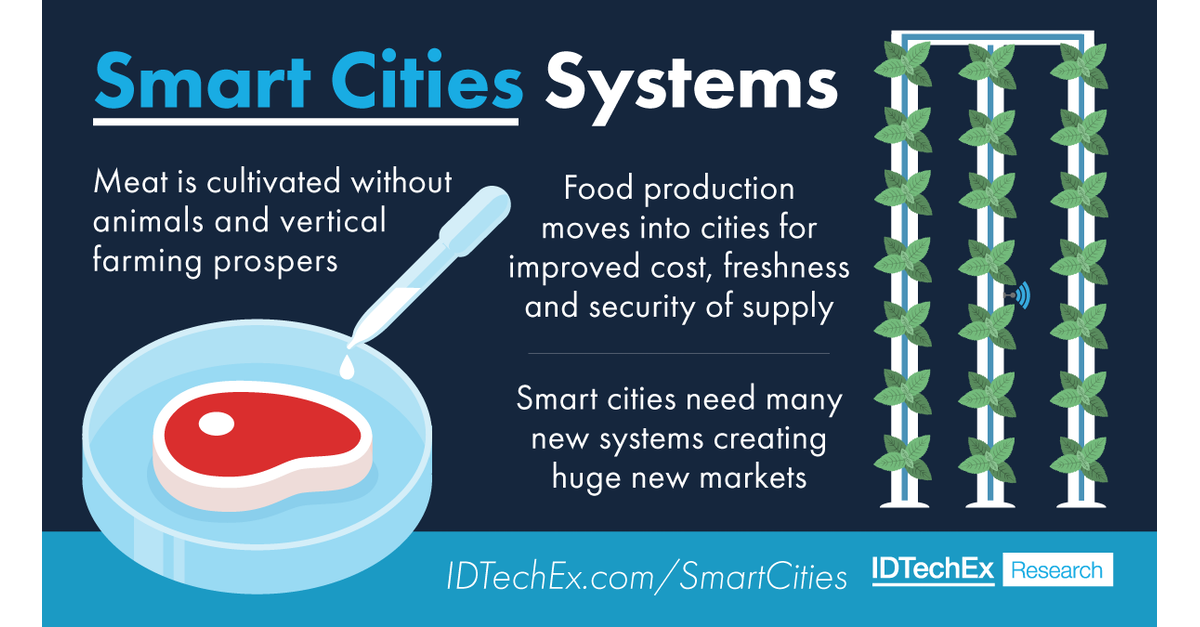
Soliculture greenhouses on rooftops and elsewhere are adopting smart glass that provides electricity for the robots as well as optimally growing the plants again with almost no water. Robotic food cultivation is integrated with human facilities in parts of China, saving space and water.
Fish farming and barley, samphire, seaweed, and other vegetable growing in saline water is a done deal back to the ancient Sumerians, but it is necessarily broadening in scope as global warming and people moving to cities makes land even more scarce. The amazing thing is that there is a roadmap of many options to go even further. For example, aquaponics uses even less land than hydroponics, and it costs less. This is growing fish and vegetables in one closed system, the fish excrement feeding the plants.
Some are planning turf that produces electricity as well as tapping and filtering rainwater for use. Xeriscaping is appearing in smart cities. It is the process of landscaping or gardening that reduces or eliminates the need for supplemental water from irrigation. It is promoted in regions that do not have accessible, plentiful, or reliable supplies of fresh water and is gaining acceptance in other regions as access to irrigation water is becoming limited. Xeriscaping is an alternative to various types of traditional gardening in necessarily frugal smart cities.
On the other hand, the trend to multi-purposing even extends to damp turf, vegetation, and soil. Plant-e is a company that develops products that can generate electricity from living plants, and
Harvard University has biofuel cells using such fuels.
Transport systems are reinvented for smart cities, and necessarily, Hyperloop shooting passengers from city to city by magnetic levitation in a vacuum and Boring Company Loop shooting autonomous cars at high speed across cities will increasingly be tubes in sea, lake or river for at least part of the way. That even saves money. Autonomous underwater vehicles are zero-emission and they monitor offshore wind turbines, sea-floor mining, fish stocks, and more. Leisure submarines anyone – as taxis too?
The largest challenge of the $0.5 trillion NEOM smart city in the Saudi Arabian desert is drinking water – all desalinated from the sea. See the
IDTechEx report, “
Desalination: Off Grid Zero Emission 2018-2028“. The Bill Gates Belmont desert city in Arizona is nowhere near the sea, and the state gets its water from the Colorado River, which is drying up. By far its biggest challenge is water. It has to guarantee 100 years’ supply to be allowed to start. Arizona-based startup Zero Mass Water’s SOURCE
photovoltaic panels make electricity but also use the sun’s rays to pull water from the air. Each panel has the potential to draw up to 10 liters (2.64 gallons) of water per day. That will help, but all the sources still leave that city with severe water conservation requirements.
Here is one. Bill Gates has proven from his investments that the elimination of sewage distribution and treatment farms is coming when it is treated at the source. That saves huge amounts of water. One new toilet has an
electrochemical reactor that can break down water and human waste into fertilizer for fields and hydrogen, which can be stored in hydrogen fuel cells as a green energy source. Even the little water used is treated enough to reuse for flushing or for irrigation.
IDTechEx guides your strategic business decisions through its Research, Subscription and Consultancy products, helping you profit from emerging technologies. For more information, contact
[email protected] or visit
www.IDTechEx.com.



Recent Comments