


Dive Brief:
- Twelve percent of supply chain professionals say their organizations are currently using artificial intelligence (AI) in their operations and 60% expect to be doing so within the next five years, according to the latest annual MHI Industry Report which surveyed 1,001 supply chain professionals in manufacturing, transportation and other industries. Results have remained flat from last year when 13% said they were using AI.
- Predictive analytics, which relies on many of the same techniques as AI, is being used by 28% of respondents, the survey found.
- Low-level AI implementation could be the result of the difficulty hiring technology talent and the inability to properly manage enterprise data streams, according to experts.
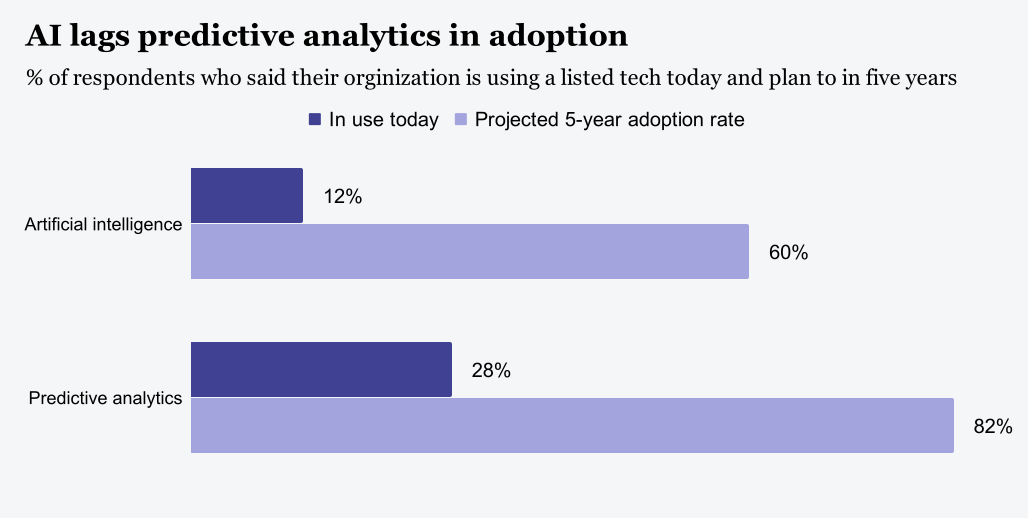
Matt Leonard / Supply Chain Dive, data from MHI Annual Industry Report
Dive Insight:
One problem with pinning down the number of people who are using AI is if you ask two people what they consider to be AI you’ll get two answers. I know because I did just that.
Thomas D. Boykin, a supply chain specialist at Deloitte and leader of the MHI white paper, said he considered AI to be not just predictive analytics and prescriptive analytics, but a system where the human is taken completely out of the loop. An example would be a system used by a waste management company to reroute vehicles based on sensor data from waste receptacles around the service area, Boykin said.
“There’s some things that can be executed systematically without human intervention,” he said in an interview. “And for us, that’s where AI comes in.”
But the definition is quite different for Stefan Nusser, the VP of product at Fetch Robotics who used to run the Cloud AI team for Google in Europe.
“In my mind, any data-driven, model-based machine learning approach — that to me is AI,” Nusser said in an interview with Supply Chain Dive. This would include an algorithm based on historical data that provides outputs with a certain level of accuracy, he said.
For Nusser, if AI is the car then machine learning is the engine. In this case, many of the methods analysts currently use for predictive analytics — clustering, classification, etc. — would be considered AI.
But definitions aside, Boykin and Nusser agree that AI is far from widespread within the supply chain at this point.
“I think penetration is just slow,” Nusser said.
There are also two ways a company could be using AI:
- Buy AI applications from a vendor.
- Build AI models in-house using Python, R or another programing language.
The latter of these approaches is probably even rarer in the world of supply chain right now unless you’re a transportation company trying to predict traffic and optimize route planning, Nusser said.
“I really doubt 12% of companies have that level of investment in AI,” he said about in-house modeling capabilities.
This doesn’t mean companies aren’t interested in using more of the technology. However, bringing the required talent on board can be a struggle. Fifty-six percent of respondents considered hiring a top challenge in the current environment and 78% said there was high competition for the talent available.
Access to data is another issue.
AI applications are trained on historical data and, depending on the application, a company will need to ensure access to its data as a first step. But the MHI report found that only 16% of respondents consider their organization’s data stream management to be either “good” or “excellent.”
Data is more available thanks to cheap sensors and other Internet of Things technology, but “it also presents a problem with being able to synthesize it and filter it and understand what data is needed to drive what insights,” Boykin said.
Putting this data in the cloud can make it easier to share with vendors and other business partners when looking to create an AI application with outside help, Nusser said. These struggles aside, he still considers it a good technology for companies to invest.
While some technologies like blockchain might have been overhyped, AI has proven itself.
“I do think that it has the potential to even exceed what people are expecting from it,” Boykin said. “And I do think it is a worthwhile investment.”
So what is AI good for? It’s great for understanding unstructured data like images or language, Nusser said.
Within a warehouse this could mean using cameras to get a better understanding of inventory, the use of robotics or anything else in the physical world, he said.
“The value I see us bringing to the table is the physical world: an understanding of the physical world, an understanding of what get’s touched … how the environment changes over time?” he said.
This story was first published in our weekly newsletter, Supply Chain Dive: Operations. Sign up here.
Recent Comments