

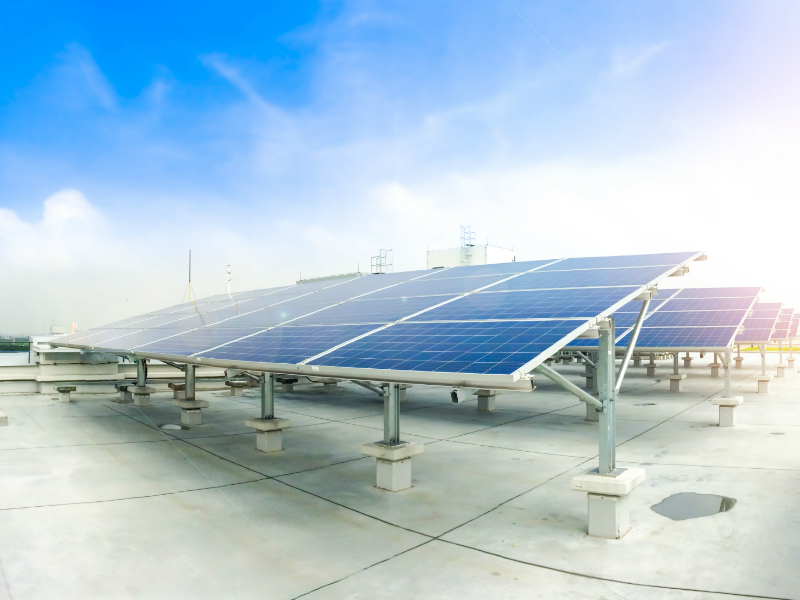

The Indian solar industry is facing disruptions in the procurement of raw material and components for solar installations. The industry is heavily reliant on China for its sourcing requirement and is expected to face challenges in procurement of module glasses and wafers required for the system.
Modules account for approximately 60% of a solar project’s cost and Chinese companies supply approximately 80% of solar cells and modules. Chinese vendors have informed Indian developers about delays in production, quality checks and component transportation due to the outbreak. China has imposed work restrictions in eight affected provinces, most of which are the hub of solar module manufacturers.
Canadian Solar, LONGi Group, Trina Solar, Q-CELLS and JA Solar have their facilities in Jiangsu province. Jinko Solar and JA Solar conduct their manufacturing operations in Zhejiang province. PV inverter companies such as SolarEdge and Enphase Energy had contract manufacturers in affected provinces of Guangdong and Anhui respectively.
As a result, Indian developers have started facing a shortfall of raw materials required for solar panels and cells and limited stocks. It is expected that Covid-19 is going to affect the installations in the first half of the year and will likely to start showing signs of recovery only by the end of the third quarter.
According to the Confederation of Indian Industry (CII), the sector is expected to see a rise in the component prices due to the decrease in production and constraints that the supply chain and logistics are facing in procuring it from China, which has stopped production due to the Covid-19 pandemic. The virus outbreak has also created other issues for the Indian solar industry as ship container companies stopped picking up load from China ports and transporting it to different countries, including India.
CII has shown concerns for the completion of solar projects scheduled in the next two quarters and has decided to revisit import strategies for solar module sourcing. The confederation has encouraged Indian PV manufacturers to consider it as an opportunity for Make in India for the solar sector and build a strong and competitive domestic solar manufacturing industry.
Approximately 2.3GW of the solar plants planned to be commissioned from June to August are already affected as they were expecting to receive modules supplies by March. In the ongoing situation, it is expected to further impact the capacity and future bids.
To overcome this, the All India Solar Industries Association has recommended the government to consider subsidising the cost differential and ramping up domestic manufacturer production. It has also suggested exempting solar module producers in SEZs from 25% safeguard duty on imports of cells and modules for domestic facilities apart from using coal cess as a support for the domestic industry.
CII has also recommended removing the higher customs duties imposed on certain products that are primarily sourced from China but may need to be sourced from other countries now and the government may reconsider the recent imposition of higher duties.
In response to industry concerns, India’s finance ministry in February indicated that businesses with supply chains disrupted by the coronavirus in China could declare force majeure, using the ‘Act of God’ clause that frees them from contractual obligations due to unforeseeable events. Monetary penalties are imposed for a three-month delay in commissioning of a project, while projects delayed further also face downward revisions in tariffs.
Tariffs at which a company will sell the power to customers are quoted when the developer bids for a project and, at the current scenario of delayed procurement, the developers are expecting the government to extend the deadline without renegotiating the tariff.
Most solar companies involved with government energy projects now have the possibility to invoke cause if they were unable to meet deadlines. SB Energy, Aditya Birla Renewables and ReNew Power are some companies that plan to invoke the clause in case of delay. A deadline to meet schedule on approximately 2.3GW of solar projects worth over $2bn is at risk, starting as soon as July. In addition, with the prices of supplies from other sourcing nations such as Taiwan or Malaysia being 15-20% higher, it becomes riskier for developers to control price increases. Industries are looking for additional financial support to deal with working capital costs and interest payments due to the delay.
India’s clean energy sector aims to increase its renewable energy capacity to more than 175GW by 2022, of which 100GW is planned to be from solar energy. India is progressing slowly due to policy confusion and land acquisition issues. With the coronavirus now posing a new threat to India’s plans, it is expected that the disruptions due to Covid-19 would leave an impact for the next two to three quarters.
The current situation is forcing Indian developers to diversify their sourcing and manufacturers to expand their domestic production. This requires domestic solar power equipment manufacturers’ interest subvention to stay competitive in the market and enjoy a level playing field against foreign firms. The interest subvention allows subsidy or rebate in the rate of interest, on which a financial institution provides a loan to domestic manufacturers and the subsidy is borne by the government.
Lending rates in India range from 10%-12% for setting up a solar manufacturing business, while in China it ranges from 3%-5%. Chinese manufacturers have the advantage of pricing the components at a cheaper rate and establishing mass-scale production facilities. The current domestic manufacturing capacity for solar cells in India is approximately 3GW-4GW and for module manufacturing is approximately 9GW-10GW annually.
India is looking to reach approximately 20GW-25GW of capacity to fulfil its domestic needs itself. Encouraging domestic manufacturers would make India self-reliant. The Ministry of New and Renewable Energy (MNRE) has recommended imposing basic custom duty on imported solar cells and modules. In addition, to focus on domestic manufacturing, the ministry has brought in a manufacturing-linked tender where the subsidy is inbuilt.
The wind installations in India are also expected to be affected by the Covid-19 outbreak. India is the world’s fourth-largest onshore wind market by installations with 38.06GW of wind capacity as of 2019. The country has an ambitious target of achieving 175GW of renewable energy capacity by 2022, of which 60GW would come from wind energy, and a whopping 450GW by 2030, of which 140GW would be wind-based generation.
The Covid-19 outbreak has made it more difficult to achieve the targets due to the challenges of land acquisition, grid unavailability, supply chain bottlenecks and a lack of project financing. Though India is self-sufficient in manufacturing wind components, projects scheduled to come online in Q2 2020 will be delayed due to a lag in engineering and construction activities. The country is currently in a 21-day lockdown and the situation is still not clear in terms of a complete recommencement of construction activities.
The lack of viable alternatives, transit delays and the right to invoke force majeure clauses will see the estimates for wind annual installations decline in 2020. India’s expected wind additions are likely to be impacted by 600MW and reach approximately 2.69GW in 2020. Any extensions of the current Covid-19 lockdown could lead to a further reduction in project commissioning forecast for 2020.
Vestas, Siemens Gamesa and LM Wind Power have temporarily suspended production at plants in India in response to the government lockdown. Vestas blade factory in Ahmedabad and hub and nacelle plant in Chennai are both at a halt in response to 21-day lockdown measures. GE-owned LM Wind Power has suspended production at its Dataset and Vadodara facilities and have further instructed employees at the LM Wind Power Technology Center at Bangalore to work remotely.
India and China are the major suppliers in the global wind market. Due to a challenging situation in implementing wind projects, India has been struggling to use the full capacity of the three major giants, which can support 10GW annually. During the early stages of the Covid-19 outbreak and the production halt in China, it was expected that India would become the major alternative hub but the ongoing interruption in supply could restrict installations both domestically and abroad in Western markets.
Globally, the Covid-19 impact would be able to be measured in the long run, primarily due to delays in production and logistics issues. Chinese production is now resuming but not to the fullest capacity. India is in lockdown for 21 days, scheduled to end on 14 April.
The global developers that rely on Chinese components will face challenges in procurement and in shifting towards alternative sources. For under-construction projects, the delay of goods that are in transit or are not produced will affect the construction schedule and increase construction costs.
The Middle East and South-East Asian countries heavily reliant on China will face considerable challenges with ports being shut down and import restrictions imposed at several countries. With uncertainties in ocean freight, there could be a sharp increase in sea freight rates, following an increase in logistics demand. The delay in shipments can disturb the production schedule and create problems for developers with heavy debt.
Latest reports from

GlobalData is this website’s parent business intelligence company.
Recent Comments