
Tech News, Magazine & Review WordPress Theme 2017
  • Home
  • Supply Chain Updates
  • Global News
  • Contact Us
  • Home
  • Supply Chain Updates
  • Global News
  • Contact Us
No Result
View All Result
No Result
View All Result
Home Supply Chain Updates

Supply chain problems at worst level since the 1990s

usscmc by usscmc
February 21, 2021
Supply chain problems at worst level since the 1990s
Share on FacebookShare on Twitter

Economic activity declines again as manufacturing sector hit by worst supply chain problems since the 90’s – but there are signs of better times coming

  • Shipping delays, Brexit and demand for worldwide materials hit supply chains
  • But, manufacturing sector still showed signs of growth last month  

By Jane Denton For Thisismoney

Published: 06:40 EST, 19 February 2021 | Updated: 06:43 EST, 19 February 2021

Severe supply chain disruption hampered the manufacturing sector’s performance last month, the results of a closely-watched survey have revealed.

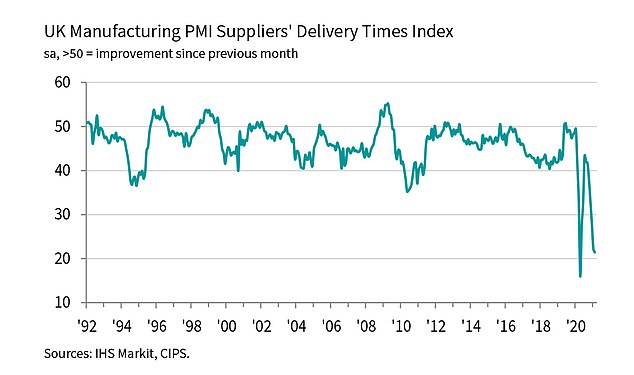
Supply chain disruption problems were the worst since the 1990s in January this year, and only fractionally better than at the height of the pandemic in April 2020.

While the manufacturing sector still enjoyed a degree of growth last month, international shipping delays, strong worldwide demand for raw materials and Brexit-related trade frictions all took their took.

Britain’s economy continued to falter in the first two weeks of February, but the speed of the falls slowed compared with a significant slump in January, according to new data. 

Trouble: Supply chain disruption problems were the worst since the 1990s in January this year

Trouble: Supply chain disruption problems were the worst since the 1990s in January this year

The IHS Markit/CIPS Flash UK Composite PMI report came in at 49.8, with anything below 50 seen as a market in contraction.

This improved from January’s figure of 41.2.

The manufacturing sector recorded a flash PMI of 54.1 as new orders rose, although exports remain troublesome with many reporting difficulties fulfilling orders to existing clients in the EU due to higher costs and transportation delays.

The services sector continues to struggle as Covid-19 lockdowns and restrictions remain. It recorded a PMI of 49.7 compared with 39.5 in January.

But overall, the flash data for February, which comprises 85 per cent of expected respondents for the final number released next month, showed only a marginal drop in private sector output compared with heavy falls in January.

In the manufacturing sector the output index grew slightly to record a score of 50.5, but the rate of growth was the weakest since June 2020.

Results: Output by different business sectors across the UK, according to IHS Markit
Results: Output by different business sectors across the UK, according to IHS Markit

Trouble: A chart showing supplier delivery times since back in 1992

Trouble: A chart showing supplier delivery times since back in 1992

Output: A chart showing output and GDP levels since 2007

Output: A chart showing output and GDP levels since 2007

The delays at ports and in global supply chains saw 58 per cent of those surveyed report longer delivery times from suppliers, with just 2 per cent revealing an improvement.

Services continue to drag down the overall score with tight restrictions on travel, leisure and hospitality remaining in place.

But, staffing levels in the sector showed signs of stabilisation, the survey found, with the level of job losses slowing compared with January.

Some manufacturers also reported that their own sales volumes have fallen due to the closures in hospitality, meaning the lockdown is having a knock-on effect.

Data also showed a slight reduction in the total new work received by businesses – for the fifth consecutive month and export sales underperformed domestic orders for the first time since last September.

Chris Williamson, chief business economist at IHS Markit, said: ‘The UK economy showed welcome signs of steadying in February after the severe slump seen in January, albeit with business activity remaining sharply lower than late-last year due mainly to the ongoing national lockdown.

‘Although the hospitality sector, including hotels and restaurants, reported a further steep decline, as did the transport and travel sector, rates of contraction eased considerably.”

Duncan Brock, group director at CIPS, added: ‘February saw some of the worst supply chain disruptions since records began in the early 1990s, only surpassed by those reported in April last year as the pandemic first hit.

‘Manufacturers were affected the most, as production in some cases was halted due to shortages in shipping and raw materials and many services businesses remained in a lockdown stranglehold unable to operate.’  

TOP SIPPS FOR DIY PENSION INVESTORS

Advertisement

Share or comment on this article:

Some links in this article may be affiliate links. If you click on them we may earn a small commission. That helps us fund This Is Money, and keep it free to use. We do not write articles to promote products. We do not allow any commercial relationship to affect our editorial independence.

usscmc

usscmc

No Result
View All Result

Recent Posts

  • How Hapag Lloyd captured a major market share in the Container Shipping Industry in USA
  • Why USA’s East Coast is the Favorite Destination for Manufacturing Companies
  • How Trade Relations Between the USA and UK Improved After Keir Starmer Became Prime Minister
  • Tips and Tricks for Procurement Managers to Handle Their Supplier Woes
  • The Crazy Supply Chain of Walmart Spanning Across the Globe

Recent Comments

  • Top 5 Supply Chain Certifications that are in high demand | Top 5 Certifications on Top 5 Globally Recognized Supply Chain Certifications
  • 3 Best Procurement Certifications that are most valuable | Procurement Newz on Top 5 Globally Recognized Supply Chain Certifications

Archives

  • July 2024
  • June 2024
  • May 2024
  • April 2024
  • March 2024
  • February 2024
  • January 2024
  • December 2023
  • November 2023
  • October 2023
  • September 2023
  • August 2023
  • July 2023
  • June 2023
  • May 2023
  • April 2023
  • March 2023
  • February 2023
  • January 2023
  • December 2022
  • November 2022
  • October 2022
  • September 2022
  • August 2022
  • July 2022
  • June 2022
  • May 2022
  • April 2022
  • March 2022
  • February 2022
  • January 2022
  • December 2021
  • November 2021
  • October 2021
  • September 2021
  • August 2021
  • July 2021
  • June 2021
  • May 2021
  • April 2021
  • March 2021
  • February 2021
  • January 2021
  • December 2020
  • November 2020
  • October 2020
  • September 2020
  • August 2020
  • July 2020
  • June 2020
  • May 2020
  • April 2020
  • March 2020
  • February 2020
  • January 2020
  • December 2019
  • November 2019
  • September 2019

Categories

  • Global News
  • Supply Chain Updates

Meta

  • Log in
  • Entries feed
  • Comments feed
  • WordPress.org
  • Antispam
  • Contact Us
  • Disclaimer
  • Home
  • Privacy Policy
  • Terms of Use

© 2025 www.usscmc.com

This website uses cookies to improve your experience. We'll assume you're ok with this, but you can opt-out if you wish. Cookie settingsACCEPT
Privacy & Cookies Policy

Privacy Overview

This website uses cookies to improve your experience while you navigate through the website. Out of these cookies, the cookies that are categorized as necessary are stored on your browser as they are essential for the working of basic functionalities of the website. We also use third-party cookies that help us analyze and understand how you use this website. These cookies will be stored in your browser only with your consent. You also have the option to opt-out of these cookies. But opting out of some of these cookies may have an effect on your browsing experience.
Necessary
Always Enabled
Necessary cookies are absolutely essential for the website to function properly. This category only includes cookies that ensures basic functionalities and security features of the website. These cookies do not store any personal information.
Non-necessary
Any cookies that may not be particularly necessary for the website to function and is used specifically to collect user personal data via analytics, ads, other embedded contents are termed as non-necessary cookies. It is mandatory to procure user consent prior to running these cookies on your website.
SAVE & ACCEPT
No Result
View All Result
  • Home
  • Supply Chain Updates
  • Global News
  • Contact Us

© 2025 www.usscmc.com