


By Audere Team & A. Concilio
Companies have varying degrees of internal processes for Supply Chain Risk Management (SRM), often-centered on optimization to minimize costs and reduce inventories; this focus is quickly becoming insufficient. With the unexpected trials of today’s environment – COVID-19, Anti Free Trade Efforts, Climate Change, and a push for Sustainable Supply – SRM processes are neither resilient nor robust enough to handle current and potential future challenges.
Internally, companies have managed Supply Chain Risk through Sales & Operations Planning (S&OP) Processes, often-coupled with more formal Supply Chain Risk Management reviews. SRM processes have historically focused on ten critical risk factors: 1) Cost variability, 2) supplier financial risk 3) supplier relationship management, 4) quality control, 5) supplier staffing shortages, 6) second-tier supplier disruption, 7) transportation disruptions, 8) cross-border controls, 9) geopolitical risk, and 10) compliance risk. However, the current pandemic has highlighted many deficiencies in the manufacturing supply chain, which has prompted organizations to reevaluate SRM plans, addressing future potential disruptions.
According to the Manufacturing Leadership Council and the National Association of Manufacturers, only 23% of manufacturers say they are very capable of identifying supply chain risks.
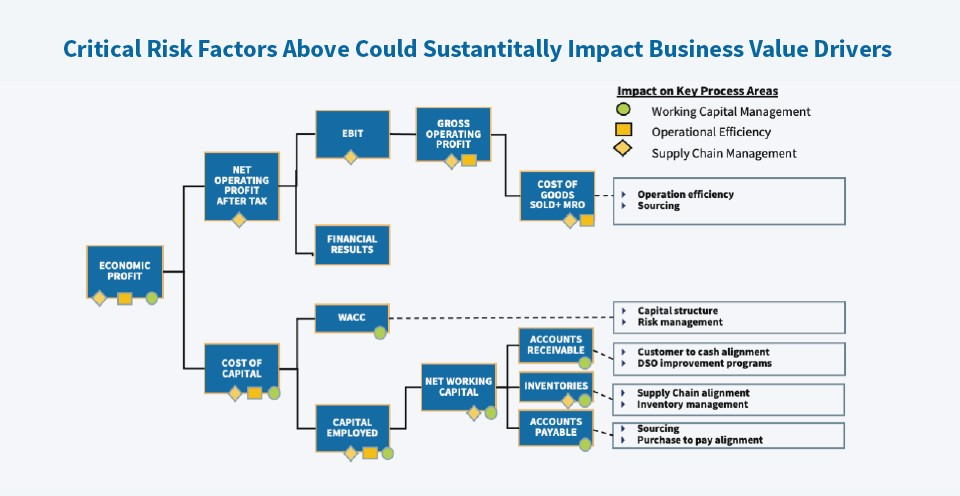
The list on the below illustrates the potential impact of both the historical risk factors defined above and more recent ones on the various business value drivers. The risk posed by these factors can have serious consequences, not only for Supply Chain Management but also for Working Capital Management and Operational Efficiency.
Potential Downstream Impact of Supply Chain Risk
- Cost Variability
- Second-Tier Supplier Disruption
- Supplier Financial Strength
- Trade & Tariffs
- Transportation Disruption
- Current & Future Unplanned Macro Events (pandemics, market corrections etc.)
- Supplier Relationship Management
- Cross-Border Controls
- Regulatory & Political Change
- Geo-Political Risks
- Demand Change
- Staffing/Resource Challenges
- Compliance Risks
- Climate Change
- Quality Control
Critical New Risk Factors to Consider
Trade and Tariffs
Though some of the global trade friction may decrease with the impending change in US administration, the Trump Administration’s trade approach may be adopted by other nations who perceive that an aggressive trade policy will likely serve their national interest best.
Sustainability
Sustainability is becoming an important driver across many industries (electric vehicles, food, plastics etc.) and needs to be formally addressed as part of any Supply Chain Risk Management plan. In the Automotive space, many car manufacturers are driving Sustainability requirements into the entire Supply Chain.
Regulatory
Compliance has always been an integral part of Supply Chain Risk Management, but the definition of compliance may need to be expanded. Today, for example, in the US Food/Beverage space, with the Food Safety Modernization Act (FSMA), risk management of the Supply Chain has become a legal requirement.
Demand Changes
Typically, one does not think of Demand changes impacting the SRM plan. However, in an environment where demand may change rapidly, the SRM plan’s impact may need to be considered a Risk Factor.
Climate Change
Despite other risk factors incorporating Climate Change, it may be useful for specific industries to break climate change out as a separate factor; weather-related impacts on farming, transportation, water availability, etc., will potentially increase risk in the years ahead.
These new risks reveal a need for companies to not just step back and take a fresh look at their existing SRM and S&OP processes, but also look at how well they integrate across functions. Although many organizations have somewhat improved their cross-functional communications and operations within the Supply Chain, many activities still exist in functional silos. With an increasing number of risks to the Supply Chain, there is a need to rethink the process fundamentals and cross-functional communication needed to enhance decision-making across the organization’s entire value chain.
Specific Actions to Address These New Risks
S&OP
Given that the SRM process is more strategic in nature, it is imperative that it is integrated seamlessly into the more tactical S&OP Process.
Liquidity and Cash Flow Management
Given the impact on the Purchase-to-Pay process, it is imperative to minimize working capital risk.
Metrics
It is critical to develop the appropriate metrics and mechanisms to continually measure and report performance of your updated SRM Plan. The best-designed process is of little value unless it is well-executed, rigorously monitored, and continually improved. Many companies have instituted performance monitoring programs to better manage their networks in response to rising supply chain costs and shrinking budgets. Some additional measures to consider when looking at SRM Processes:
- % Conformance to S&OP Supply Chain Plans
- $ Impact of Supply Chain Disruptions
- Conformance to SRM Plan Review Cycle Commitments
- Number of available backup Suppliers for Fastest-Moving Products
- General Carrier Performance
- Total Revenue lost during any disruption
Summary
- Firms should evaluate and update their SRM processes/plans to incorporate additional Risk Factors to address the current global environment and enhance overall resiliency.
- Each Firm should formally document its SRM process/plan and ensure all stakeholders are trained. The process should be directly linked to the S&OP process.
- Due to enhanced Risk Factors, a larger group of stakeholders may need to be identified and integrated into the S&OP Process and S&OP.
- SRM Metrics should be developed and deployed tied to Supply Chain Performance. These metrics should ensure the SRM process is delivering desired business performance and adapt to the constantly changing business environment.
- Management should evaluate an investment in key transformation technologies to address the increased risks identified.
The previous focus on supply chain optimization to minimize costs, reduce inventories is no longer sufficient. Today’s environment requires additional focus on a more robust Supplier Risk Management process to deal with the unexpected and ensure overall business success.
Sponsored by:
Recent Comments