

Tech News, Magazine & Review WordPress Theme 2017
  • Home
  • Supply Chain Updates
  • Global News
  • Contact Us
  • Home
  • Supply Chain Updates
  • Global News
  • Contact Us
No Result
View All Result
No Result
View All Result
Home Supply Chain Updates

Tanker Market: The Latest Variables to Affect Freight Rates

usscmc by usscmc
January 12, 2020
Tanker Market: The Latest Variables to Affect Freight Rates
Share on FacebookShare on Twitter

2020 has already started with a “bang” when it comes to the tanker market after the latest developments in the Middle East. In its latest weekly report, shipbroker Gibson said that “2020 is already turning out to be a highly volatile year. Most tanker freight markets have remained extremely firm over the first two weeks of January whilst geopolitical risk has ratcheted up once again. The US killing of General Soleimani, followed by Iran’s retaliatory action could have had major repercussions for the oil and tanker markets. However, aside from price impacts, so far no physical effect on the market has come to fruition and tensions appear to be cooling – for now. What happens next however will be key, with countless different scenarios that could play out”.
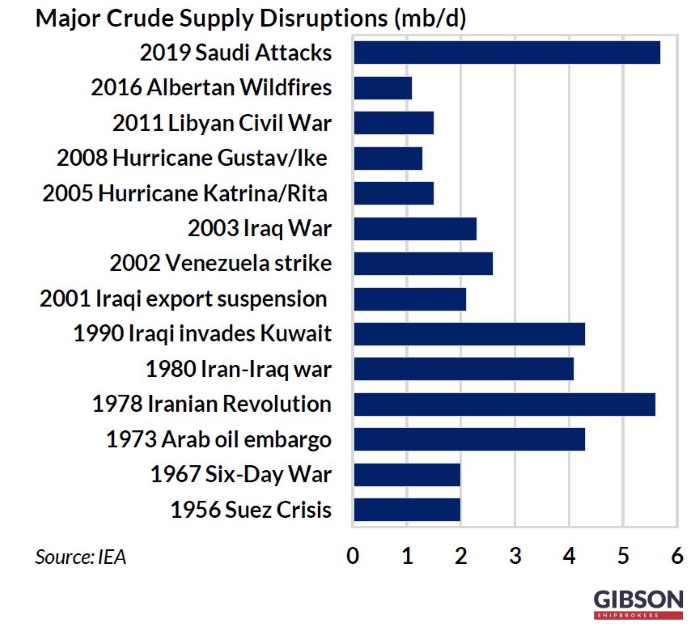
According to Gibson, “one of the most talked about scenarios remains the possibility that the Strait of Hormuz could be closed. Whether this is achievable or not, and whether it would trigger a major conflictis beyond the scope of this report, but any closure no matter how temporary would impact approximately 17.2 million b/d of crude oil and 2.4 million b/d of refined product flows. If this was to materialise, the impact on the oil price would be extreme, with major economic ramifications”.

The shipbroker added that “the loss of 17.2 million b/d of crude flows could not be replaced from anywhere in the world within a short time frame. Saudi Arabia, Iran and Venezuela possess the biggest spare production capacity; however, none would be in a position to increase exports. Whilst Saudi Arabia could theoretically push approximately 3 million b/d of crude to the Red Sea via the East-West pipeline (assuming that loading infrastructure could handle these volumes), the pipeline itself could become a target”.

Gibson also noted that “the obvious place to source additional crude would be from OPEC+ members outside the Middle East Gulf who could reverse their 715,000 b/d of pledged production cuts, whilst some countries like Russia may be able to produce even more. Collectively however, it is unlikely that OPEC+ production increases would exceed 1 million b/d in the short term. The US could also contribute more, although much of this might be retained for domestic consumption, whilst it is unclear how much additional crude the US could produce quickly. The largest month on month increase in US shale production recorded was 300,000 b/d, whilst Canada could remove government mandated cuts to increase output by up to 300,000 b/d. However, even if all these players delivered quickly (which is uncertain) and Saudi maxed out its East-West pipeline, only 5.315 million b/d of the loss could be recovered, leaving a near 12 million b/d shortfall. Emergency stocks would of course be released, although this would have little benefit to tanker trades”.

“So, with approximately 12 million b/d of seaborne oil trade lost if the Strait of Hormuz was closed, the implications for freight rates would be disastrous, perhaps akin to the periods following the oil shocks of 1973/1974 and 1979, both of which led to prolonged downturns in tanker freight rates. Of course, endless different scenarios could materialise. If the Strait stayed open, but with attacks on tankers becoming more common, then freight and insurance rates could surge to record levels. Right now, it is difficult to rule out any scenario, but one thing is certain;the risk to oil and shipping is arguably the highest it has been this century”, the shipbroker concluded.
Nikos Roussanoglou, Hellenic Shipping News Worldwide

usscmc

usscmc

No Result
View All Result

Recent Posts

  • How Hapag Lloyd captured a major market share in the Container Shipping Industry in USA
  • Why USA’s East Coast is the Favorite Destination for Manufacturing Companies
  • How Trade Relations Between the USA and UK Improved After Keir Starmer Became Prime Minister
  • Tips and Tricks for Procurement Managers to Handle Their Supplier Woes
  • The Crazy Supply Chain of Walmart Spanning Across the Globe

Recent Comments

  • Top 5 Supply Chain Certifications that are in high demand | Top 5 Certifications on Top 5 Globally Recognized Supply Chain Certifications
  • 3 Best Procurement Certifications that are most valuable | Procurement Newz on Top 5 Globally Recognized Supply Chain Certifications

Archives

  • July 2024
  • June 2024
  • May 2024
  • April 2024
  • March 2024
  • February 2024
  • January 2024
  • December 2023
  • November 2023
  • October 2023
  • September 2023
  • August 2023
  • July 2023
  • June 2023
  • May 2023
  • April 2023
  • March 2023
  • February 2023
  • January 2023
  • December 2022
  • November 2022
  • October 2022
  • September 2022
  • August 2022
  • July 2022
  • June 2022
  • May 2022
  • April 2022
  • March 2022
  • February 2022
  • January 2022
  • December 2021
  • November 2021
  • October 2021
  • September 2021
  • August 2021
  • July 2021
  • June 2021
  • May 2021
  • April 2021
  • March 2021
  • February 2021
  • January 2021
  • December 2020
  • November 2020
  • October 2020
  • September 2020
  • August 2020
  • July 2020
  • June 2020
  • May 2020
  • April 2020
  • March 2020
  • February 2020
  • January 2020
  • December 2019
  • November 2019
  • September 2019

Categories

  • Global News
  • Supply Chain Updates

Meta

  • Log in
  • Entries feed
  • Comments feed
  • WordPress.org
  • Antispam
  • Contact Us
  • Disclaimer
  • Home
  • Privacy Policy
  • Terms of Use

© 2025 www.usscmc.com

This website uses cookies to improve your experience. We'll assume you're ok with this, but you can opt-out if you wish. Cookie settingsACCEPT
Privacy & Cookies Policy

Privacy Overview

This website uses cookies to improve your experience while you navigate through the website. Out of these cookies, the cookies that are categorized as necessary are stored on your browser as they are essential for the working of basic functionalities of the website. We also use third-party cookies that help us analyze and understand how you use this website. These cookies will be stored in your browser only with your consent. You also have the option to opt-out of these cookies. But opting out of some of these cookies may have an effect on your browsing experience.
Necessary
Always Enabled
Necessary cookies are absolutely essential for the website to function properly. This category only includes cookies that ensures basic functionalities and security features of the website. These cookies do not store any personal information.
Non-necessary
Any cookies that may not be particularly necessary for the website to function and is used specifically to collect user personal data via analytics, ads, other embedded contents are termed as non-necessary cookies. It is mandatory to procure user consent prior to running these cookies on your website.
SAVE & ACCEPT
No Result
View All Result
  • Home
  • Supply Chain Updates
  • Global News
  • Contact Us

© 2025 www.usscmc.com