


ATLANTA — Change management isn’t what it used to be.
In the past, managers could start with a well-known process, said Jeremy Davidson, vice president of sales at Fortna. Begin with a future state and work backward to map out the change management process.
“There’s a lot that’s less known right now in this environment, and it poses some unique challenges with change management,” Davidson told Modex attendees in Atlanta Monday.
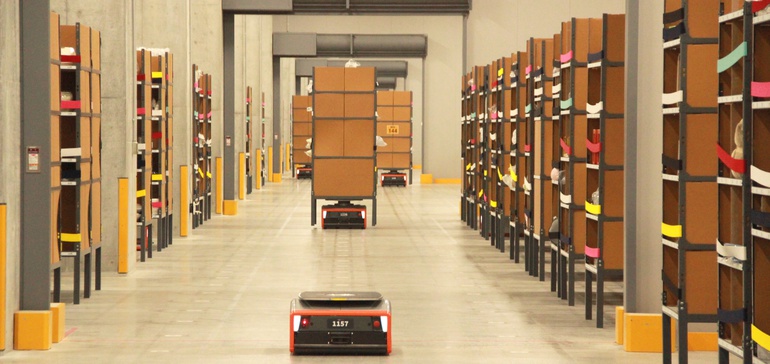
Warehouse automation technology has advanced far beyond conveyor belts. Implementation of automated picking or mobile sortation can drastically change what a worker does on a daily, or even hourly, basis. The job function could take a 180-degree turn, from moving around and picking products to working in a large station where product comes to the worker, said John Seidl, partner at GreyOrange.
“This isn’t handing them an RF gun and teaching them how to use it,” Seidl told Modex attendees.
He said new technologies and job functions can result in different KPIs, too. Because of that, today’s change management requires a strategic, often individualized approach, especially at a time when low unemployment has shrunk the available pool of workers and made retention a critical issue.
“You have to be thinking about labor from an onboarding, a training and a turnover perspective,” said Roger Counihan, vice president of sales at Fortna. “We’re seeing 80% turnover with some of our clients.”
Turnover is especially problematic in areas with high concentrations of warehouses, as workers can jump ship for higher pay to a facility down the street.
When Amazon opened a Chicago facility with $15 hourly pay, 80 of the 220 workers at a 3PL in Chicago called in sick, Michael Wohlwend, managing principal at Alpine Supply Chain Solutions, told Supply Chain Dive. Pay is important, but it’s only part of workers’ calculus. Many eventually returned to the more favorable working conditions at the 3PL, he said.
Counihan said mitigating retention issues and high turnover in warehousing often begins with making worker tasks simpler and easier. Robotics vendors have responded to operations managers’ calls for solutions that automate functions while simultaneously improving the work environment.
Some automated tools reduce walking time (a major productivity drain), others remove the need for workers to bend or reach, and others take over repetitive tasks, freeing humans to focus on strategy. No worker wants to stand all day placing items from one tote into another, Vince Martinelli, head of product and marketing at RightHand Robotics, told Supply Chain Dive.
Regardless of the automation’s function or how much it improves the labor environment, warehouses still require a top-down leadership approach to guide workers through the changing nature of their job functions.
“There are some very creative things being done around how you’re going to account for labor performance and change management during the initial deployment,” Seidl said.
He described one Chilean retailer’s autonomous mobile robot (AMR) implementation and its piecemeal approach to change management. Instead of replacing all forklifts with AMRs, the retailer removed 80% of its forklifts, he said. Then the retailer made several of the top forklift drivers each responsible for four AMRs. Executives modified the labor management system (LMS) to monitor how well the AMRs performed and how well the forklift drivers performed as supervisors.
Today, the retailer uses forklifts to move product only during peak season. The remainder of the year, the forklifts are not in use.
The deployment of AMRs and strategy of making forklift drivers into robotic supervisors altered KPIs for the retailer, according to Seidl. Metrics go well beyond picker productivity to instead focus on the value that a picker adds to the overall business, he said.
“The people [who] understand how to leverage human resources to enable that broader value proposition are going to be the real winners,” Seidl said.
This story was first published in our weekly newsletter, Supply Chain Dive: Operations. Sign up here.
Recent Comments