


Railway operators and developers should reconsider the use of the country’s rail network for cargo transport
by AFIQ AZIZ / Pic by BERNAMA
MALAYSIA’S rail industry — which has long coped with many changes in the transportation services sector — is now forced to contend with new challenges brought about by the Covid-19 pandemic.
Restrictions on movement and strict health guidelines imposed to curb the spread of the disease have seen the number of railway passenger plunge for most parts of the year, forcing both railway operators and developers to reconsider the use of the country’s rail network for cargo transport.
Railway developer Dhaya Maju Infrastructure (Asia) Sdn Bhd (DMIA) said the shift towards rail freight not only helps sustain businesses within the rail industry, but also bring transport costs down on a broader scale.
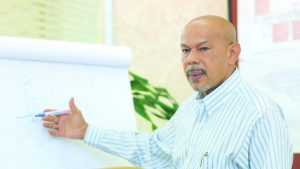
DMIA group CEO Datuk Mohamed Razeek Md Hussain Maricar. (Pic By RAZAK GHAZALI/ TMR)
“Sea freight is still the cheapest option to transport goods from abroad into Malaysia, but it takes a longer time. Meanwhile, air freight is the quickest, yet the most expensive for cross-country or cross-continent delivery.
“But when the products land at our ports, either in Johor, Klang or Penang, how do you get them to its local destination? For this, I believe rail is the cheapest option compared to hauler trucks or other modes of delivery, so we should leverage this,” DMIA group CEO Datuk Mohamed Razeek Md Hussain Maricar told The Malaysian Reserve in an hour-long interview recently.
He said a locomotive could pull more than 2km of wagons via track, which allows more items to be loaded and transported before they are handed over to radial feeders for last-mile delivery.
“It is cost-efficient and this is how the railway industry can grow,” he added.
Unearthing the Potential of Rail
Keretapi Tanah Melayu Bhd (KTMB), which has a track length spanning over 2,783km and a route length of 1,655km, has immense potential if certain upgrades were made, Mohamed Razeek said.
Citing the 192km Gemas-Johor Baru electrified double-tracking project, which is slated for completion by October 2022, Mohamed Razeek said such updates would make the national rail network more efficient and help increase rail traffic.
“With a single track, you have to wait for the train from another direction to pass through before allowing the opposite train to proceed.
“However, with a double crossover track system, you can route the train from the northern line to the southern line. Meanwhile, with the signalling system, it will allow the train to go back-and-forth or left and right, allowing the train to pass or wait,” he explained.
DMIA, with its partner Lembaga Tabung Angkatan Tentera, is now spearheading the Klang Valley Double Tracking (KVDT) project — a rail rehabilitation venture covering 160km of the electrified double-track network spanning from Port Klang to Sentul-Batu Caves, and from Rawang to Seremban.
The first phase of KVDT rehabilitation from Rawang to Salak Selatan is now 87% completed, while the KVDT2 is currently progressing at 20%.
Apart from the KVDT, the resumption of the East Coast Rail Line (ECRL) next year will further expand the rail network on the east coast front.
“We hope there will be more links as far as track development is concerned, which is to improve and enhance the rail networks,” Mohamed Razeek said.
The ECRL project is expected to cut travelling time from Kota Baru to Putrajaya to four hours, linking the states of Kelantan, Terengganu and Pahang with Negri Sembilan, Selangor and Putrajaya. The 640km rail network is expected to be completed in 2026.
A Make-or-Break Effort
Mohamed Razeek said one of the most significant challenges in uplifting the local railway industry is the liberalisation of tracks, namely to allow other train operators to run on a track belonging to a distinct owner.
He said this would require long deliberations and comprehensive agreements between the asset owner and multi-railway operators (MROs).
Mohamed Razeek said no industry player has put forward the idea so far. Transport Ministry’s Railway Network Access Agreement (RNAA) introduced in 2016 is the only such an effort that exists.
However, the agreement — which aims to separate the roles between a rail operator and a rail owner, particularly between KTMB and Railway Assets Corp (RAC) — remains inconclusive until now.
While he agreed that KTMB, RAC and the ministry need to work out their differences in the RNAA, Mohamed Razeek said a holistic approach and mechanism must be brought to the table to determine the next viable business model for the industry to grow.
“One option when you allow independent operators with independent wagons to share the KTMB line is for KTMB to be the only entity that can manage the schedule on who travels when and for how long.
“It is like an airport, where planes come and go according to what is scheduled. You do not have to crowd the sky, and in this case, you don’t have to crowd the tracks,” Mohamed Razeek said.
Is KTMB Up for the Challenge?
While acknowledging that liberalisation would cannibalise KTMB’s market, Mohamed Razeek said it is important to consider the bigger picture where KTMB would be managing the system and creating schedules for third-party operators. KTMB also stands to gain from rental fees, he added.
“How much the charges should be for using the mainline can be worked out in the business model as KTMB is the one in control. I think this is a business model that should be studied and explored,” he said.
Mohamed Razeek said a crucial aspect to consider is the interconnectivity offered in the model which could contribute to the utilisation of railways throughout the country.
“As far back as 1990, when telecommunications companies (telcos) signed up on their own, they had to build their own infrastructure like telecommunications towers, some even (built) at the same locations to ensure interconnectivity. This means you can switch your line from one telco to another, but still keep your number. That is the level of interconnectivity that we have.
“Similarly, the business model that can be worked out as far as KTMB’s business is concerned is in letting other operators use their network,” said the seasoned engineer.
During the launch of the National Transport Policy (NTP) 2019-2030 last year, former Prime Minister Tun Dr Mahathir Mohamad expressed the idea of liberalising the country’s rail tracks, especially to ferry cargo, indicating that it would start with the KTMB line.
Dr Mahathir said allowing MROs to run on KTMB tracks can boost the track utilisation rate and minimise serious road accidents by reducing the number of large hazardous trucks on the road, as well as allowing KTMB to gain access fee with the services provided.
However, the idea was not welcomed by KTMB as the operator sought to maintain their control over the tracks. It has instead promised to introduce a sustainable plan to expand its cargo capacity.
Back to the Drawing Board
The NTP launched last year, among others, emphasises on the emergence of the e-commerce sector in Malaysia.
According to official data, Malaysia’s e-commerce growth is progressing at between 10% and 15% rate per annum, equal to that of Thailand and Indonesia. In contrast, the annual growth rate for India, Singapore, China and Taiwan is double, between 20% and 25%. From 2012 to 2015, e-commerce contributed between RM49 billion and RM68 billion.
Before the Covid-19 outbreak, the government forecast the upward trend to continue, almost doubling in 2020 with a target of about RM114 billion to RM170 billion fuelled by the “right intervention” derived by the rise in commercial traffic, creating spillover effects on the logistics sector.
Mohamed Razeek suggested the industry and the government to go back to the drawing board with the NTP — a 10-year plan that provides a comprehensive data and outlook on land, air and sea transport.
He said the right strategies are needed to ensure the rail sector benefit from the Covid19 disruption. At the same time, it is crucial to make sure that the rail development would not be derailed by wasting billions of ringgit from government coffers.
“But where do we start? Perhaps we can revisit the NTP together, look at the rail and expand from there,” Mohamed Razeek said, adding that forward spending for infrastructure like transportation is a must in anticipation of growth.
“When we built the longest highway in the country, the North-South Expressway, there were so many detractors saying that RM6 billion is such a waste of investment,” he said.
Today, the 1,130km-long road network is being used by 1.7 million motorists daily, epitomising the need for the government to spend wisely with hindsight on infrastructure, Mohamed Razeek added.
“So, forward spending is necessary for the anticipation of growth. If not, we will have to play catch-up. But for rail, you cannot have a concession model like expressways, so a suitable business model must be addressed to ensure growth and that public money is well spent,” he concluded.
Recent Comments