

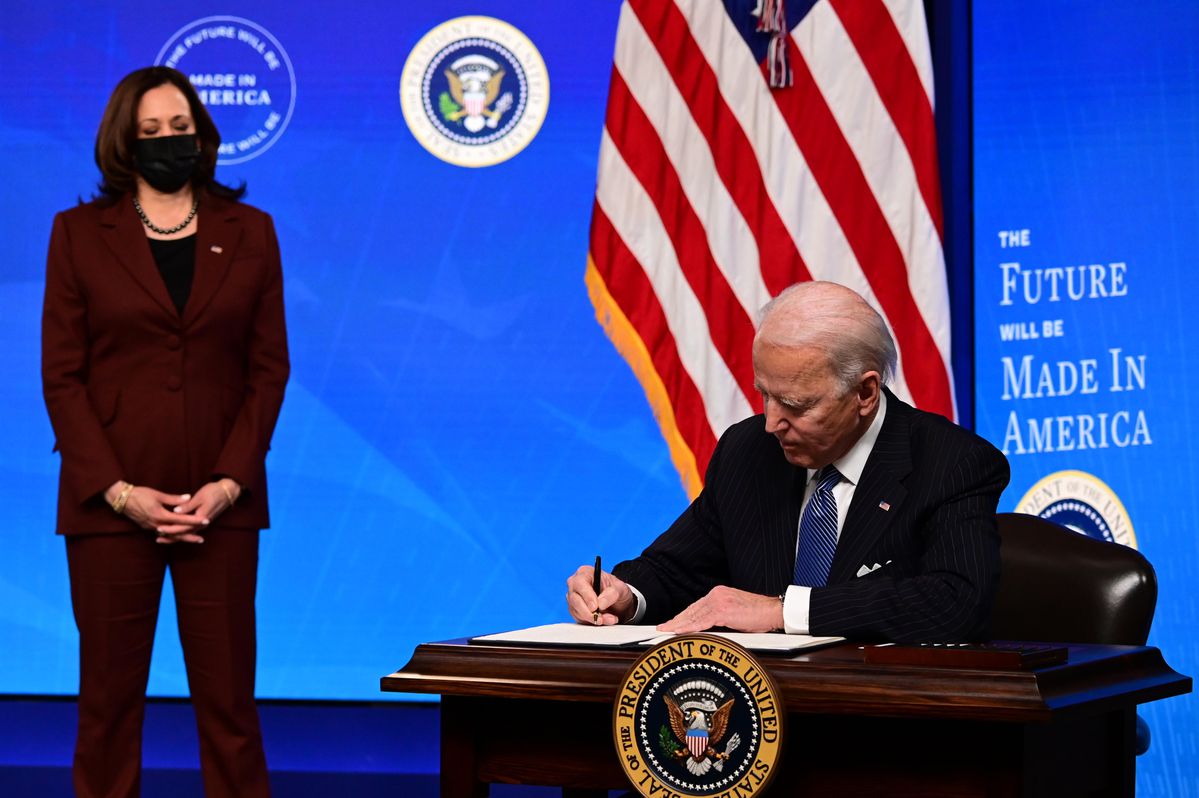

On January 25th, President Biden signed a “Made in America” Executive Order (EO) to strengthen the federal government’s policy to buy American. A political war is raging: nationalism emotions are challenging the principles of global supply chain effectiveness. Ironically, manufacturers—and ultimately American workers— will lose.
Covid-19 is challenging day-to-day supply chain operations. The pandemic is a layer of complexity on top of the residual 2020 trade and tax tariff policy impacts. As I watch the shift in policy and the increase in nationalism, I question, “Why are we not pushing for a supply chain modernization act? If we care about jobs, we need to make it easier for manufacturers to do business in the United States.”
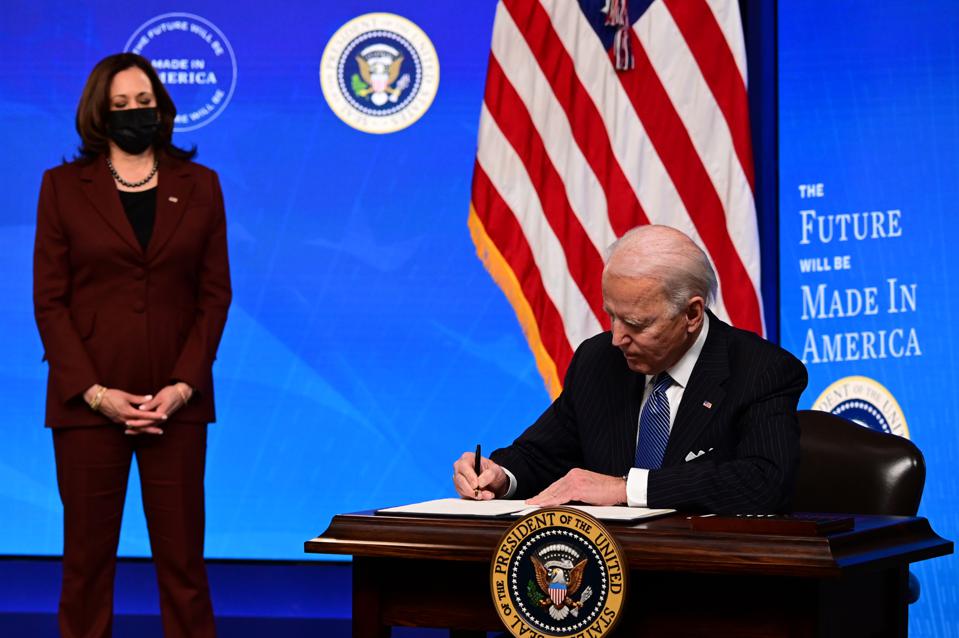
US President Joe Biden with Vice President Kamala Harris (L) signs a “Made in America” Executive … [+]
AFP via Getty Images
The issue is jobs. Biden is attempting to appease the disenfranchised blue-collar worker. While I understand the intent, in this post, I argue that we create more jobs by making the global supply chain effective than through protectionism legislation.
The Issues
Let’s start with the issues:
What Does Made in America Mean? In 2020, the Defense Department spent nearly $300 million by buying industrial machinery from foreign entities instead of buying American vehicles and engines from American companies. Today, federal law loopholes allow “Made in America” classification for federal procurement purposes even if barely 51% of the materials are sourced domestically. Administration officials did not say how much Biden intends to increase the threshold.
The product claim of “Made in America” sounds easy, but it is not. Nuances prevail with brand owners gaming their supply chains to gain favor. To help, the Federal Trade Commission published a forty-page document, but it is as clear as mud. We now have a proliferation of terms—Manufactured in the USA, Produced in the USA, Assembled in America. They are all meaningless if we cannot effectively track and trace products. This level of tracking is not possible today.
We will never drive compliance unless we can track goods and improve supply chain visibility. To do this, we need to strengthen barcoding, scanning, and transparency over business networks. The Federal Government needs to spend funds on a Supply Chain Modernization Act to improve digital transparency and accelerate network interoperability between and amongst networks. Today’s supply chain runs on the back of spreadsheets, portals, and EDI (Electronic Data Interchange) signals. None are sufficient. (With EDI, the data latency is high, and there is no bi-directional interoperability. The difference is analogous to old-fashioned mail. EDI is like an old-fashioned letter. It must be opened. The time in transit reduces effectiveness, and communication requires a return EDI signal.) Instead, we need a business internet designed for supply chain inter-operability.
Time Is Of The Essence. China proved remarkably resilient in 2020. At the end of last year, China emerged from a trade war with the US with a higher trade surplus, while the US saw its trade deficit grow.
United States growth contracted by 2.5% in 2020 but is forecasted to grow at 3.7% in 2021. Supply chains are in pandemic recovery mode. Every day brings a surprise. There is a shift from buying services to products. Supply chain leaders are struggling to catch-up. Manufacturing is only one part of an effective supply chain. We need to focus on redesigning the system, not focusing myopically on manufacturing. There is a 10-15% shortage of supply chain workers. We need to train and onboard the critical workers that inventory and move our products.
Transportation Infrastructure Needs To Be Job One. In 2020, United States imports were $3.1 trillion, and exports were $2.5 trillion. We take logistics for granted. This is a mistake. Manufacturers struggle with the decline in air freight and the congestion in ports. For example, global air freight capacity fell in January by 18%. In January 2021, there is 50% more cargo inbound than in 2020. Exports have declined for 23 out of the prior 25 months. Air cargo is scarce and expensive, and global ports are congested. It is a catch-22.
The rise in imports is a combination of trade policy, the US dollar’s strength, and preparation for the pending Chinese New Year shutdown. Today, there is a record number of ships off the United States’ west coast ports. Thirty ships are anchored off the Long Beach coast in a thick brown haze, with 21 expected in the coming next week.
The longer that goods are on the water, the greater the risk. Six days ago, winds gusting to 55 knots (63 mph) and 17-foot seas forced ships to leave spots at which they were anchored to relocate for safety. 2500 containers were swept overboard. No one knows what goods were lost.
Due to the imbalance of trade, US west coast ports are shipping back to Asia twice the number of empty boxes than full containers. Containers are dwelling longer. Covid-19 crew restrictions are a constraint. The US Government needs to accelerate vaccinations for dockworkers and improve shipping global digitization.
If we cannot move goods, manufacturers cannot sell products. In 2021, consumers are buying more products and fewer services. The acceleration of demand is good news for manufacturers, but the selling of products requires logistics infrastructure and global shipping is a constraint. We need to act.
Isolationism Is Not the Answer. The focus needs to be on improving the effectiveness of United States manufacturers. A myopic focus on manufacturing is not sufficient. Manufacturing is only one, albeit an important, element of global supply chain effectiveness for manufacturers. Most companies are global manufacturing companies serving global markets. For example, today, manufacturers are struggling with the worldwide shortage of semiconductors. The United States manufactures 47% of semiconductors. A Made in America program does not help, and can even compound the issue. With demand outstripping global supply in many categories, the focus needs to be on business continuity.
Can We Focus on Building An Effective Supply Chain?
There is a need for supply chain digitization and modernization. If we care about jobs and manufacturing, can we rapidly build a guiding coalition of supply chain professionals to attack the pressing issues of logistics infrastructure and business-to-business connectivity?
Recent Comments