


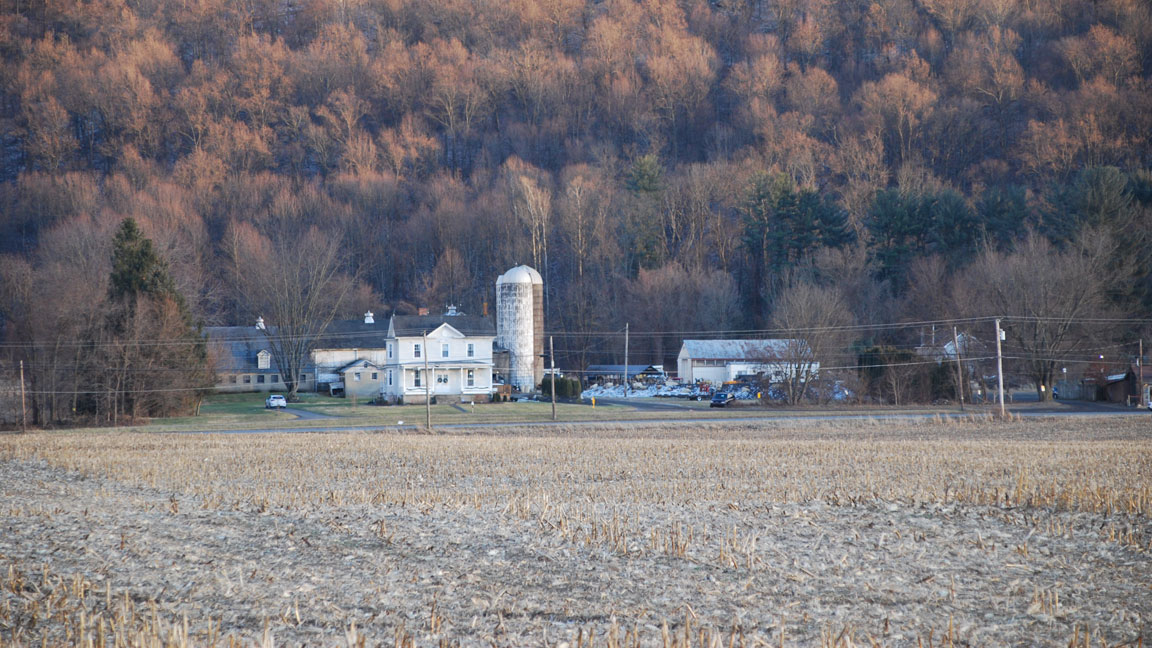
 Credit: Jon Hurdle
In Jackson, a developer is poised to clear 72 acres of forest to make room for more than 1 million square feet of warehouse space. In White Township, officials are weighing whether to allow construction of 2.8 million square feet of warehouse on farmland. And in Hamilton, a 1.2 million square-foot logistics park is taking shape on the site of a disused power plant by the Delaware River.
The warehouse projects are just a selection of those around New Jersey springing up following the surge in e-commerce, strongly fueled by the COVID-19 pandemic, and the resulting need by retailers to deliver more goods from new distribution points.
Developers justify the warehouse building trend as a response to strong market demand, and local officials welcome the creation of jobs and new tax revenue at a time of COVID-19-ravaged budgets. But residents and environmentalists say the giant projects swell truck traffic on local roads, increase the runoff of contaminated stormwater from newly impervious surfaces, and threaten to turn the remaining rural corners of the nation’s most densely populated state into industrial parks.
Emissions from commercial trucks have eclipsed the greenhouse gases from power plants, adding to the concern over increased traffic. New Jersey, under Gov. Phil Murphy, has been pushing for an increase in electric trucks to cut greenhouse gas emissions.
Another of those giant projects that environmental groups are concerned about is set for Upper Freehold in Monmouth County.
‘Irreversible, detrimental effects’
“We believe the proposed warehouse will pose irreversible, detrimental effects to the quality of life for residents in Upper Freehold Township and the surrounding towns due to loss of open space, increased traffic congestion, numerous adverse environmental effects, and the need for a water mitigation system and sewer to support the building’s infrastructure,” said the No Warehouse on 524 Coalition, a community group that’s fighting a plan to build a 566,840-square-foot warehouse on 118 acres of farmland along Route 524 in the township — a project that would require a change in zoning.
The opponents in Upper Freehold are urging local zoning officials to deny a permit for the warehouse, which they say should instead be built on a previously developed site such as a disused shopping mall or an old industrial site, both of which would have the infrastructure such as roads and access to mass transit to support it. The township’s planning board on Monday deferred a hearing on the application until April 15.
Marc Covitz, a member of the nearby Crosswicks-Doctors Creek Watershed Association, which opposes the project, said the developer, NP Freehold Industrial, is seeking zoning variances for warehousing, the building’s proposed 50-foot height, and parking. The company did not respond to a request for comment.
The current zoning is intended to ensure that any development is “congruent” with the surrounding area, which is farmland and planned residential development, Covitz said. “The point is to try to keep Upper Freehold as rural as possible,” he said.
In Jackson Township, Ocean County, officials on Monday reviewed but deferred a decision on an application to build two warehouses totaling just over 1 million square feet on a currently wooded 72-acre parcel that would be the final phase of Adventure Crossing, a sports, entertainment and commercial complex already under construction.
One vision of ‘Jackson’s future’
While Mayor Michael Reina has hailed the project as “Jackson’s future,” and the developer, Vito Cardinale, predicts the complex will become one of the top venues for youth sports in the Northeast, opponents say just the warehouse component will choke local roads with trucks and generate runoff that will pollute two watersheds.
Cardinale told the Jackson Township Planning Board on Monday that in response to residents’ concerns, he had reduced the size of the warehouse area by 16% from its original plan, cut the number of parking spaces by 28%, and moved the proposed warehouses to a part of the site not visible to residents.
“We will do everything in our power to make sure the residents don’t see them,” he said, referring to the warehouses.
But critics insist the plan is inappropriate for a residential area.
“There are thousands of residents living adjacent to this,” said Britta Wenzel, executive director of Save Barnegat Bay, whose watershed would be impacted by runoff from the new warehouses. “This is not an industrial area where you would anticipate traffic and heavy trucks and air pollution, and runoff and 24-7 operations; this is essentially adjacent to housing.
‘Bad plan, wrong place’
“It’s a bad plan, it’s a bad design, it’s in the wrong place, and there are plenty of other locations in Ocean County that would be appropriate for warehouses,” she said.
Wenzel said the best outcome would be for the township to use Ocean County’s open space fund to permanently preserve the 72 acres.
She urged the township’s planning board to reject the plan but acknowledged that she’s fighting an uphill battle. “I’m hoping that wiser minds will prevail but it’s very hard when someone owns a piece of land to tell them that they can’t develop it,” she said.
Doug O’Malley, director of Environment New Jersey, one of the groups opposing the Jackson project, called the township a “developer’s paradise” which has already approved projects that have clear-cut forests on the edge of the Pinelands and degraded waters that flow into Barnegat Bay. The warehouse project, he said, would create a “diesel truck mecca” on the edge of a residential community.
Big warehouse projects also prompt smaller distribution hubs to pop up, said Anne Strauss-Wieder, director of freight planning at the North Jersey Transportation Planning Authority.
“They are not just 1 million square-foot buildings,” she said, referring to all warehouses. “If you buy furniture from Pottery Barn, they aren’t going to send it straight from that big warehouse; they are going to send your furniture to a white-glove delivery service, which has its own distribution center, much smaller.”
By August of last year, e-commerce for home delivery or pickup at a store was 475% higher than a year ago, she said.
Are warehouses NJ’s new ‘McMansions’?
Across New Jersey, warehouses appear to have replaced “McMansions” as the cause of sprawl that is eating up the state’s scarce land resources, but the new development wave has not yet attracted much attention from planners, said Tim Evans, director of research at New Jersey Future, a nonprofit that advocates for “smart growth.”
While residential sprawl has slowed in the last 20 years in response to more consumer demand for urban living in denser communities — and a consequent increase in supply of those properties by developers — warehouse developers seem less interested in “brownfield” sites than previously undeveloped “greenfield” sites, Evans said.
“It has fallen under the radar for a while,” he said. “A lot of planners don’t think about goods movement. Most of the professional discussion is about where we put the buildings that people live in, and that we work in, and that we shop in but not so much about where our stuff comes from.”
Demand for warehouse space in New Jersey is fueled in part by the Port of Newark, which attracts an increasing volume of imported goods from South Asia, which can reach the eastern U.S. market more quickly by using the Suez Canal and the Atlantic Ocean than it can by crossing the Pacific and then shipping goods across the country by truck or train, Evans said.
Distributors of the influx of foreign goods want to put them in warehouses next to highways but much of that land is taken, and so the demand is spreading to undeveloped areas where a surge in truck traffic threatens to overwhelm rural roads and small towns.
“These forces have been building up, but they are hitting a critical mass now, with the port becoming busier and with more people shopping online,” he said. “We’re getting to that point where we should be taking a bigger-picture look at what’s happening. We’re probably going to see more and more of this.”
In September, a report from Rutgers and Rowan universities said the use of newly developed land for housing or commerce slowed sharply between 2012 and 2015 compared with the late 1990s largely because of rising demand for city living. But its authors warned that the trend could be reversed by a pandemic-driven increase in demand for a return of people to the suburbs.
Old shopping malls, industrial lots
Advocates for curbs on warehouse development say developers should build on previously used sites like abandoned shopping malls or industrial lots rather than greenfield sites. But even reused sites can have drawbacks, environmentalists say.
In Hamilton, Mercer County, the site of the Mercer Generating Station, a retired coal-fired power plant next to the Delaware River, is being redeveloped for two warehouses totaling 1.23 million square feet, due for completion by the middle of this year. The site is being reused by Chicago-based Hilco Redevelopment Partners, a major national developer of obsolete industrial sites, which is also converting a 1,300-acre refinery in Philadelphia into a massive logistics complex with up to 15 million square feet of warehouse space.
Even though the Hamilton project is on a “brownfield” site, O’Malley of Environment New Jersey argued that the warehouses should not have been permitted because the site is in the middle of a wetland and runoff from the impervious surface created for hundreds of trucks and cars will damage the adjacent river. He predicted the warehouses will create a “24-hour truck pollution hot spot.”
In Warren County, concern about warehouse sprawl prompted officials to order a study last year into the impact of current, proposed and potential warehouses that could total 45 million square feet on 4,000 acres across 11 towns. It concluded that if all were built, new truck traffic would create “unacceptable conditions” on local roads.
The proposed Warren County projects include one for 2.8 million square feet on farmland in White Township, whose location between Interstates 78 and 80 is attractive for warehouse developers. Residents fear county roads would be overwhelmed by trucks if the project goes ahead.
Michele Donato, a land-use attorney who represents townships facing warehouse development, said she tries to persuade them to adopt land-use plans that aren’t driven by the need to attract developments that will increase tax revenues.
She said most new warehouse projects are on greenfield sites because their developers don’t have to clear away traces of the old use, including environmental contamination.
“Developers purchase vacant land because that gives them a blank slate, so there is less complication with the uses they propose,” she said. “They can design it as they choose, in a way that suits their needs. It’s just an easier way to do it.”
She said warehouse sprawl in New Jersey is adding to over-development that threatens the nature of the whole state.
“New Jersey is at a point where we’re never going to be able to call it the Garden State again,” she said.
Recent Comments