


The modern fascist movement relies on Big Tech to reproduce itself—and they know it.
Before Twitter, Facebook, Instagram, and even Pinterest banned Donald Trump, the then president was taking aim at a wonkish target: Section 230, a 1996 provision of the Communications Decency Act that shields tech companies from being sued for the content they host. As he told his base in the lead-up to the fumbled coup attempt on January 6, “We have to get rid of Section 230, or you’re not going to have a country.” Around the same time, Trump vetoed the annual defense spending bill because it didn’t repeal 230, and pressured Republican Senate Majority Leader Mitch McConnell to make it a bargaining chip in the stimulus negotiations.
In pursuing their campaign against 230 at the same time that they’re seeking to protect corporations from worker lawsuits related to Covid-19, conservatives have made their agenda painfully clear: Corporate liability is only permissible in the tech industry if it helps them dominate the platforms and capture a sector that has long been the darling of liberals.
It was the so-called Atari Democrats who, deeming tech a source of growth during the economically stagnant 1980s, grew the industry through tax breaks, regulatory loopholes, and the privatization of the formerly public “Internet.” Today, computational infrastructure has crept into nearly every corner of our lives, enabling media curation, labor control, means testing, resource distribution, and much more. These systems generally employ AI—powerful algorithms that require surveillance and other data to train and inform them. The result is an unprecedented scale and granularity of tracking and control.
This ascent was part of an implicit bargain: Democrats relied on Big Tech for campaign contributions and the partisanship of its elite workforce; in exchange they gave companies control over the infrastructure on which our civic institutions relied. Then came 2016. The industry that Democrats had spent decades boosting wasn’t living up to its unspoken agreement to use their power responsibly. Rebuking tech executives for disseminating misinformation through engagement-driven algorithms, Democrats revisited the terms of their deal. “The same Federal law that allowed your companies to grow and thrive,” said Democratic Senator and Section 230 author Ron Wyden, “gives you absolute legal protection to take action against those who abuse your platforms to damage our democracy.” For some, the time had come to break them up.
The US right, meanwhile, was taking a different tack to gain influence over tech infrastructure. Conservatives, joined by some hawkish Democrats and tech titans like Alphabet’s Eric Schmidt, have been working to align the profit motives of these giant corporations with the interests of the police and US armed forces. At the same time, the global far right is using YouTube and other social media to radicalize people who follow algorithmic recommendations to hate speech and misinformation while countering grassroots efforts to deplatform such dangerous language.
The right in the US has made a clever calculus. Just the threat of repealing Section 230 restrains tech companies from taking action against online fascists and hate speech. If they were to take incendiary speech off their platforms, not only would fascists troll the firms, but Republicans would push even harder to remove 230 under the banner of “anti-conservative bias.” And if the right were to go through with its threat and repeal 230, companies would still want to avoid lawsuits from well-funded and well-organized conservatives. In this scenario, tech companies would push their decisions about “permissible content” into the hands of their top lawyers. Afraid of Republican backlash, they would become de facto editors. In either case, companies would hesitate to expel fascists, especially given the revenue-generating potential of their content—which is substantial for engagement-driven platforms, as Harvard’s Joan Donovan points out.
For now, the far right in the US has hit a road bump in its attempt to seize tech from the liberals. Not only have thousands of far-right accounts been banned by the most powerful social media platforms, but efforts to move its base to Parler have been contained after the alt social network (underwritten by the powerful Mercer family) was deplatformed by Apple, Google, and Amazon, which has so far successfully invoked Section 230 against Parler’s legal claim that it should be reinstated on Amazon’s web-hosting services. Seeking a stable transfer of power during the violent dusk of the Trump presidency, the owners of US tech platforms have finally heeded the warnings of workers, researchers, and advocates. For years, Black feminist scholars like Sydette Harry and I’Nasah Crockett have documented the way online ad-tech companies like Facebook and YouTube amplify and enable a fascist media ecosystem that results in Black women in particular being hounded off platforms.
That it took this long for Big Tech companies to take fascists seriously enough to remove some of them from social media should serve as a wakeup call: Elites tend to realize the dangers of fascism only when violent flashpoints hit close to home. It is workers and historically marginalized people who are—and always have been—the antifascist frontline. If progressives are to ensure that technical systems aren’t yoked to a far-right agenda, they’ll need to stop relying on legislative maneuvering or entreaties to corporations and, together with these frontline actors globally, vie for control over the infrastructure itself.
Infrastructures of Control
Reflecting on the dynamics of German National Socialism in 1941, exiled philosopher Herbert Marcuse saw “a striking example of the ways in which a highly rationalized and mechanized economy with the utmost efficiency in production can also operate in the interest of totalitarian oppression.” Industrial capitalism’s tools of efficiency and profit, he argued, can easily serve authoritarian ends.
The history of IBM’s work on the Nazi census presents a chilling lesson. In service of the Nazi regime, IBM’s German subsidiary customized its Hollerith punch-card systems to allow the government to classify, track, and sort people based on categories like “Jewish.” Without IBM’s proto-computational technology, the Holocaust’s ghastly efficiency would not have been possible. Indeed, the numbers tattooed on the arms of many Nazi prisoners were their Hollerith codes, which allowed them to be neatly accounted for in the database.
Nazi Germany isn’t exceptional in its use of the computational tools to discipline and oppress its population. South Africa’s Apartheid government also relied on systems of technological efficiency to maintain brutal minority rule. In 1970 they contracted IBM to build the Book of Life, a computerized identity registry linked to the country’s hated passbooks. This system provided pretext for stop-and-frisk-style police domination and harassment and for managing an exploitable, racialized labor force. As one bureaucrat put it, “The combination of [passbooks] and a central registry would permit total control of the black population, allowing Native Affairs bureaucrats to allocate the black labour force efficiently while permitting police to locate and identify any individual swiftly and positively.”
Hollerith machines and the mainframe computers that powered the Book of Life are a far cry from the powerful computational infrastructure of today. But the modern systems are built on those foundations. They are still codifying and reproducing patterns of racialized and gendered inequality, and they are already use in high-stakes domains—applied by insurance companies and hospitals to decide who gets health care, by landlords to select “good” tenants, by cops to predict who is a criminal, and by employers to determine whether or not someone will be a productive worker and then to surveil, control, and assess them once they are hired.
Labor’s Past
Just as Big Tech’s command of the means of surveillance and coercion echo authoritarian histories, labor’s historical fight against mechanized and automated systems points a way forward, toward militant mass movements demanding ownership and agency over the infrastructure of social control.
In 1912, the Massachusetts state legislature passed a law that reduced weekly hours for women and children. But workers in the textile hub of Lawrence suspected a loophole, and their suspicions were confirmed “when the mill corporations speeded up the machines and posted notices that, following January 1, the 54-hour work week would be maximum for both men and women operatives,” as labor educator and historian Joyce Kornbluh recounts. In other words, while the mill owners honored the weekly-hour limit set by the legislature, they subverted its intent by speeding up the mechanical looms, which increased workloads and reduced workers’ take-home pay.
Organized through the Industrial Workers of the World, mill workers went on strike with banners that read, “We want bread, and roses, too”—a demand for more than subsistence. Reflecting on this bold political scope, labor reporter Mary Heaton Vorse commented at the time, “It was the spirit of workers that was dangerous.”
Those opposing the workers understood this as well. Militias made up of Harvard students attacked strikers; Congress called hearings; and strike leaders were imprisoned under false charges. Ultimately the workers won increased wages and agreed to return to the mills. But they did not gain power over the mechanized infrastructure of worker control, which made them vulnerable to a counteroffensive. In addition to creating a spy network on the shop floor to identify and root out worker organizing, mill owners implemented additional speedups that displaced workers and nullified the wage increase won during their strike.
This is a lesson the US labor movement of the 1920s and ’30s took to heart. They shaped their demands for control over production technologies and linked them to questions of human dignity and political autonomy.
In Southeastern Michigan, workers challenged the terms of Henry Ford’s “wage-effort bargain,” in which a $5 wage and other material benefits came at the expense of domination on and off the clock. Ford’s “sociology department” would even make unannounced home visits to determine if workers were sufficiently clean and sober. Black workers, newly arrived through the Great Migration, were made especially vulnerable through usurious payment plans for homes that Ford built as industrial growth outpaced housing availability.
As the benefits that workers had traded for autonomy dried up with the Great Depression—during which two-thirds of the sector was laid off—Detroit’s working class began organizing through the Unemployed Councils, a national initiative of the Communist Party. This was particularly important for Black workers, who were usually the “last hired, first fired.” The Councils shut down several plants and jumpstarted the first wave of strikes in the auto sector. They made economic and political demands that went well beyond the workplace: They wanted the reinstatement of unemployed workers, health insurance for them and their families, a halt to the Ford home foreclosures, an end to discrimination against Black workers, the abolition of Ford’s internal security agency, and even the release of the Scottsboro Boys, Black teens who had been framed for rape. These organizers understood that that worker power was a force that could achieve political ends toward justice and equity.
Inside the plants, workers began experimenting with a series of slowdowns that culminated in the famous 1936–1937 Flint sit-down strike. They forced the auto industry to recognize their union after shutting down several “mother plants,” which were indispensable to production. But their fight didn’t end there. The camaraderie that developed during the plant occupations emboldened them to make demands over the pace of work and the infrastructure of worker control. On an almost daily basis, they challenged managerial authority through shop steward representation, slowdowns, and strikes. The threat these workers posed to capital accumulation prompted employers, the state, and union bureaucrats to work together to undermine their power. The postwar “red scare”—and the wartime no-strike pledges that laid the ground for it—saw union leadership cutting deals with management as they purged leftwing dissidents. As Walter Reuther, the president of the United Auto Workers (UAW) during this period, said, “Labor is not fighting for a larger slice of the national pie…labor is fighting for a larger pie.” What was good for business was, in Reuther’s view, good for workers.
This did not turn out to be true. The narrowing of organized labor’s focus took militant action off the table and reduced the site of worker struggle from politics and power to negotiating contracts around pay and benefits—with few ways to push back when these were violated. Carl Keithly, a Chevrolet factory worker under United Auto Workers at this time, summarized the cost: “The company will cut your wages, knock out your seniority and your vacations, and there will be no way to protest outside of quitting your job. There will be nothing left at the plant but wage cuts and speedup.”
In the face of increasing automation, this was a serious misstep for labor. As scholar and autoworker James Boggs stated, “A new force had now entered the picture, a force which the union had given up its claim to control when in 1948 it yielded to management the sole right to run production as it saw fit… Management began introducing automation at a rapid rate.” Boggs, writing in the early 1960s, went on to remark that “today the workers are doing in eight hours the actual physical work they used to do in 12.”
The State of Play Today
Automation was just one aspect of US employers’ reassertion of control. Sociologists Joshua Murray and Michael Schwartz show that after the UAW’s conciliatory turn, US automakers decoupled their production process, stockpiling parts in every plant so that workers at one particular plant would be unable to fully disrupt operations again. Moreover, as a global economic crisis took hold in the 1970s, employers invested in systems of technical management and automation in order to recover profitability, further entrenching mechanisms of worker control and immiseration. This strategy didn’t return the US to manufacturing leadership. Instead, it helped elevate tech as a sector in its own right.
Today, the app-based precarity (or “gig”) economy, enabled by large-scale AI systems, has led to an increasingly dire situation, in which workers’ livelihoods are dictated by opaque algorithms calibrated to extract as much profit from them as possible. This is compounded by US-based gig companies’ self-serving legislative maneuvering and dissembling marketing, which as legal scholar Veena Dubal argues, has already rolled back US labor protection to create a low-rights category of app-based workers who lack basic protections, like an hourly wage floor or health insurance. But this isn’t confined to app-based workers. Across all job categories, workers are being hired, surveilled, controlled, and assessed by opaque algorithmic systems tuned to maximize employers’ objectives. A startup called Argyle is even selling a service that claims to create a kind of worker credit score by aggregating workers’ employment records across jobs along with other data. The company sells this to businesses for use in hiring, as well as to insurers and lenders.
It’s not surprising then that we’ve seen a surge of labor action, particularly among workers most subject to these systems. Amazon warehouse workers, whose labor is controlled by a punishing algorithmic productivity rate, have organized across Europe and the United States, carrying signs reading, “We are not robots.” Striking Instacart workers have also opposed the company’s “black box” app, which sets workers’ pay via an unintelligible model that “mathwashes” their exploitation. In a similar vein, the All India Gig Workers Union recently demanded that app-based delivery company Swiggy “stop algorithmic manipulation of ratings and incentives payout.”
Those suffering under Big Tech know the source of their pain and are not fooled by marketing about “flexibility” and “entrepreneurship.” These workers have broadened the terrain of labor struggle to include the technical infrastructure that dictates their livelihoods, something that heralds a return to the militancy of the ’20s and ’30s.
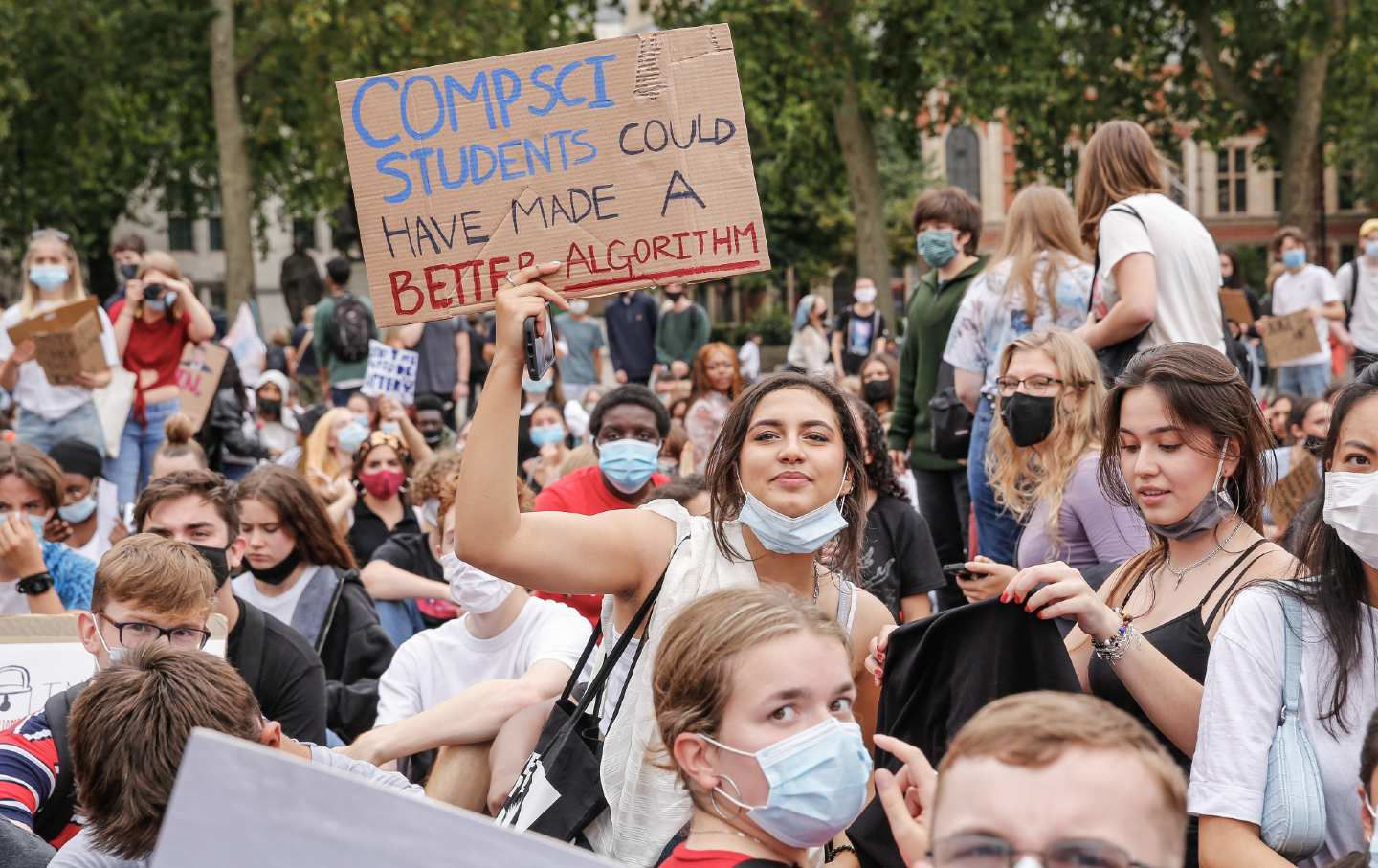
People outside of the workplace but whose tastes and opportunities are increasingly directed by algorithms have also registered dissent. These efforts often combine strategic litigation, protest, and legislative campaigns. Protesters have pushed for—and in some cases won—bans and moratoria on the use of facial recognition in the US. Students in the UK rallied under the slogan “fuck the algorithm” and successfully sued the British government for using racist software that determined student rankings during Covid-19. And in Canada, after years of struggle, the Block Sidewalk campaign forced Google to abandon its plan to develop a “smart” surveillant city on the Toronto waterfront.
The growing worker uprisings and community-based opposition movements present an organic coalition that progressives would do well to acknowledge and support, especially when their demands involve issues of control and ownership of technical systems. Amazon warehouse workers in Poland, who are fighting not only for a reduction in the grueling pace of work but for access to the data and algorithms that set it, are making a claim to the conditions of their labor and to the systems that mediate it. Similarly, organized white-collar tech workers are fighting for the right to refuse unethical work and the ability to shape their companies’ decisions on issues like climate change or whether or not they should partner with the US military. Importantly, many of these efforts go beyond the scope of the workplace or workers’ immediate material conditions. Aims shared by tech workers and community organizers in the US have animated the movement, putting those directly affected by technologies of social control, like people experiencing surveillance and tracking by Immigration and Customs Enforcement, in coalition with workers refusing to create such technologies.
Terrains of Contestation
We’re not likely to get much help from the mainstream of the Democratic Party in claiming a tech infrastructure for the people. Failing to situate congressional reform efforts within a broader strategy for building power, establishment liberals have a record of losing even their piecemeal initiatives to the right.
In addition to leading the charge against Section 230, Republican members of Congress Jim Jordan, Tom Cotton, and Josh Hawley spent much of 2020 working to appropriate and warp progressives’ antitrust agenda to combat tech’s alleged anti-conservative bias. In reality, the far right has been using algorithmic targeting and social media to create a powerful propaganda arm that bypasses more responsible media. Indeed, the role that social media played in helping coordinate the recent coup attempt on the Capitol speaks to the centrality of these platforms to the fascist agenda and to Big Tech’s historical permissiveness and perverse business incentives. And it’s not just in the US; Facebook was used to fan a genocide of the Muslim Rohingya minority in Myanmar and similar dynamics are visible now in Ethiopia.
The US far right has fashioned a compelling if fatuous narrative for its growing base: The “Big Tech oligarchs,” as Cotton calls them, are liberal gatekeepers driving conservatives out of business and curbing their freedom of speech. The recent enforcement of terms of service for a handful of English-speaking accounts will further fuel this narrative, even if this move follows years of inaction on similar accounts around the globe, as scholar Jillian York points out.
Establishment Democrats remain unable to counter this narrative. Hamstrung by their allegiance to large corporate donors and reticent to reclaim the interests of their once more working-class base, they are easily neutralized in their legislative efforts to reform tech. And Biden’s willingness to consider Big Tech insiders to key cabinet positions does not signal a change.
The Political Horizon
Facing the consequences of punitive technologies of social control, workers and social movements are beginning to reject meek unionism and the conciliatory reforms of the Democratic Party. In the process, they are building a progressive flank in the battle for control of algorithms, data, and the computational systems. These coalitions are also claiming ownership of the imaginative horizon, including the right to dismantle, reject, and rebuild technical infrastructures. And they’re recognizing themselves as political actors, pushing institutions to meet social obligations. This is something typified by progressive teachers’ unions, who have not only fought the use of tracking and ed-tech surveillance but are also “bargaining for the common good.”
Tech workers, too, are forming unions and coalitions that unite those building technologies of social control—or, refusing to build them—with the communities harmed by them. Adrienne Williams, an Amazon delivery driver and organizer, expressed this when she called on drivers and engineers to design the algorithmically generated driving routes together. As she told Vice, “Our routes [in the San Francisco Bay Area] are designed by employees in Seattle. They’re so dangerous and inefficient. You could fix this immediately if the drivers just had someone to talk to.” Here we see the progressive wing fight to determine who gets to shape, or be shaped by, tech. It is one of our best hopes for combatting a fascist takeover of computational systems of control.
While Section 230 certainly needs improvement, reform alone will neither reduce concentrated platform power nor address the capitalist incentives that propelled Big Tech companies to provide propaganda tools for fascists around the world. Meanwhile, it is also clear that the fight against a brute repeal of Section 230, which would be disastrous for sex workers and other marginalized populations, will only be won as part of a broader and more militant fight. It will require the kind of nuanced understanding of tech’s unevenly distributed harms and consequences that does not come from the executive offices of tech companies or the halls of Congress.
The progressive tech agenda must be international, and will emerge through supporting and drawing connections between sex workers who’ve opposed the harmful effects of SESTA/FOSTA, the 2018 amendment to Section 230 that made online platforms liable for content promoting sex work; elite tech workers, like those at Kickstarter who’ve contested their employers’ capitulation to fascist trolls; low-paid tech workers objecting to algorithmic exploitation; frontline workers who, in the model of Los Angeles safety councils, are demanding access to data about their lives and health; Amazon workers who’ve formed international organizations; Coupang e-commerce workers in South Korea who sent messages of solidarity to e-commerce workers elsewhere; tenants who’ve fought landlords’ use of assessment and surveillance technologies; and other communities and organizers resisting carceral infrastructure of control and domination. These, among others, are the protagonists shaping a more socially just tech infrastructure, and it is their struggle that regulation efforts should work to bolster.
The neoliberal bargain is fraying, and if we don’t vie for control over the algorithms, data, and infrastructure that are shaping our lives, we face a grim future. It is time to rally behind a militant strategy that recognizes the danger of leaving US tech capitalists at the helm of systems of social control while far-right authoritarians jockey for access. A new and historic bloc is possible. Militant workers, engaged social movements, progressive politicians, radical lawyers, and critical researchers will find that achieving their demands for control will—indeed, must—radically change the tech ecosystem. Contesting for power against those who have it is never easy, but the path forward is clear: Fuck the algorithms, dismantle the tech monopolies, and build infrastructures of care and justice where these systems of social control once stood.
Recent Comments