

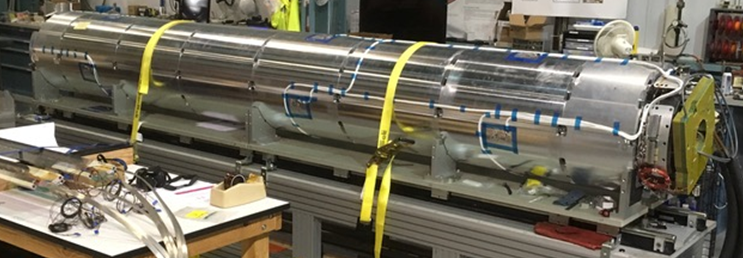

In a multiyear effort involving three national laboratories from across the United States, researchers have successfully built and tested a powerful new magnet based on an advanced superconducting material. The eight-ton device –- about as long as a semi-truck trailer — set a record for the highest field strength ever recorded for an accelerator focusing magnet and raises the standard for magnets operating in high-energy particle colliders.
The Department of Energy’s Fermilab, Brookhaven National Laboratory and Lawrence Berkeley National Laboratory designed, built and tested the new magnet, one of 16 they will provide for operation in the High-Luminosity Large Hadron Collider at CERN laboratory in Europe. The 16 magnets, along with another eight produced by CERN, serve as “optics” for charged particles: They will focus beams of protons into a tiny, infinitesimal spot as they approach collision inside two different particle detectors.
The ingredient that sets these U.S.-produced magnets apart is niobium-tin – a superconducting material that produces strong magnetic fields. These will be the first niobium-tin quadrupole magnets ever to operate in a particle accelerator.
The ingredient that sets these U.S.-produced magnets apart is niobium-tin – a superconducting material that produces strong magnetic fields.
Like the current Large Hadron Collider, its high-luminosity successor will smash together beams of protons cruising around the 17-mile ring at close to the speed of light. The HL-LHC will pack an additional punch: It will provide 10 times the collisions that are possible at the current LHC. With more collisions come more opportunities to discover new physics.
And the machine’s new focusing magnets will help it achieve that leap in delivered luminosity.
“We’ve demonstrated that this first quadrupole magnet behaves successfully and according to design, based on the multiyear development effort made possible by DOE investments in this new technology,” said Fermilab scientist Giorgio Apollinari, head of the U.S. Accelerator Upgrade Project, which leads the U.S.-based focusing-magnet project.
“It’s a very cutting-edge magnet, really on the edge of magnet technology,” said Brookhaven National Laboratory scientist Kathleen Amm, the Brookhaven representative for the Accelerator Upgrade Project.
What makes it successful is its impressive ability to focus.
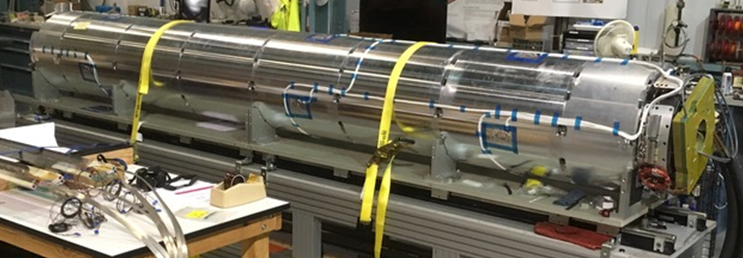
This new magnet reached the highest field strength ever recorded for an accelerator focusing magnet. Designed and built by Fermilab, Brookhaven National Laboratory and Lawrence Berkeley National Laboratory, it will be the first niobium-tin quadrupole magnet ever to operate in a particle accelerator — in this case, the future High-Luminosity Large Hadron Collider at CERN. Photo: Dan Cheng, Lawrence Berkeley National Laboratory
Focus, magnets, focus
In circular colliders, two beams of particles race around the ring in opposite directions. An instant before they reach the collision point, each beam passes through a series of magnets that focus the particle beams into a tiny, infinitesimal spot, much the way lenses focus light rays to a point. Now packed as tightly with particles as the magnets can get them — smash! — the beams collide.
The scientific fruitfulness of that smash depends on how dense the beam is. The more particles that are crowded into the collision point, the greater the chance of particle collisions.
You get those tightly packed beams by sharpening the magnet’s focus. One way to do that is to widen the lens. Consider light:
“If you try to focus the light from the sun using a magnifying glass at a small point, you want to have a more ‘powerful’ magnifying glass,” said Ian Pong, Berkeley Lab scientist and one of the control account managers.
A larger magnifying glass focuses more of the sun’s rays than a smaller one. However, the light rays at the outer rim of the lens have to be bent more sharply in order to approach the same focal point.
Or consider a group of archers shooting arrows at an apple: More arrows will stick if the archers shoot from above, below and either side of the apple than if they are stationed at one post, firing from the same position.
The analog of the magnifying glass size and the archer array is the magnet’s aperture — the opening of the passageway the beam takes as it barrels through the magnet’s interior. If the particle beam is allowed to start wide before being focused, more particles will arrive at the intended focal point — the center of the particle detector.
The U.S. team widened the LHC focusing magnet’s aperture to 150 millimeters, more than double the current aperture of 70 millimeters.
But of course, a wider aperture isn’t enough. There is still the matter of actually focusing the beam, which means forcing a dramatic change in the beam’s size, from wide to narrow, by the time the beam reaches the collision point. And that requires an exceptionally strong magnet.
“The magnet has to squeeze the beam more powerfully than the LHC’s present magnets in order to create the luminosity needed for the HL-LHC,” Apollinari said.
“The magnet has to squeeze the beam more powerfully than the LHC’s present magnets in order to create the luminosity needed for the HL-LHC,” Apollinari said.
To meet the demand, scientists designed and constructed a muscular focusing magnet, calculating that, at the required aperture, it would have to generate a field exceeding 11.4 teslas. This is up from the current 7.5-tesla field generated by the niobium-titanium-based LHC quadrupole magnets. (For accelerator experts: The HL-LHC integrated luminosity goal is 3,000 inverse femtobarns.)
In January, the three-lab team’s first HL-LHC focusing magnet delivered above the goal performance, achieving an 11.5-tesla field and running continuously at this strength for five straight hours, just as it would operate when the High-Luminosity LHC starts up in 2027.
“These magnets are the currently highest-field focusing magnets in accelerators as they exist today,” Amm said. “We’re really pushing to higher fields, which allows us to get to higher luminosities.”
The new focusing magnet was a triumph, thanks to niobium-tin.
Niobium-tin for the win
The focusing magnets in the current LHC are made with niobium-titanium, whose intrinsic performance limit is generally recognized to have been reached at 8 to 9 teslas in accelerator applications.
The HL-LHC will need magnets with around 12 teslas, about 250,000 times stronger than the Earth’s magnetic field at its surface.
“So what do you do? You need to go to a different conductor,” Apollinari said.
Accelerator magnet experts have been experimenting with niobium-tin for decades. Electrical current coursing through a niobium-tin superconductor can generate magnetic fields of 12 teslas and higher — but only if the niobium and tin, once mixed and heat treated to become superconductive, can stay intact.
“Once they’re reacted, it becomes a beautiful superconductor that can carry a lot of current, but then it also becomes brittle,” Apollinari said.
Famously brittle.
“If you bend it too much, even a little bit, once it’s a reacted material, it sounds like corn flakes,” Amm said. “You actually hear it break.”
Over the years, scientists and engineers have figured out how to produce niobium-tin superconductor in a form that is useful. Guaranteeing that it would hold up as the star of an HL-LHC focusing magnet was another challenge altogether.
Berkeley, Brookhaven and Fermilab experts made it happen. Their assembly process is a delicate, involved operation balancing niobium-tin’s fragility against the massive changes in temperature and pressure it undergoes as it becomes the primary player in a future collider magnet.
The process starts with wires containing niobium filaments surrounding a tin core, provided by an outside manufacturer. The wires are then fabricated into cables at Berkeley in just the right way. The teams at Brookhaven and Fermilab then wind these cables into coils, careful to avoid deforming them excessively. They heat the coils in a furnace in three temperature stages, a treatment that takes more than a week. During heat treatment the tin reacts with the filaments to form the brittle niobium-tin.
Having been reacted in the furnace, the niobium-tin is now at its most fragile, so it is handled with care as the team cures it, embedding it in a resin to become a solid, strong coil.
That coil is now ready to serve as one of the focusing magnet’s four poles. The process takes several months for each pole before the full magnet can be assembled.
“Because these coils are very powerful when they are energized, there is a lot of force trying to push the magnet apart,” Pong said. “Even if the magnet is not deforming, at the conductor level there will be a strain, to which niobium-tin’s performance is very sensitive. The management of the stress is very, very important for these high-field magnets.”
Heat treating the magnet coils — one of the intermediate steps in the magnet’s assembly — is also a subtle science. Each of the four coils of an HL-LHC focusing magnet weighs about one ton and has to be heat-treated evenly — inside and out.
“You have to control the temperature well. Otherwise the reaction will not give us the best performance. It’s a bit like cooking,” Pong said.
“You have to control the temperature well. Otherwise the reaction will not give us the best performance,” Pong said. “It’s a bit like cooking. It’s not just to achieve the temperature in one part of the coil but in the entire coil, end to end, top to bottom, the whole thing.”
And the four coils have to be aligned precisely with one another.
“You need very high field precision, so we have to have very high precision in how they align these to get good magnetic-field uniformity, a good quadrupole field,” Amm said.
The fine engineering that goes into the U.S. HL-LHC magnets has sharpened over decades, with a payoff that is energizing the particle accelerator community.
“This will be the first use of niobium-tin in accelerator focusing magnets, so it will be pretty exciting to see such a complex and sophisticated technology get implemented into a real machine,” Amm said.
“We were always carrying the weight of responsibility, the hope in the last 10, 20 years — and if you want to go further, 30, 40 years — focusing on these magnets, on conductor development, all the work,” Pong said. “Finally, we are coming to it, and we really want to make sure it is a lasting success.”
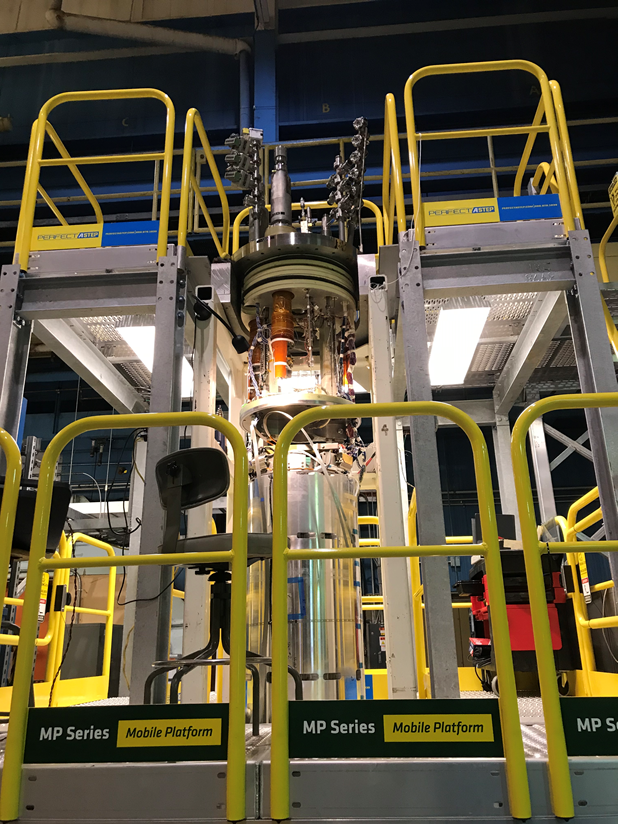
The magnet gets ready for a test at Brookhaven National Laboratory. Photo: Brookhaven National Laboratory
The many moving parts of an accelerator collaboration
Ensuring lasting success has as much to do with the operational choreography as it does with the exquisite engineering. Conducting logistics that span years and a continent requires painstaking coordination.
“Planning and scheduling are very important, and they’re quite challenging,” Pong said. “For example, transportation communication: We have to make sure that things are well protected. Otherwise these expensive items can be damaged, so we have to foresee issues and prevent them. Delays also have an impact on the whole project, so we have to ensure components are shipped to destination in a timely schedule.”
Amm, Apollinari and Pong acknowledge that the three-lab team have met the challenges capably, operating as a well-oiled machine.
“The technologies developed at Fermilab, Brookhaven and Berkeley helped make the original LHC a success. And now again, these technologies out of the U.S. are really helping CERN be successful,” Amm said. “It’s a dream team, and it’s an honor to be a part of it.”
The U.S.-based Accelerator Upgrade Project for the HL-LHC, of which the focusing-magnet project is one piece, kicked off in 2016, growing out of a 2003 predecessor R&D program that focused on similar accelerator technology projects.
From now until about 2025, the U.S. labs will continue to build the large, hulking tubes, starting with fine strands of niobium and tin. They plan to begin delivering in 2022 the first of 16 magnets, plus four spares, to CERN. Installation will take place over the three years following.
“Our magnets are massive superconducting devices, focusing tiny invisible particle beams that are flying close to the speed of light through the bore. It’s quite magical,” Pong said.
“People say that ‘touchdown’ is a very beautiful word to describe the landing of an airplane, because you have a huge metal object weighing hundreds of tons, descending from the sky, touching a concrete runway very gently,” Pong said. “These magnets are not too different from that. Our magnets are massive superconducting devices, focusing tiny invisible particle beams that are flying close to the speed of light through the bore. It’s quite magical.”
The magic starts in 2027, when the High-Luminosity LHC comes online.
“We are doing today the work that future young researchers will use in 10 or 20 years from now to push the frontier of human knowledge, just like it happened when I was a young researcher here at Fermilab, using the Tevatron,” Apollinari said. “It’s a generational passing of the baton. We need to make the machines for the future generations, and with this technology, obviously what we can enable for the future generation is a lot.”
Learn more about the High-Luminosity LHC in Symmetry and in an 11-minute Fermilab YouTube video.
Fermilab is America’s premier national laboratory for particle physics and accelerator research. A U.S. Department of Energy Office of Science laboratory, Fermilab is located near Chicago, Illinois, and operated under contract by the Fermi Research Alliance LLC, a joint partnership between the University of Chicago and the Universities Research Association, Inc. Visit Fermilab’s website at www.fnal.gov and follow us on Twitter at @Fermilab.
This accelerator magnet work is supported by the Department of Energy Office of Science.
Fermilab is supported by the Office of Science of the U.S. Department of Energy. The Office of Science is the single largest supporter of basic research in the physical sciences in the United States and is working to address some of the most pressing challenges of our time. For more information, please visit energy.gov/science.
Recent Comments