

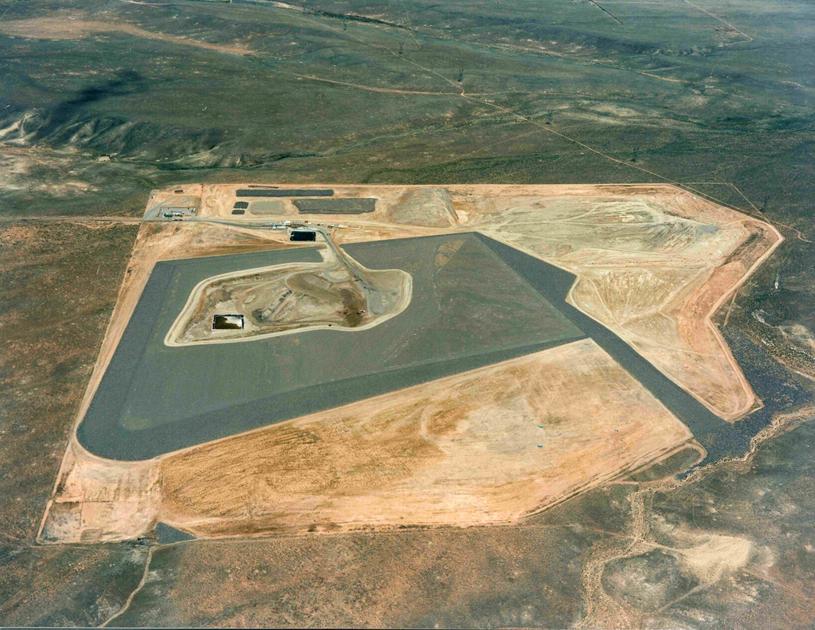

A local Department of Energy uranium mill tailings disposal site has gotten a new lease on life under language included in the massive COVID-19 relief and federal spending bill signed by President Donald Trump on Sunday.
The language — one of the last measures to be successfully carried by U.S. Rep. Scott Tipton, R-Cortez, before he leaves office — extends the life of the site through 2031 or until it is full.
The 94-acre disposal site for low-level radioactive waste is located 18 miles southeast of Grand Junction, east of U.S. Highway 50 and south of Kannah Creek, and is sometimes referred to as the Cheney site. It “is the only government-owned, noncommercial disposal facility in the country still open to accept uranium mill tailings,” the Department of Energy said in a news release in mid-December regarding the site’s then-uncertain status.
Before the new law extended its congressional authorization, the Department of Energy’s Office of Legacy Management was making plans to comply with the previous deadline that it shut down no later than 2023. To do that, it said it would need to stop accepting more material for disposal by Sept. 30 of next year.
That would have driven up the cost for disposal of mill tailings that continues to this day and involves entities such as the city of Grand Junction. Trent Prall, public works director for the city, said the disposal costs at the local DOE site are about $100 a cubic yard, whereas if it closed, tailings from western Colorado would have had to have been taken to a private disposal site outside Salt Lake City that charges about $2,000 a ton, and there would have been trucking expenses on top of that.
The city currently provides a temporary storage site for tailings collected around the region, with the tailings then being moved periodically to the DOE site for permanent disposal and the city being reimbursed by state Department of Local Affairs energy-impact dollars, Prall said. The DOE also shares in the per-ton cost of disposal at the site.
The DOE site is part of the region’s Cold War history, which included uranium mining and processing sites. In Grand Junction, the Climax Uranium Mill produced 2.2 million tons of radioactive mill tailings, according to DOE. For a while, tailings were used in local construction, such as for homes, sidewalks and roads, before health concerns arose over that practice.
In 1978 Congress passed a law authorizing remediation of tailings and other residual radioactive material at 22 inactive uranium mill sites and associated vicinity properties, leading to construction of 19 disposal cells. The Grand Junction disposal site was chosen for its remote location, lack of significant underlying groundwater, and the fact that it was underlain by a thick, impermeable layer of Mancos shale.
The uranium mill site was cleaned up and is now home of the Las Colonias Park. Also, according to DOE, it was able to clean up more than 4,000 properties in Mesa County, despite challenges such as trying to find contamination where tailings were used underground. The disposal site now contains about 4.5 million cubic yards of waste, and continues to receive about 2,700 cubic yards a year as tailings continue to be cleaned up. Prall said the local community continues to come across tailings during things such redevelopment projects and replacement of old utility lines, sidewalks and building foundations.
Also, in some cases previous landowners refused the DOE’s offer to clean up properties, leaving current landowners to deal with tailings now.
While DOE says its disposal site is 95% full, it is estimated that at current disposal rates the site has space to operate for 87 more years.
“There is still residual radioactive material in the Grand Valley community that is part of the nation’s nuclear legacy, but how much is left, we don’t really know,” Bill Frazier, site manager of the Grand Junction disposal site, said in the DOE’s recent release. “While DOE no longer has the authorization to clean the material up, the (Office of Legacy Management) team can protectively dispose of it at the Grand Junction disposal site at no direct cost to the community.”
Prall said the city of Grand Junction “is relieved that the Cheney repository has been given additional life.”
“The continued operation of the Cheney disposal cell allows the City and surrounding communities to have a safe, designated location in which mill tailings and other radioactive materials can be permanently stored in a predictable, cost-effective manner,” he said.
Tipton and U.S. Rep. Diana DeGette, D-Denver, carried a bill last year that cleared the House and provided for extending the disposal site’s life. It had been hung up in the Senate before being included in the bill Trump signed, among energy-related appropriations measures in the appropriations package, said Liz Payne, Tipton’s legislative director.
“I think the congressman is glad that we were able to push it forward,” Payne said.
Tipton is about to leave office following his defeat earlier this year in the Republican primary by Lauren Boebert.
She went on to win the general election. Payne said Tipton has had recent success on three bills now, bringing to 17 the number of measures he carried during his congressional career that will become law. Trump recently signed a Tipton measure authorizing a sculpture to memorialize the women’s suffrage movement in Washington, D.C. The Senate also has passed Tipton’s measure to expand the boundary of Yucca House National Monument near Cortez to allow for donation of private land and resolve access issues at the monument, and Payne said it is headed to Trump’s desk.
U.S. Sen. Michael Bennet, D-Colo., and Sen. Cory Gardner, R-Colo., also worked on extending the disposal site’s life. Bennet said in a statement Monday, “The reauthorization of this site is good news for western Colorado as we continue to dispose of radioactive material that was used for construction projects in the region shortly after the Cold War.”
Recent Comments