

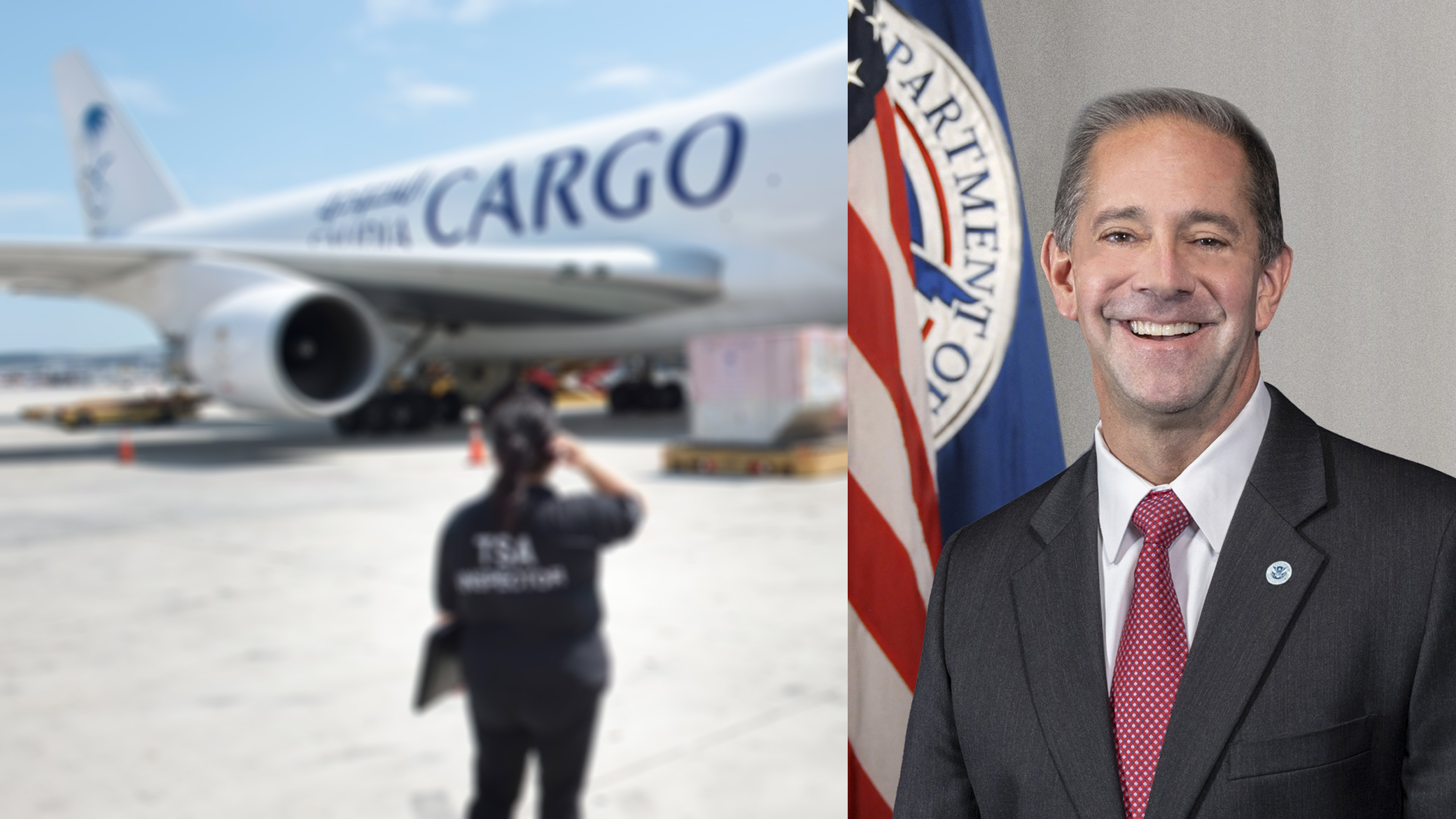

Most people know the Transportation Security Administration as the folks with blue shirts who check documents and carry-on bags at the airport before passengers board aircraft. The agency also has a less visible but no less important role, ensuring that cargo loaded on passenger and freighter aircraft doesn’t contain explosives.
A big issue on the TSA’s plate this year is the June 30 deadline for member states of the International Civil Aviation Organization to implement 100% screening of export air shipments on all-cargo aircraft.
Physical screening of cargo that rides on passenger planes has been the law for a decade, and the TSA utilizes a public-private approach to ensure security and minimize logistics disruptions. Airlines use X-ray and explosive trace detection machines to screen cargo. The Certified Cargo Screening Program (CCSP) allows logistics providers, ground handlers or independent security companies that follow TSA-approved criteria to inspect the cargo and tender it to the airlines following strict chain-of-custody requirements. There are about 500 to 700 companies in the program, according to TSA and industry officials, including manufacturers and other shippers that can do their own screening during the packing process. Another popular screening option is the use of third-party canine providers and their bomb-sniffing dogs.
The TSA’s other top air cargo priority is supporting development of next-generation X-ray systems for screening pallets. Differences in shipment type and size present technical challenges to scan products such as fresh flowers, frozen fish or machinery in a uniform manner.
The TSA plans to unveil an alternative to 100% screening in the all-cargo environment that could reduce the financial burden for some cargo owners. FreightWaves caught up with John Beckius, the Air Cargo division’s executive director, ahead of this month’s industry meeting to learn more about the plan and how shippers should prepare for the new security regulations.
Beckius started his government career in 1991 as an inspector with the Federal Aviation Administration. A decade later he joined the National Transportation Safety Board, leading investigations into hazardous material accidents across all modes. In 2002, Beckius returned to aviation security when he joined the newly established TSA as an air cargo branch manager. As an assistant federal security director of inspections in Indianapolis, he established the first passenger screening canine program at a domestic airport.
In 2015, Beckius became the TSA’s senior liaison to the Department of State and worked in State’s Counter-Terrorism Bureau for two years. Prior to his selection as the executive director of the Air Cargo Division, he spent 18 months as the branch manager for policy analysis in the Office of Policy, Plans, and Engagement.
Q: Can you give some details on the upcoming proposal to industry on how you’ll implement the ICAO standards or what other options are in the cards besides the 100% screening that’s alluded to in TSA regulatory documents?
A: ICAO allows us to create an alternative framework or another secure supply chain that meets the intent of the ICAO standards, and we plan to develop what we’re calling a secured packing facility, or SPF model. This would be, more or less, a voluntary security program for manufacturers, fulfillment centers and others [with] oversight by TSA, which will mean inspections. Cargo from those locations could be transported on an all-cargo aircraft outbound international without traditional screening.
And what we’re trying to do is reduce the screening burden on industry, and specifically, the full all-cargo carriers, by creating this additional option.
Does it help the all-cargo carriers or the manufacturers and shippers who are exporting?
I think it’s going to help both.
One, it’s going to reduce the burden on the all-cargo carriers. But also, I think it’s almost certain that the all-cargo carriers are going to charge for the screening. I’ve spoken with the industry and I know they’ve invested millions of dollars already getting ready for this with screening capabilities. In my opinion, they will pass that on to the shippers. So, really, it’s going to be a business decision for the shipper. [They may] look at this new program and say, ‘Hey, we’re almost at the TSA standards now, it makes sense for us to sign up for this and then avoid the screening charge by the all-cargo carriers.’
With an alternative, will there still be enough business to make it worthwhile for the all-cargo carriers to make those security investments?
I absolutely believe there will be plenty of freight that the all-cargo carriers are going to have to screen. We’ve been talking to industry about this for five years. They knew this was coming. They highly encouraged us to look at this other option that ICAO allows in order to take some of that screening volume off their plate. So, really they’ve been very supportive and encouraging of TSA creating this alternative framework option.
What about shippers just joining the CCSP program or having an expanded CCSP? Why would this help them more than them just in-sourcing that task?
That’s definitely an option. And I honestly think there’s going to be room for the Certified Cargo Screening Facility market to grow as well, because the cargo has to be screened by the all-cargo carrier if it hasn’t been screened earlier in the supply chain. Some of those CCSFs have already approached TSA with their intent to increase the number of those screening locations in anticipation of the June deadline. So we think there’s room for growth and expansion there as well.
How do you see the canine program expanding?
I see it expanding significantly. When we put that into place in December 2018, we already had this June 2021 deadline on our radar. And one of the reasons we created it was to give the all-cargo industry additional options for how to screen freight. It has been a huge success but is mostly used by the passenger carriers.
Speaking with several of the express carriers, other carriers, they’re already well down that route of having the dogs in their facilities practicing for June.
Right now there are nine approved third-party canine providers operating at about 25 domestic airports, but we see that expanding dramatically before June. And we encourage more third-party canine providers to apply for TSA approval. We would love that.
What do you say to the forwarders, who seem to say that physical screening creates a level playing field, is more secure than having a certified facility and that the CCSP program is the way to go?
As we create the SPF model, the one thing we won’t compromise on is security. We will be 100% confident the model we create ensures a secure supply chain. As we flesh out SPF, people should have confidence that it’s 100% secure.
Because in addition to C-TPAT (Customs trusted-trader) type vetting of their security plans, there will be specific add-ons for air cargo checks?
Absolutely. I will include physical security, personnel security. Plus we’ll have the TSA oversight by our inspector cadre.
On the technology side, have there been any new developments on some new types of large pallet-scanning machines? Is more R&D money needed to push that along?
That’s a challenge. We evaluate and qualify new equipment. And we welcome manufacturers bringing that to TSA, and I’ve heard repeatedly about the large-aperture pallet-size X-rays. There’s none in the evaluation pipeline that I’m aware of. But industry has been asking for it and we’re ready to evaluate that when it’s brought to us. I would love for industry to bring that to us for evaluation. There’s definitely an appetite for it.
We’re also doing a pilot evaluating computed tomography. In the cargo environment. That was actually part of the TSA Modernization Act of 2018, and I understand some of the express carriers are looking at that as part of the 2021 solution.
Click here for more FreightWaves/American Shipper stories by Eric Kulisch.
RELATED NEWS:
TSA to propose scan-all alternative for air cargo security
TSA seeks enhanced screening capabilities for air cargo
New air cargo security standards could gum up e-commerce exports
Recent Comments