


In summary
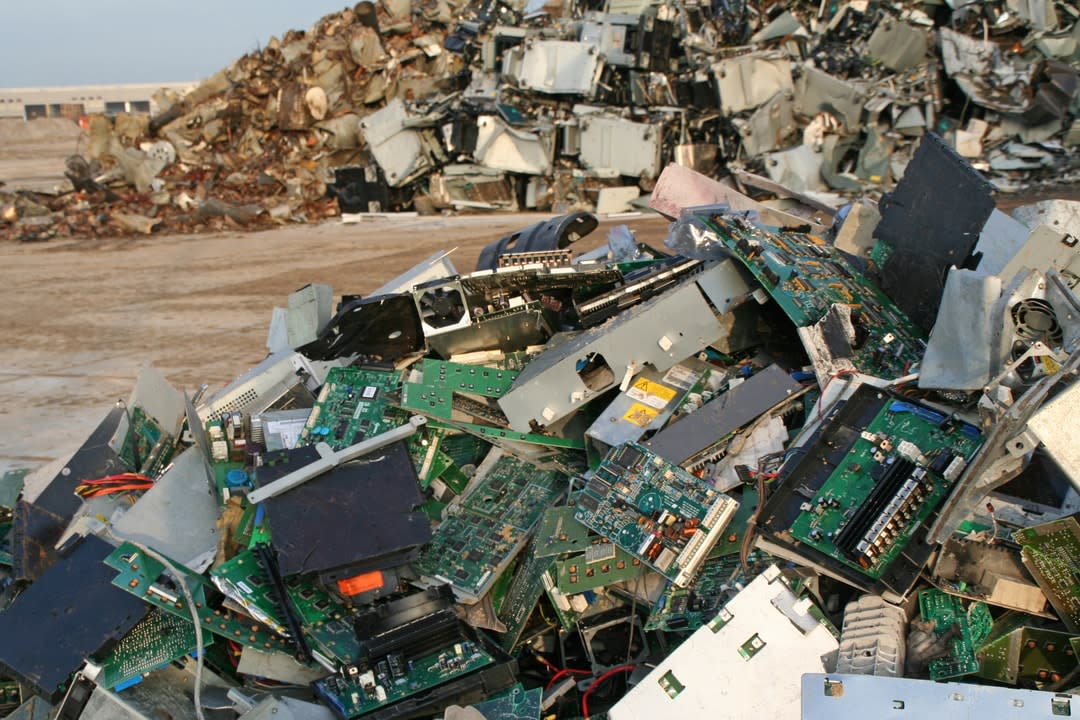
- In 2016, the world generated 44.7 million tonnes of e-waste – enough material to build 4500 replicas of the Eiffel Tower.
- Only 20 per cent is recycled through appropriate channels.
- Rare and valuable materials that can be recovered from e-waste such as gold, silver, copper, tin, platinum and palladium are estimated to be worth US$62.5 billion annually.
- Malaysian Chemical engineering expert, Dr Saman Ilankoon, is exploring new e-waste recycling processes that can reduce energy consumption by 35 per cent.
- Dr Ilankoon, in collaboration with Dr Chun Yong Chong, Monash University Malaysia, is researching the effectiveness of a Smart E-Waste Collection Box which uses a mobile application to optimise the collection of e-waste materials.
Mobile phones and laptops have become indispensable. As our means of obtaining and relaying information for personal use, work and entertainment, one would be hard-pressed to imagine a world without these portable electronic devices.
The confluence of global trends – rapidly advancing technology, rising adoption of information and communication technology (ICT), growing middle-class societies, and shorter replacement cycles for e-devices – results in more electronic and electrical products in the market.
Why e-waste is a problem
The problem is that every device running on an electrical plug or a battery eventually reaches the end-of-life stage and becomes e-waste – all types of electrical and electronic equipment and their parts that have been discarded without the intention of reuse.

In 2016, the world generated 44.7 million tonnes of e-waste, which is enough material to build 4500 replicas of the Eiffel Tower, according to World Economic Forum (WEF) estimates.
Unfortunately, only 20 per cent is recycled through appropriate channels, with little data on what happens to the rest, reported the Global E-Waste Monitor 2017, a joint effort of the International Telecommunication Union (ITU), the United Nations University and the International Solid Waste Association (ISWA).
The majority of e-waste is discarded into the rubbish bins, where it ends up in landfill or in the hands of illegal, informal recyclers.
When e-waste is improperly disposed of through illegal recycling or dumping, hazardous chemicals and metals contained in them, such as lead, mercury and cadmium, can be released into the soil, water or air, with the potential to harm our health and the environment.
Recovering lost treasure
What many fail to understand is that e-waste is extremely valuable, with WEF estimating it to be worth US$62.5 billion annually. This is due to the rare and valuable materials that can be recovered from e-waste such as gold, silver, copper, tin, platinum and palladium.
“In the next 50 to 60 years, we need to produce 60 per cent more natural materials to sustain our current lifestyle, which is equivalent to [the resources of] four planet Earths! This is the resource limitation we have,” says Dr Saman Ilankoon, a senior lecturer at Monash University Malaysia’s School of Engineering.

E-waste recycling can help meet that surging demand for natural materials, which is otherwise lost. The WEF points out that there’s more gold to be found in 100 tonnes of smartphones than in 100 tonnes of mined gold ore.
Meanwhile, figures by the US Environmental Protection Agency showed that recycling one million mobile phones could recover 34kg of gold, 350kg of silver, 16,000kg of copper and 15kg of palladium.
Without e-waste recycling, natural materials used in electronic and electrical components are lost when products are discarded. “We are not closing the loop. In a circular economy, we need to ensure the collection of e-waste and recovery of the materials,” Dr Ilankoon says.
Improving e-waste recycling efficiency
An expert in mining and minerals engineering, Dr Ilankoon is exploring the use of larger (coarse) particles in the extraction of copper from discarded printed circuit boards (PCBs).
Typically, during the hydrometallurgical process used in e-waste recycling, PCBs are crushed to ultra-fine, sub-micron particles before they’re dissolved in an appropriate solvent or liquid to produce a leaching chemical reaction. The metals are then extracted from the acidic solution.
Dr Ilankoon explains that using larger particles instead of sub-micron ones in the metal extraction process will reduce energy consumption by up to 35 per cent.
Financed by the Malaysian government under a Fundamental Research Grant Scheme (FRGS) grant worth RM77,000 for the next three years, Dr Ilankoon hopes to develop an optimal way of packing the particles for metals extraction, a technique that could potentially impact the industrial sector.
“Corporations need to be held accountable for what they produce, and people need to understand that e-waste disposal must be done in the right place. We need to be responsible for what we use.”
Under his other research project, the Smart E-Waste Collection Box, Dr Ilankoon uses a mobile application to optimise the collection of e-waste materials. The pilot project, a collaborative effort between Monash University Malaysia’s School of Engineering and Dr Chun Yong Chong from the School of IT, is based on an existing e-waste collection box system initiated by Sunway Education Group and a local recycling company, Meriahtek (M) Sdn Bhd, where discarded e-waste is collected via strategic bins placed at Sunway University and Monash University Malaysia.
With the Smart E-Waste Collection Box, Dr Ilankoon introduced a wider opening slot to accommodate the disposal of electronic devices, as well as the use of a mobile application and ultrasonic sensors to monitor e-waste collection and capture useful collection data.
“We wanted to gauge how much e-waste is collected in a month, what types of e-waste we were collecting and, based on collection patterns, determine how many collection boxes are needed and which locations were the most strategic. The e-waste recycling company can be notified digitally when the collection boxes are full so that they can empty the boxes at more regular intervals,” he says.
Using an app that’s activated by a QR code available on the Smart E-Waste Collection Box, students and lecturers would be able to find out what kind of items constitute e-waste, and locate the other collection boxes to facilitate easier drop-offs.
Stronger links needed for better e-waste management
“Household e-waste is currently not optimised. The link between the collection of e-waste and recovery of materials needs to be improved in Malaysia – the link between manufacturers, consumers, recyclers and the government. On the one hand, we need more e-waste materials; on the other, we need to extract maximum value from discarded materials. In order to achieve the United Nations’ Sustainable Development Goals, e-waste management is critical,” Dr Ilankoon says.
While a legislative framework needs to be put in place in Malaysia to govern household waste management, he says the government should also look into employing the services of informal recyclers to improve e-waste collection.
“Perhaps the government can provide incentives for businesses to extract more metals instead of focusing on a few lucrative ones, which is a problem even in developed markets. As researchers, we need to come up with techniques that are economical and are able to extract more metals, so that full-recyclers can use these techniques in their operations,” he says.
While Dr Ilankoon is keen to collaborate with the private sector for future projects, many recyclers are hesitant to disclose their technical know-how, as each company uses different metal recovery processes. This presents a stumbling block in the way forward for e-waste recycling in Malaysia, he says.
“Social responsibility should be the key driving force in driving sustainability. We should conserve our natural environment, water and soil for the betterment of the next generation. Corporations need to be held accountable for what they produce, and people need to understand that e-waste disposal must be done in the right place. We need to be responsible for what we use,” he says.
Recent Comments