

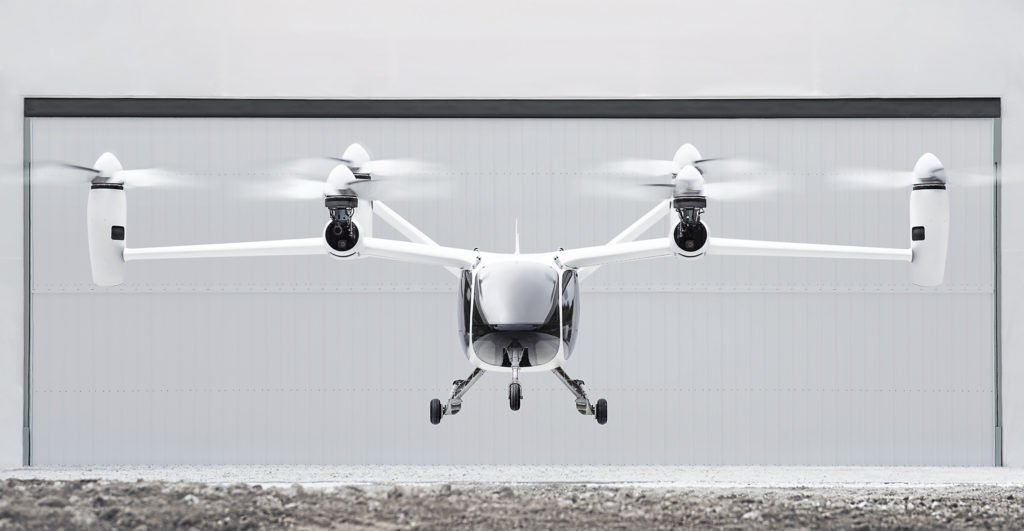

The U.S. Air Force’s new Agility Prime project aims to encourage the development of the U.S. eVTOL market, assisting companies with testing, certification, and other key focus areas and accelerating the fielding of promising technologies for the government.
The Agility Prime initiative is being driven by an integrated product team spearheaded by the Program Executive Office for Air Force Mobility, which is based at Wright-Patterson Air Force Base in Dayton, Ohio. An Innovative Capabilities Opening (ICO) was published on Feb. 25, outlining the core goal of establishing “a collaborative strategy with industry and investors that accelerates fielding of the most promising technologies for savings and utility to the government, as well as potential commercial market success.”

The ICO noted that as the systems mature towards certified commercial operations, “the government will identify opportunities for early adoption, with the potential for procurement and fielding in the next three years.”
The Air Force outlines interest in a broad swathe of technologies, with core focuses including emerging eVTOL and urban/advanced air mobility (UAM/AAM) aircraft, though it notes that alternatives will be considered. The ICO states that the aircraft may incorporate non-traditional electric or hybrid propulsion for manned or optionally manned missions, with onboard pilot, remote pilot, or autonomous control.
The opening outlines an array of goals, though fundamentally it aims to test the hypothesis that eVTOLs could revolutionize mobility based on five key factors: lower maintenance cost and time due to mechanical simplicity; improved safety and declining personnel demands through the use of autonomy; affordable quantity due to potential mass production; improved acoustics, employing distributed propulsion; and greater flexibility and reduced infrastructure needs, with runway independence.
“To mitigate risk, this hypothesis will initially be tested outside of the urban environment in scenarios that could potentially open a broad public-use market for early government adoption prior to civil certification in a way that accelerates UAM,” it states.
The ICO refers to the vehicles as “ORBs,” which can be interpreted in various ways. They “are not drones, cars, helicopters, trucks, airplanes, motorcycles, or SUVs, but might support similar missions,” the ICO states. “Given their flexibility, an ORB could act as an organic resupply bus for disaster relief teams, an operational readiness bus for improved aircraft availability, and an open requirements bus for a growing diversity of missions. ORBs could enable distributed logistics, sustainment, and maneuver, with particular utility in medical evacuation, firefighting, civil and military disaster relief, installation and border security, search-and-rescue, and humanitarian operations.”
In a media briefing following the publication of the ICO, Agility Prime team lead Col Nathan Diller, assistant director of aeronautics at the White House Office of Science and Technology Policy, outlined two core goals of the project. First, he noted the development of new flying platforms, with the Air Force keen “to make sure that we are potentially a part of that, if that provides additional capability for our operators and the potential of savings for the taxpayer.”
Second, this would be done in a way that boosts the industrial base, creating new options for companies so that “we can accelerate the potential value that comes from that market and do it in a way that creates value to the DoD [Department of Defense] as well as the industrial base,” he said.
At a media roundtable ahead of the publication of the ICO, Dr. Will Roper, assistant secretary of the Air Force for acquisition, technology and logistics, said the aim is to catalyze the commercial market by bringing the military market to bear. It is important that this commercial market first catalyzes in the U.S., he said, pointing to the example of the small drone market as a warning.
“It was a commercial technology, the Pentagon didn’t take a proactive stance on it, and now most of that supply chain has moved to China,” he said. “If we had realized that commercial trend and had shown that the Pentagon is willing to pay a higher price point for a trusted supply chain drone, we probably could have kept part of the market here and not have to go through the security issues we do now when someone wants to use a foreign-made drone at some kind of Air Force or service event.”
The ICO will be continuously open until the end of February 2025, and will be broken into a series of future Areas of Interest (AOIs) that will request briefs and proposals for new solutions or capabilities. The first of these — AOI 1 — was published alongside the ICO, focusing on platforms with a payload of three to eight personnel, a range of more than 100 miles (160 kilometers), a speed of more than 100 miles per hour, endurance of over 60 minutes, and a first full-scale flight set to take place before Dec. 17, 2020.
Diller referred to this AOI as an “air race to certification.” AOI 1 will take place across a number of stages, Diller said. First, it will request details about planned commercial technologies and the market that different companies are looking to access, before identifying which technologies are likely to result in successful prototypes. He stressed that the aim is not to write explicit requirements and pay for R&D to achieve these requirements; rather, it will take feedback from industry, identify technologies, and create opportunities for collaborative test planning, potentially using DoD or other government test assets and expertise.
The aim is to eventually develop a test report that will help “test the hypothesis that has been posed by the urban air mobility or advanced aerial mobility markets — that this is a revolutionary approach to mobility.” There would then be an opportunity to leverage the test campaign for near-term airworthiness authorizations that would allow for very near-term government use cases “in a way that ideally . . . is accelerating civil certification, potentially providing revenue and data that accelerates the broader adoption of this technology and potential further development of the technology.”
Recent Comments