

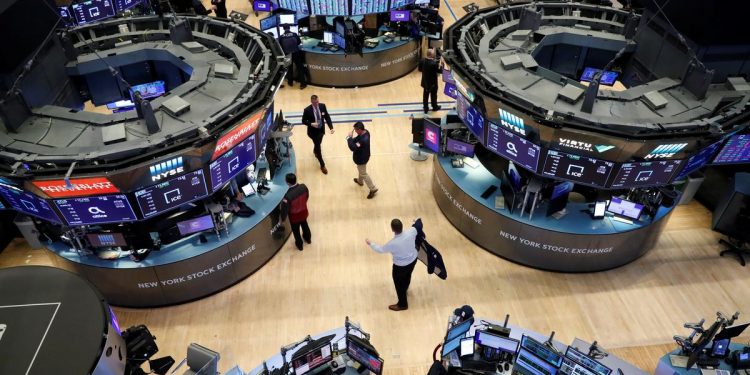
NEW YORK (Reuters) – U.S stocks seesawed on Wednesday, digesting the previous session’s huge rebound, with investors torn as optimism about an imminent $2 trillion coronavirus package was offset by concerned about the lasting economic impact from the pandemic. [.N]
The S&P 500 .SPX was up 1.17% and yields on U.S. treasury securities US10YT=RR US2YT=RR were mainly off as markets waited for senators to vote on a $2 trillion bipartisan package of legislation to alleviate the devastating economic impact of the coronavirus pandemic, hoping it will become law quickly.
The Senate was due to convene at 12 p.m. EDT (1600 GMT), though timing of the vote was unclear. The House of Representatives is expected to follow soon after. President Donald Trump supports the measure, the White House said, and has talked about reopening U.S. businesses by Easter on April 12.
COMMENTS
RON TEMPLE, HEAD OF U.S. EQUITY, LAZARD ASSET MANAGEMENT, NEW YORK
“On the fiscal stimulus, this is very important progress but the devil’s also in the details. We still don’t have the legislation to read for particulars in how it will be executed and there are some concerns about how long it will take for money to arrive at the households, how long will it take for small businesses to access funding.
“This is not the all-clear, it’s just material progress. Until we know we can go back to work safely and that we can go to restaurants and go to stores and actually engage with other humans in close proximity, I don’t think you can make an economic call or a market call. It’s premature to be trying to call the bottom, and trying to use past crises and looking at valuation levels, while it can be instructive, there aren’t any parallels historically to use given that we don’t know how long or extensive these lockdowns might be. We also don’t know how widespread, how severe the impact will be on the economy.
“We’re trying to figure out what unemployment claims might be this week and we’re coming up with a number that could be over 3 million and perhaps as high as 3.4 million. Last week it was 281,000. When you think about those kind of numbers and that kind of magnitude of an increase in unemployment and shock to the system, it’s way too early to be trying to call a bottom or prognosticate how much further (the market) could go down.”
RANDY WATTS, CHIEF INVESTMENT STRATEGIST, WILLIAM O’NEIL+CO, NEW YORK
“The market would like to see that bill get passed and put that behind them. I think the market may be a little disappointed that this is still not done yet. And until it’s signed by the House and agreed to by all three parties, there’s still some uncertainty. Clearly investors would like to see the bill committed, done and put into action.”
“In the short run, the market still going to stay very volatile until one of three things happens – either the number of deaths and the number of new infections in the U.S, peak, until there is some kind of a cure or vaccine developed or until the U.S. economy begins to reopen.”
“Investors are also having a very hard time figuring out what underlying earnings are for the for the U.S. economy right now. It’s been very very hard for investors right now to forecast corporate profits. When that occurs on the market, it’s going to have a higher degree of volatility.”
“There’s been significant technical damage done to the market. I don’t think the market is going to totally repair itself, quickly. It was a straight move down, but we don’t expect it to be a straight move up. It’s going to take time.”
ANDREA CICIONE, HEAD OF STRATEGY, TS LOMBARD, LONDON
“Obviously, the U.S. deciding to go twice the size with the fiscal stimulus declaration anticipated, is definitely good news.
“What’s remarkable in this particular crisis, compared to 2008 or to previous crisis, is the response by policy because the speed with which they’ve revamped existing programs and introduced new ones is completely unprecedented. Clearly, authorities have learned from the 2008 global financial crisis.”
“I think there’s no reason to be too optimistic at this stage. The market of course, has come through the initial shock phase, but still we have to go through the consequences space before we even start thinking about recovery.
“We still haven’t seen evidence that things are improving enough in terms of contagion. And that’s to be optimistic at this stage.
“We also haven’t fully appreciated how far this recession will go, not just because of the shocks of global demand but also because of second round effects such as rising unemployment, slashing of capex, and potentially even tightening financial conditions because of companies defaults or being downgraded.”
KEVIN LOANE, SENIOR ECONOMIST, FATHOM CONSULTING (IN A NOTE TO INVESTORS)
“Assets appear cheap. On the surface, this may encourage a ‘buy-the-dip’ mentality. However, they remain more expensive than in the trough of previous historical downturns including the Global Financial Crisis, the aftermath of the dot-com bubble and the early 90s US recession. While valuations are not always a great timing indicator, the outlook for asset prices, while more balanced, remains skewed to the downside.”
“Investors may be complacent about the severity of the initial shock that awaits us. Admittedly, markets broadly shrugged off historic declines in survey measures of activity in Europe and the US, released yesterday. However, there remains a risk that investors underestimate the first-round impact on employment. “

SEBASTIEN GALY, SENIOR MACRO STRATEGIST, NORDEA ASSET MANAGEMENT, LUXEMBOURG
“There seems to be a view that this is as bad as it’s going to get. That doesn’t mean we’re not still in a high volatility environment—the crisis will be long, the data is going to be very poor, it’s still going to be a difficult market.”
“We’ve essentially recommended for our client base to make incremental changes, to start moving … some of their allocation back into equities and moving some into alternative assets.”
Compiled by Alden Bentley
Recent Comments