

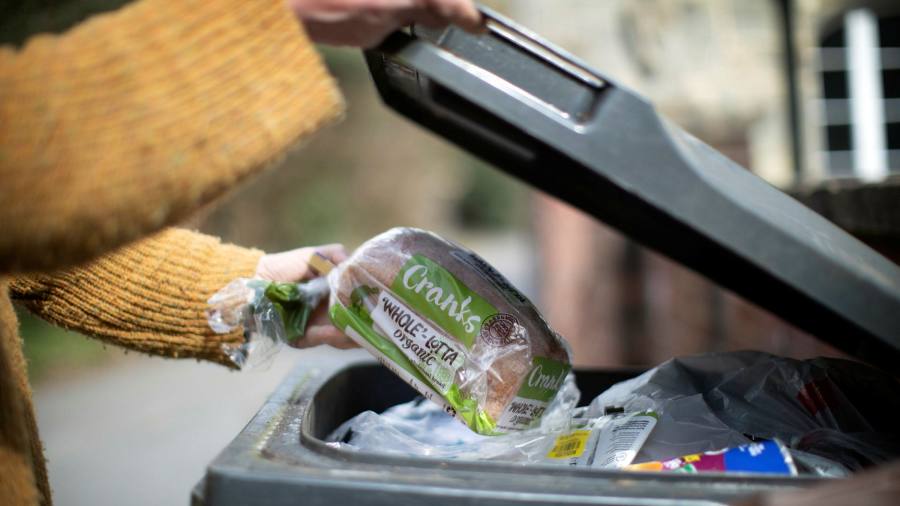

The UK faces a surge in food waste after supermarket sales jumped by a fifth and restaurants were ordered to close as part of the government’s measures to fight the coronavirus pandemic.
Figures released by Nielsen, the market data provider, on Tuesday showed that shoppers bought an extra £1.9bn of groceries and personal goods in the four weeks ending March 21, leaving many stores and warehouses without stock.
The subsequent shutdown of the hospitality sector then delivered a second dose of heavy disruption to a supply chain that relies on stability and predictability to keep stock moving and minimise waste.
“When you rock the supply chain like this it becomes really inefficient,” said Mette Lykke, founder of food waste reduction app Too Good To Go.
Hayley Conick, UK manager for the start-up, added that the stockpiling of groceries was “concerning”. “The risk for increased food waste is huge during these extraordinary times,” she said.
For Tony Reynolds, that risk has already become reality. Over the past few days the managing director of the food supply business that bears his family name, has had to discard about a quarter of his stock of tomatoes, bananas, avocados and mushrooms.
His customers — hotels, pubs and restaurants — have been told to shut up shop due to the coronavirus pandemic. Some of them, such as Italian-themed chain Carluccio’s, have already gone into administration.
Chefs demand produce in peak condition, so stock is usually out of the door again within 48 hours of arrival — there are no “ripen at home” fruits or vegetables.
“There’s an old saying in this business: either it sells or it smells,” said Mr Reynolds. “We have tried to find a home for it . . . we’ve moved it into wholesale and retail, then given it to charities,” he added, pointing out that what is left is no longer fit for consumption.
Restaurants have also tried to hand on surplus food. Chains such as Zizzi, D&D, McDonald’s and PizzaExpress have donated excess stock to charities.
Lindsay Boswell, chief executive of food charity FareShare, said the pandemic had “given with one hand and taken away with the other”. The organisation normally distributes about 1m meals a week from surplus food donated by supermarkets and the food industry.
“The rise in panic buying [in supermarkets] meant that demand exceeded supply and there was no surplus . . . [so] we were receiving less than a third of what we normally would.”
The hoarding was followed by a fall in demand as cupboards and freezers filled. That drop in retail sales coincided with the shutdown of the catering industry, which led to a pile up of unsold produce.
Shane Brennan, chief executive of the Cold Chain Federation, pointed out that it was not easy for catering supplies to be redirected into retail outlets. “The pack sizes are different, the labelling is different,” he said.
He warned that his members’ warehouses were filling up again. “In four to six weeks we will see pretty high levels of occupancy,” he warned. “That could create problems for [meat and poultry] processors if they cannot store product.”
Vita Mojo, a developer of software for restaurant businesses, has developed new products to help suppliers redirect unwanted produce by selling online.
“It’s crazy to see really lovely fruit and vegetables going to waste while people are clambering over themselves in supermarket aisles [to buy some],” said founder Nick Popovici.
High levels of wastage are unusual in the food industry. According to Mr Reynolds in normal times, just 0.5 per cent of his stock is discarded. The proportion is similar at leading supermarkets, which have made major strides in reducing waste in recent years.
Coronavirus business update

How is coronavirus taking its toll on markets, business, and our everyday lives and workplaces? Stay briefed with our coronavirus newsletter.
British consumers are less efficient, however. They are responsible for more than 50 per cent of food waste, throwing away about 4.5m tonnes each year at a cost of £700 per household, according to Waste and Resources Action Plan, a charity.
Pictures have already emerged on social media showing domestic dustbins overflowing with unopened loaves of bread and chilled food.
Mr Boswell, of FairShare, hopes the pandemic will force a rethink of how food is sold in the UK. “Looking at the resilience of the supply chain has got to be something that is a national priority,” he said.
“If the government, in the cold light of day, does not reflect on that then they are perhaps not doing what we have put them in power to do.”
Recent Comments